
Panayiota Antypas
Launceston, Tasmania, Australia
Neurologists occupy a liminal zone, oscillating between a fascination with the complexity of the nervous system and an understanding of the devastating impact these diseases have on patients’ lives. During my medical student elective, I became immersed in this duality. Neurology is characterized by paradoxes—hope and suffering, certainty and uncertainty, vulnerability and strength. And perhaps it is this very tension—the ability to accept and reconcile opposing truths—along with my own experience as a neurology patient, that draws me to the field.
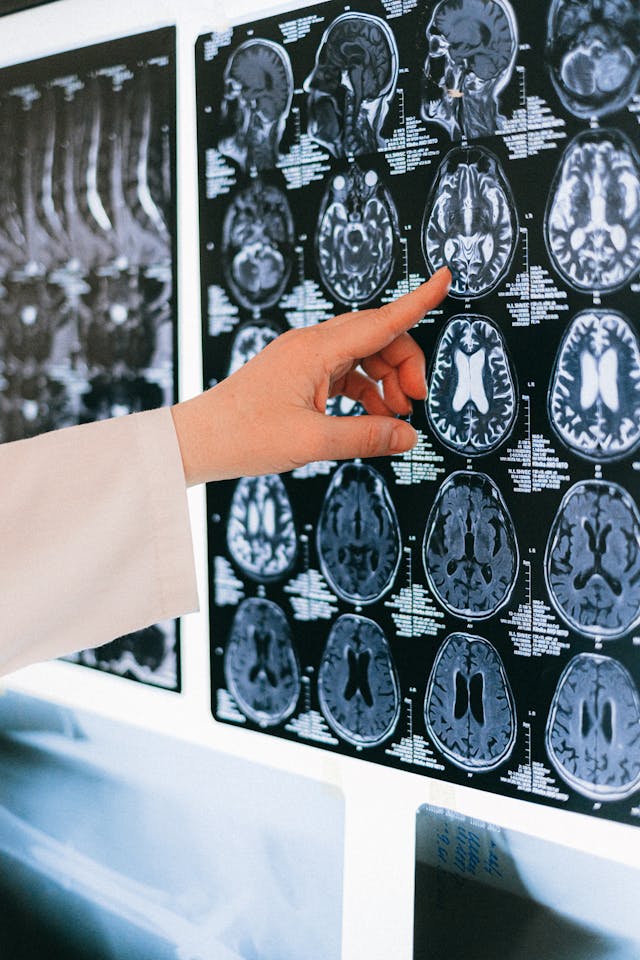
One of the first patients I met was a woman in her early sixties. She had initially been diagnosed with functional neurological disorder in the context of involuntary movements, speech impairment, and personality changes. However, her recently worsening ataxia had prompted further investigation. An MRI and a lumbar puncture revealed findings consistent with Creutzfeldt-Jakob disease (CJD). The team explained that CJD is a rare neurodegenerative disease caused by the accumulation of abnormal brain proteins called prions. She would continue to deteriorate and likely die within weeks to months.
Her family was in shock. What they had first understood to be a neuropsychiatric illness with a relatively good prognosis had abruptly become a life sentence.
As we continued the afternoon ward round, I kept thinking about this woman and her condition. We could offer her a diagnosis and a prognosis, but we could not cure her. I wondered: What does it mean to be a doctor when a patient’s disease is incurable? I began to question whether healing could exist outside the traditional boundaries of care. For this patient and her family, the most powerful acts of medicine were not in medical interventions, but rather, in acts of compassion.
As we listened to the patient’s daughter share memories of her vibrant mother and explained how we would ensure her comfort as she deteriorated, I realized that our role is not always to cure or prolong life, but to bear witness to suffering. This can be confronting, especially for the archetypal medical student—goal-driven, perfectionistic, conditioned to identify and fix. Yet sometimes, simply being there to guide a patient and family through suffering is the most important thing we can do.
While working with the stroke team, I met a seventy-five-year-old woman with lateral medullary (Wallenberg) syndrome. The consultant, unaware of my long-standing fascination with the condition, declared it a “rare find” and urged me to examine her alone. Excited, I quickly gathered my equipment and made my way to her bedside.
The first thing I noticed was a collection of tissues on her lap. Every few minutes, she would cough up a secretion, wipe her mouth, and add it to the growing pile. She could not swallow and she swayed to the left when attempting to walk. She had numbness and pain-temperature deficits on the left side of her face and her right limbs. An MRI matched the clinical picture, demonstrating a small lesion in the left lateral medulla—small enough to be missed on CT but large enough to dismantle her ability to function.
As a neurology enthusiast, I was fascinated; witnessing a textbook-perfect case of Wallenberg syndrome was one of the most exhilarating moments of my medical training. Yet soon, I started to feel guilty—while I marveled at her condition, she endured its torturous reality. My intellectual fascination was a byproduct of another person’s suffering. Nevertheless, it is this very curiosity that drives both our passion for learning and our devotion to helping others. So, how do we reconcile this? By never losing sight of who we are truly working for. Intellectual curiosity must exist alongside a deep honoring of the human being in front of us.
In the final week of my elective, I met a forty-four-year-old schoolteacher with a ten-month history of worsening paresthesia and pain in her right thumb, index, and middle fingers, along with blurred vision, periodic limb weakness, and an action tremor. Blood tests, imaging, and electrophysiological studies did not support an anatomical or physiological diagnosis.
The neurologist sat down opposite the patient and simply listened as she described her symptoms, her frustration, and her fear that no one believed her. When the patient stopped speaking, the neurologist said something simple yet powerful: “Your pain is completely real.” They explained that the body is complex, and sometimes we cannot pinpoint the etiology of every ache or pain. While there was unlikely to be a singular pathology, many factors—physical, environmental, and psychological—can contribute to such symptoms.
After the patient had left the room, the neurologist explained that people with organic neurological disorders often develop functional symptoms over time. And conversely, people who are first diagnosed with functional neurological disorder (FND) are later found to have underlying organic neurological disorders.
This surprised me. I had always thought of neurological disorders as organic or functional, physical or psychological, “real or imagined.” But this blurred that distinction. It challenged the paradigm of Cartesian dualism, the notion that the brain and body are completely independent entities, which risks invalidating symptoms that do not fit neatly into physical or psychological categories. This dualism fuels judgment and stigma, resulting in inadequate care—even if subconsciously. Much of the suffering in FND arises not just from the condition itself, but from how the medical system perceives it.
Neurology demands precision and yet dismantles certainty. It confronts us with diseases we cannot always cure and suffering we cannot fully understand. Yet even when cure is impossible, we can still offer our presence, look patients in the eyes, and say, “I see you.” That may be what matters most.
PANAYIOTA ANTYPAS is a junior doctor based in Tasmania, Australia, with an interest in neurology, psychiatry, and medical ethics.