
Simon Wein
Petach Tikvah, Israel
The recent death of Paul R. Ehrlich (1932–2026) reminds us of the risks of hubris when prognosticating, ignoring human inventiveness, and promoting authoritarian control of society.
Paul Ehrlich won the Swedish Crafoord Prize in 1990 (which is awarded in fields not covered by the Nobel Prize) for his post-graduate ethological research. However, it was his book, The Population Bomb, which he and his wife Anne published in 1968, that made him famous and influential in an era of civil turmoil.
The book’s prologue opens with a prediction: “The battle to feed all of humanity is over. In the 1970s hundreds of millions of people will starve to death in spite of any crash programs embarked upon now.” This “headline” set hearts aflutter and caused people to consider not having another child and countries to think about limiting family size.
It was in 1798 that Thomas Malthus wrote an “Essay on Population” wherein he posited that population expands exponentially while food supply grows linearly. He predicted that the balance between the number of people and available food could only be maintained by famine, pestilence, and war. Ehrlich reprised this hypothesis.
Notwithstanding their predictions, disaster did not eventuate since both of them underestimated human inventiveness. Improvements in agriculture outpaced demographic pressures at every turn.
Ehrlich’s dramatic dystopic warning aimed to grab the public’s attention. It succeeded. The Population Bomb, a best-seller, entered the lore of the environmental movement. It also anticipated a current-day public relations technique, namely catastrophizing.
Ehrlich: “My basic claims were that population growth was a major problem. Fifty-eight academies of science said that same thing in 1994, as did the world scientists’ warning to humanity in the same year. My view has become depressingly mainline!”1 Notwithstanding that many scientists agreed with Ehrlich at the time, history has proven their conclusions to be unfounded.
Ehrlich did not think that a higher standard of living would reduce the birth rate sufficiently. “You needed harsh government programs to drive down the birthrate. The alternative was overwhelming famines and massive damage to the environment.” Ehrlich argued (terrifyingly) there was a need for compulsory population control. “The operation will demand many apparently brutal and heartless decisions. The pain may be intense.”1
The Chinese Communist Party implemented a one-child policy from 1979 to 2015. It significantly reduced births (by up to 400 million) but created demographic, social, and economic problems that are felt today. Ehrlich, it appears, would have supported the coercive enforcement of China’s one-child policy,
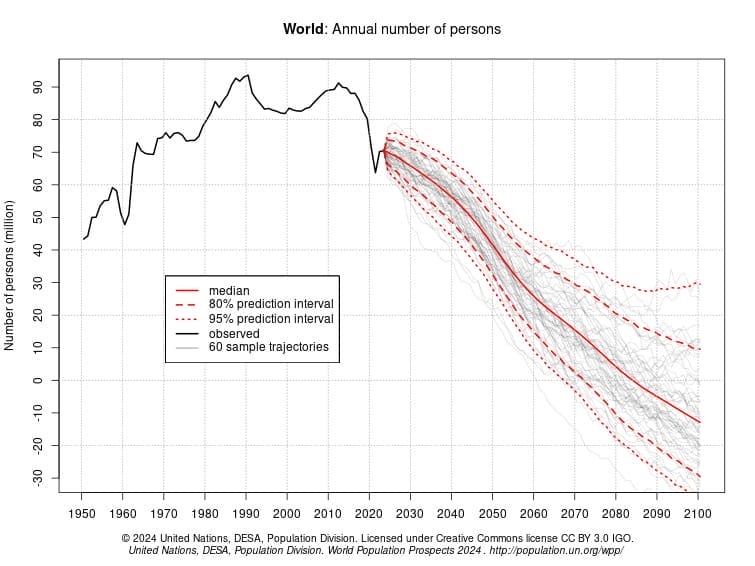
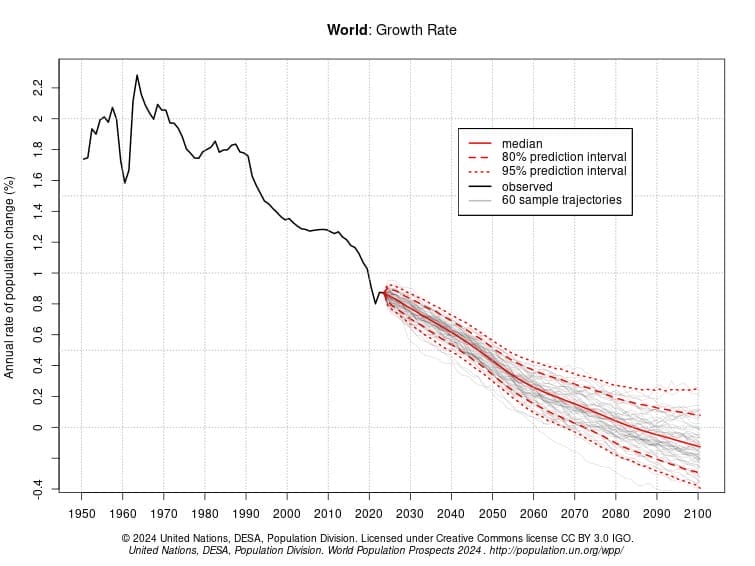
Contrary to Ehrlich’s dogma and visions, population growth rates fell after the 1960s and world population reached 6.2 billion in that year, not 7.1 billion as predicted.
As of March 2026, the world population is 8.3 billion. United Nations anticipates a peak of 10.3 billion by the mid-2080s followed by decline, driven by falling fertility. Whatever the mechanism, it negates Ehrlich’s dystopian prediction. Many governments today are offering incentives to encourage procreation because of imminent de-population!
Ehrlich ran a successful scaremonger campaign. Gloom and doom sell. But the “bomb” did not explode. Humans are the ultimate resource, and can create, invent, and hope. Optimism always trumps pessimism.
Reference
- Carrington, D. “Paul Ehrlich: ‘Collapse of civilisation is a near certainty within decades.’” The Guardian interview, March 22, 2018.
DR. SIMON WEIN trained in medical oncology and palliative care in Melbourne Australia. He is now retired after heading the palliative care unit at the Davidoff Cancer Center in Petach Tikvah, Israel.