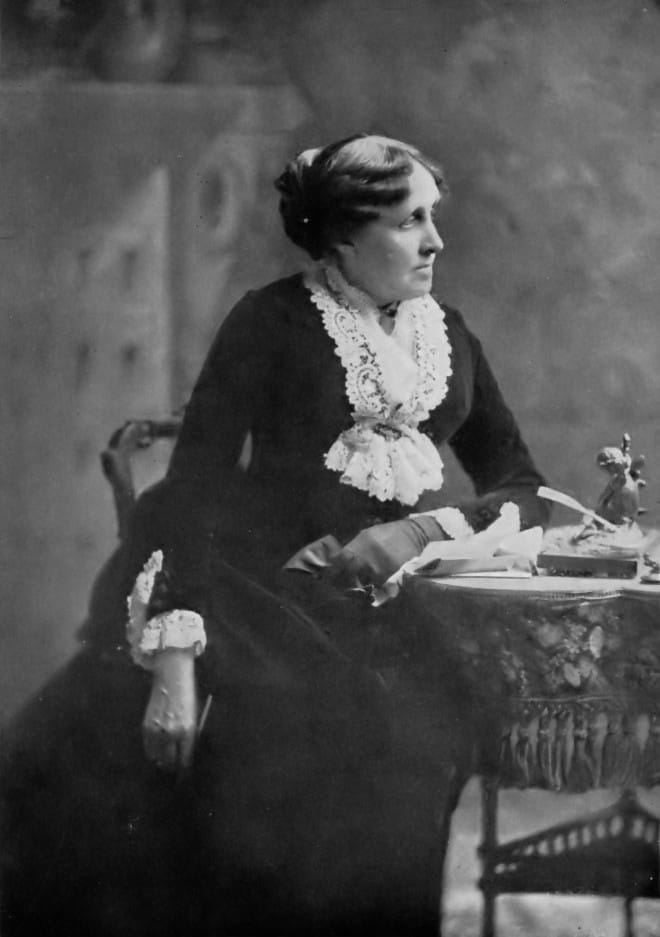
Louisa May Alcott (1832–1888) was a novelist, short story writer, and poet. Raised in New England, she was an abolitionist and feminist, remained unmarried, and became active in reform movements such as temperance and women’s suffrage. As her family always lived on the poverty line, she took on various jobs at an early age and later sought to earn money by writing short stories and novels for adults. In the 1860s, she achieved some success with her book Hospital Sketches, based on her experiences in the Civil War. But real success came in 1868 when she published the novel Little Women, which follows the lives of the four March sisters as they grow from childhood to womanhood during the American Civil War. The book was an immediate success, leading to several sequels and inspiring numerous film adaptations. It has been considered a new form of literature that combined children’s fiction with sentimental novels, resulting in a highly popular genre, especially with American girls.
In December 1862, she volunteered as a nurse for Union army soldiers and contracted typhoid fever. She was treated with calomel (mercurous chloride), then a standard remedy given in large doses as a purgative intended to flush the body of illness. Instead, she had high fever, delirium, and hallucinations, was ill for months, and never fully recovered. Her hair fell out, and her teeth were affected. For the rest of her life, she suffered persistent headaches, joint pains, and neurological disturbances.
In 1975, physician Norbert Hirschhorn published a retrospective analysis arguing that Alcott’s chronic symptoms—fatigue, muscle weakness, headaches, skin rashes, neurological disturbances, digestive problems, and mood disruptions—were consistent with chronic mercury toxicity from the calomel she had received in 1863.
In her journals, she described many of her symptoms. She wrote about being unable to hold a pen for long periods, of her arms aching so badly she had to dictate, and of exhaustion that made her writing difficult. Medical historians have generally accepted this century-old retrospective diagnosis. More recently, an additional systemic or alternative diagnosis of systemic lupus erythematosus (SLE) has been proposed, characterized by joint pain, skin rashes, fatigue, and multisystem involvement.
Whether mercury exposure compounded or precipitated an underlying lupus autoimmune condition, or whether the two diagnoses coexisted independently, is a subject of debate. What the lupus hypothesis adds is an explanation for why Alcott’s illness was a waxing and waning pattern she described in her private writings. She tried various water cures and other treatments during her illness, but with no lasting improvement.
Alcott’s illness affected her career profoundly. The success of Little Women (1868) caused a public demand that she could barely meet, given her physical condition. She wrote under pressure, frequently dictating when her hands and arms failed her. In her journals, she describes constant headaches, episodes of vertigo, and days when she could not work at all. She described writing as the activity that gave her life meaning during her physical decline. She died in 1888 at the age of fifty-five, most likely died from a cerebrovascular event (stroke), possibly related to the long-term effects of mercury toxicity or cerebral lupus. She wrote dozens of works while in chronic pain. The retroactive diagnoses of mercury poisoning and lupus place her suffering in a scientifically intelligible framework to which her own physicians never had access.