
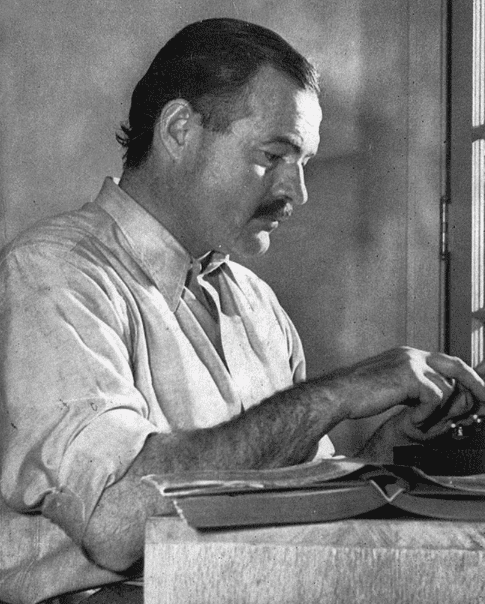
From a medical point of view, the life of Ernest Hemingway (1899–1961) was shaped by repeated physical trauma, chronic disease, hereditary factors, and profound psychological influences. In the world of literature, he is remembered for his minimalist prose—spare, direct, “bare-bones”, and stripped of ornamentation. But behind the muscular sentences and the mythology of masculine bravado lay a man repeatedly battered by trauma, eroded by hereditary illness, and ultimately shaped as much by neurologic and psychiatric factors as by genius. His biography becomes a study of traumatic brain injury, hemochromatosis, bipolar disorder, alcoholism, and macho behavior.
In World War I, serving as an American Red Cross ambulance driver on the Italian front, Hemingway was struck by an Austrian mortar shell near Fossalta di Piave in 1918. The blast drove over two hundred metal fragments into his legs while he was simultaneously hit by machine-gun fire. He survived, but the experience of violent wounding and its aftermath became central both to his psychology and to his fiction, most directly in A Farewell to Arms.
In January 1954, on consecutive days, he survived two separate plane crashes in Africa. In the first crash, the aircraft struck an abandoned utility pole; Hemingway used his head to butt open a jammed door, fracturing his skull. In the second crash, the plane caught fire on takeoff, and Hemingway suffered further head trauma, a cracked vertebra, ruptured kidney, spleen, and liver, and burns across his face and arms. The cumulative head injuries led to a pattern of his later cognitive and behavioral decline consistent with chronic traumatic encephalopathy (CTE)—the progressive brain disease caused by repeated brain trauma.
An underappreciated aspect of Hemingway’s medical history is his family history of hemochromatosis, the disorder of excessive iron absorption that accumulates in the liver, pancreas, heart, joints, and brain, causing liver cirrhosis, diabetes, cardiomyopathy, arthritis, and neuropsychiatric disturbances. Several earlier members of his family also suffered from depression and died by suicide, a pattern that strongly suggests a genetic vulnerability.
Hemingway’s health was further complicated by lifestyle habits. Overuse of alcohol was lifelong, celebrated in his own writing, and ultimately destructive. He reportedly consumed extraordinary quantities of wine, whiskey, and daiquiri daily in the bars of Paris, Havana, and Key West. He also suffered from bipolar disorder, with manic episodes alternating with severe depression. The famous prose of The Sun Also Rises, A Farewell to Arms, and For Whom the Bell Tolls was written during periods of manic states, alternating with depressive episodes lasting some years.
Psychiatrically, Hemingway’s later years were marked by severe depression, paranoia, and cognitive impairment. In 1960 and 1961, he underwent treatment at the Mayo Clinic, where he received electroconvulsive therapy (ECT), a controversial but still-used intervention for major depression at a time when this treatment still caused collateral damage in the form of memory loss. Ultimately, Hemingway died by suicide in 1961 in his home in Ketchum, Idaho, an act that underscores the severity of his psychological distress. By the time of his death, he was suffering from the accumulated effects of probable hemochromatosis, chronic CTI, bipolar disorder, alcoholic liver disease, diabetes, and hypertension. His cognitive function had declined severely. His capacity to write, the one activity that had organized his existence and given it meaning, was gone. He was in physical pain, sedated, and neurologically impaired. It was the end of a lifelong struggle against forces he could no longer overcome.