
Philip Liebson
Chicago, Illinois, United States
Clive Staples Lewis (1898–1963) was a famous author and professor of English literature at both Oxford and Cambridge. Much of his scholarly work focused on the Middle Ages. His work The Discarded Image (1964) concerned the medieval concept of the universe. He drew his material from the writings of the ancient Greeks and Romans as well as from early Christian writers. He described how Western Christian theologians conceptualized the universe around the eleventh and twelfth centuries.
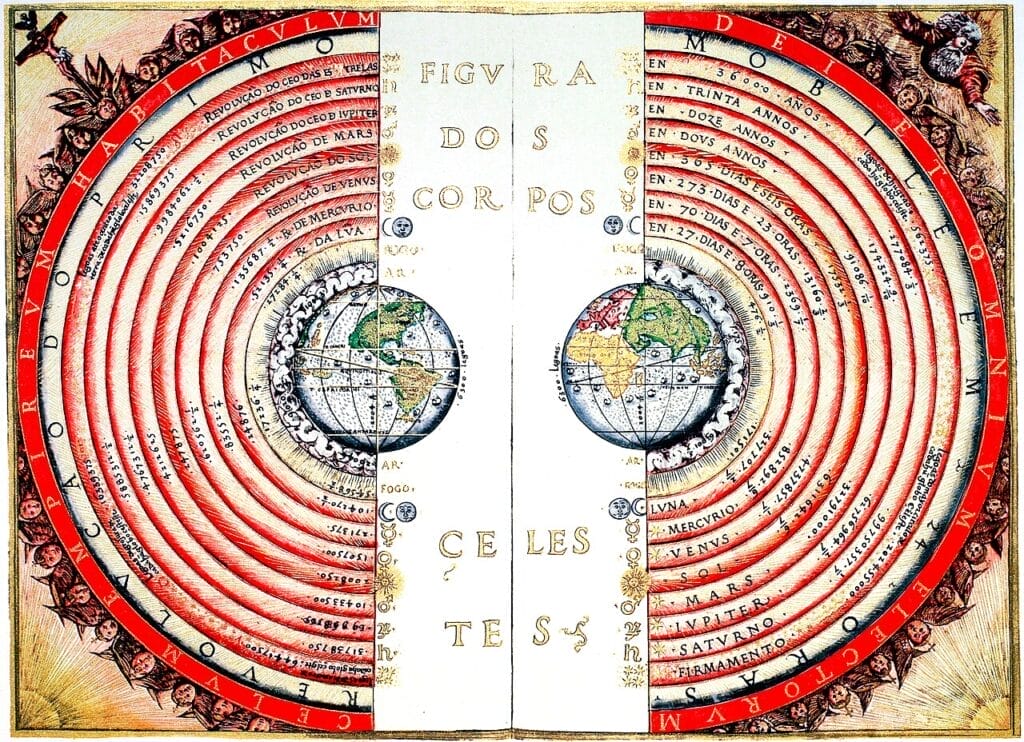
Many of the concepts of the medieval universe were based on classical concepts of authors such as Plato, Aristotle, and Cicero. For Cicero, the moon was the boundary between eternal and perishable things. Aristotle subdivided the universe between nature and sky. The Ptolemaic universe consisted of a spherical, central Earth surrounded by hollow, transparent spheres, one above the other, each larger than the one below. Starting from Earth, the lowest in order were the moon, Mercury, Venus, the Sun, Mars, Jupiter, and Saturn. What a person living in medieval northern France or the British Isles saw and noted was quite different from our modern vision of the universe. The model of the imagined medieval universe was generally accepted by the great medieval Western thinkers.
There were two regions above the earth separated by the moon and its orbit. The earth was at the lowest part of the universe and movement was always considered upward. The lower region, between the earth and the moon, was called nature. It was a region of change and irregularity. The properties of earthly matter included hot, cold, moist, and dry. Chaos was the raw material from which the four earthly elements were formed. The union of hot and dry becomes fire, that of hot and moist properties air, cold and moist properties water, and cold and dry properties, earth. A fifth element, ether, was found only above the moon, and mortals had no experience of it. The upper region beyond the moon and its orbit was called the sky. Nature was made up of air, fire, earth, and water. It was changeable and perishable. The true sky consisted of a different substance called ether, which encompassed divine bodies.
Nature, including Earth, the heaviest, was at the center and the bottom of the universe. On it lay the lighter water, above which was the lighter air, and above that fire, which formed a sphere just below the surface of the moon. The reason that flames always moved upward was that the fire in them was seeking its kind state. Flames were impure fire, and their impurity made them visible. Elemental fire just below the surface of the moon was pure, unadulterated fire, completely transparent.
The medieval theoreticians believed that the concepts of the medieval world and universe were provisional rather than factual. The difference in medieval and early Renaissance Church responses to Copernicus and Galileo dealt with this postulate. There were no objections to Copernicus treating the sun as the center of the solar system because he considered this a theory, not a fact. However, Galileo insisted on this as a fact, and began publicly reinterpreting Scripture to fit his model, producing strong controversy.
The planets known to the medieval world beyond Earth included Mercury, Venus, Mars, Jupiter, and Saturn. All of these planets were, of course, beyond the moon, therefore in the Eternal Sky. Beyond Saturn, the farthest of the known planets was the Stellatum. This consisted of the fixed stars. It was thought that traveling upward at a rate of forty miles per day would allow one to reach the surface in 8,000 years, several thousand years beyond the earth’s existence.
Even beyond them was Primum Mobile or First Moveable, which was not a luminous body and thus could not be evident to the worldly observer. Aristotle, who conceptualized this, concluded that there was an entity beyond the First Moveable that was neither a void, nor place, nor time. It could have been considered Heaven. The universe in toto was perfectly spherical.
The motion of Earth and the heavens was a result of the First Moveable rotation. The Prime Mover was moved by its love for God, and being moved communicated its motion to the rest of the universe. This concept was derived from Aristotle. This produced a motion of the Stellatum, which in turn resulted in the rotation of the sun, moon, and planets.
The planets influenced the people on Earth, a subject of astrology. Even orthodox theologians accepted that the planets could affect events on earth, even on plants and minerals. St. Thomas Aquinas believed in the physical influence of these spheres. Among people, especially the wise, reason and free will fight these influences.
The planets’ influences were considered extraordinary. Mars caused wars and was the heaven of martyrs. Saturn was influential in causing disasters, melancholy, and illness. Jupiter produced joviality, which is the source of the word. It was associated with halcyon days and, according to Dante, was the heaven of the wise and just. Venus, of course, was associated with beauty and love. Those who loved greatly went to this heaven. Mercury influenced men of action and those who would become studious. Even the sun had an influential role, producing wise and liberal people, and the heaven to which philosophers and theologians would come.
The sun and planets each produced a characteristic mineral. For example, the sun produced gold, Mercury produced quicksilver (mercury), and copper was made by Venus.
The influence of the sun and planets on earth depended on its nature in receiving them. If the realm above the moon was that of the gods, below the orbit of the moon was the realm of “daemons,” which were spirits of some divinity that acted as guardians of fate. Although the word “demon” would eventually be derived from “daemon,” these were spiritual forces, not necessarily evil, but either benevolent or malevolent. As the Middle Ages evolved, all daemons eventually became bad. They were fallen angels, or demons. The demons were found primarily in the lower air, or in the turbulent region below the moon’s orbit.
The sun illuminated the entire universe, including the stars, which had no intrinsic light of their own. Night was a finger-line conical shadow from Earth. Beyond that shadow, there was no night. There was also no silence in space. A harmony of sound spread from each planet. Planets were unaffected by time and had a consciousness and intelligence fostered by God. Eventually, the natural world and space below the moon would be destroyed, but the realm of the universe above the moon would persist.
The universe was sublimely ordered, everything in its place, nothing to be explored. To me, fascination with the cosmos comes from the uncertainty of our current precepts, such as the postulate of the “Big Bang” at the beginning of the universe. The amazing things we are learning about the cosmos allow us to build on this uncertainty and continue exploring the dazzling possibilities of its origin.
Reference
- Lewis, CS. The Discarded Image. Cambridge University Press, 1964.
PHILIP R. LIEBSON, MD, graduated from Columbia University and the State University of New York Downstate Medical Center. He received his cardiology training at Bellevue Hospital, New York and the New York Hospital Cornell Medical Center, where he also served as faculty for several years. A professor of medicine and preventive medicine, he has been on the faculty of Rush Medical College and Rush University Medical Center since 1972 and holds the McMullan-Eybel Chair of Excellence in Clinical Cardiology.