In 1187, the army of Saladin, the Ayyubid sultan of Egypt and Syria, recaptured Jerusalem for the Muslim world by defeating the Christian Crusaders at the Battle of Hattin in Galilee. Under the Hohenstaufen Emperor Frederick II, the Crusaders briefly retook Jerusalem in the Sixth Crusade (1228–1229), but the trend was irreversible, and by 1244 the City of David had been permanently lost to the Muslims. This reverse, followed by further defeats and the later catastrophe of the bubonic plague, fostered a fertile ground for the spread of legends such as that of the Emperor Prester John.
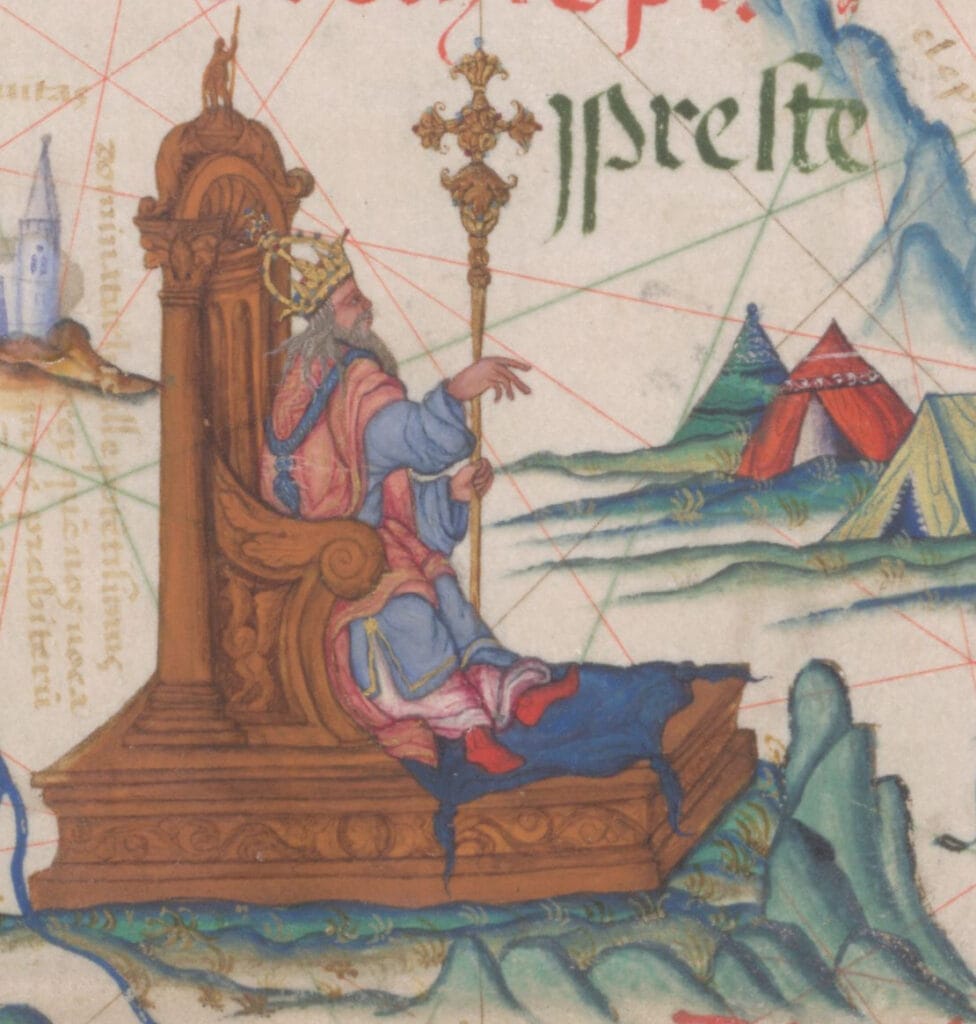
Ruler of a vast empire, Prester John had been expected to fight on the side of the Crusaders. Manuel Commenus, the Byzantine Emperor, had received a letter to that effect, and Pope Alexander III reportedly replied to it in 1177, but received no answer. However, the legend of Prester John ruling over a fabulous empire spread like wildfire across a credulous world; and when no such empire was found in one country, the location of his dominion shifted to another, and eventually to the Christian kingdom of Ethiopia in Africa. The emperor was described as a splendid ruler, long-lived and immune to affliction, who drank from a fountain that restored youth and ate from a magical table that replenished itself. His subjects, also benefitting from the fountain, lived for extraordinarily long periods, two to three centuries in some cases. The emperor owned forests of pepper, cinnamon, cloves, and ginger, which in medieval pharmacology were vital medicines that protected against disease and death.
The story of Prester John was also published in a book allegedly written by the Englishman Sir John Mandeville around 1366, believed to be a plagiarism of earlier French authors. The book describes the emperor as also being a Christian priest, with ancestors including one of the three Magi as well as the queen of Sheba. His empire was vast, with 72 dependent kingdoms. He possessed massive military power and untold wealth. The sultan of Cairo paid him tribute for his power to change the course of the Nile. Rivers running with gemstones coursed through his realm, and he had a table of emerald at which thirty thousand guests dined daily. The emperor possessed many “noble cities and good towns in his realm”, and many great and diverse islands, “all very good and very rich”, with cloths of gold, silk, spices, and all sorts of valuable precious stones.
The search for this mythical king later motivated Portuguese maritime explorations in the 15th and 16th centuries, with King Manuel I of Portugal seeking to discover new riches and territories. Reflecting the limited knowledge of the time, the legend of Prester John needs to be seen not merely as a curiosity of medieval credulity, but as the story of a susceptible population looking for help. The myth of Prester John spread as one of the most widely copied documents of the medieval period, translated into dozens of languages and disseminated across pious monasteries, among learned scholars, and to the royal courts of Europe.