
Kevin R. Loughlin
Boston, Massachusetts, United States
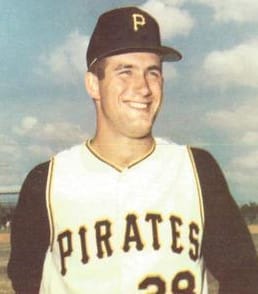

He was at the pinnacle of his profession: a baseball champion and hero who had pitched two complete game victories in the 1971 World Series, giving up only seven hits and two runs in eighteen innings while winning the deciding seventh game. In his profile of Steve Blass in The New Yorker, the esteemed baseball writer Roger Angell described an airborne Blass at the apex of an astonishing leap after retiring the final batter to clinch the world championship.1
By anyone’s estimation, Steve Blass’s future was limitless. He was twenty-nine years old, at the top of his profession, happily married, and raising two boys who loved baseball as much as he did.
In 1972, Blass won nineteen games and posted an earned run average (ERA) of 2.48. He was establishing himself as one of the dominant pitchers in the game, had been named to the 1972 National League All-Star team, and was runner-up to Steve Carlton for the National League Cy Young Award.
What could possibly go wrong? Everything did, in the 1973 season. His ERA soared to 9.85, he walked eighty-four batters in 88 2/3 innings, while striking out only twenty-seven. Nobody had an explanation as to what was wrong. Not Pittsburgh Pirates manager Bill Virdon, or any of the coaches, and especially not Blass himself. He had lost his control and could not throw strikes. He felt fine, had no injuries, and was not having any personal or family problems. Some suggested that the death of Steve’s good friend, baseball great Roberto Clemente, in a plane crash on December 31, 1972, may have contributed to the decline of Blass’s pitching performance. But nobody in the Pittsburgh Pirates organization could accept that or any other personal concern as an explanation for Blass’s dramatic decline.
The coaching staff took a proactive approach. They looked at hours of Blass’s pitching on film and analyzed arm angle, foot placement, and grip. They suggested adjustments that did not work. What was even more perplexing was that Blass seemed to pitch well on the sidelines, but could not perform under game conditions. Was it stress? Blass was not some rookie; he was a seasoned major league pitcher who had been a World Series hero.
His problems persisted and actually worsened throughout the 1973 season. Neither Blass nor the Pittsburgh management were willing to stand idly by and shrug their shoulders. After the 1973 season, Blass traveled south and joined the Pirates’ team in the Florida Instructional League. He worked assiduously with Don Osborn, an experienced major league pitching coach. These off-season workouts left Blass and the Pirates management hopeful, but still without an explanation. In February 1974, Blass reported to the Pirates’ spring training facility in Bradenton, Florida. The results were extremely disappointing, as Blass walked twenty-five batters in fourteen innings of Grapefruit League play.
At the conclusion of spring training, Blass and baseball management were both in agreement that a minor league assignment was the proper place for Blass to try and work things out. Blass reported to a Pirates affiliate, the Charleston Charlies. Unfortunately, Blass’s pitching did not improve against minor league competition. By mid-season, his record was two wins and nine losses with an ERA of 9.74. Erratic was a kind description of his pitch control. Medical consults followed. Psychiatrists, optometrists, and physical therapists weighed in and all were puzzled. No suggested intervention was helpful. What remained bewildering to all was that Blass seemed better when he was not pitching in actual games. No psychiatric evaluation proved revealing or helpful. Every suggested treatment option was tried, including transcendental meditation. Nothing worked.
At the end of the 1974 season, Steve Blass retired from baseball. He and his wife thought it was the only reasonable option left. He took a job working for the Josten Ring company, which manufactured rings for colleges and professional teams. Steve seemed at peace, but still had no explanation for the malady that forced him to give up the game he had loved since childhood. Steve had a bad case of the yips!
Steve Blass was neither the first nor last professional athlete to develop the yips. In baseball, some have been pitchers, others have been position players. Jon Lester, a Red Sox pitcher, could still throw normally to the batter at home plate, but could not throw accurately to a first baseman. If he fielded a ball that was hit to him, he would run part of the way to first base and then flip the ball underhanded to the first baseman.
Rick Ankiel was a promising pitcher for the St. Louis Cardinals from 1999 to 2001. Similar to Steve Blass, he became unable to reliably throw strikes in 2001. A variety of diagnostic examinations and therapeutic interventions failed to enable him to regain his pitching form. However, Ankiel was only in his early twenties and wanted to continue his major league career. Curiously, he could throw accurately from the outfield, despite having trouble throwing from the mound to home plate. This led him to switch to the outfield in 2004 and focus on learning to hit. He ultimately succeeded and returned to the major leagues in 2007 as an outfielder where he competed successfully for another seven years.
Major league infielders have also been afflicted by the yips. Chuck Knoblauch and Steve Sax were two All-Star second basemen who developed the yips when throwing to first base. Similar to Ankiel, their yips seemed to be selective. They both could throw elsewhere on the diamond, just not to first basemen. Knoblauch was at times so wild that he once overthrew the first baseman and hit a fan with the ball.
The yips malady is not confined to baseball; it occurs in other sports as well. Participants in cricket and tennis have been identified as being plagued with the yips, and the condition affects a reported 28% of golfers.2
The yips phenomenon is not confined just to athletics. Physicians whose practice involves performing repetitive motions such as lumbar punctures have been reported as exhibiting the yips.3 There has been no reliable data published yet on the incidence of yips among physicians and surgeons.
The etiology of yips continues to be elusive. It has been described as a psycho-neuromuscular disorder affecting the performance of fine motor skills. Its causation appears to be a continuum ranging from a localized neuromuscular disorder to a psychological condition. It may be that similar clinical manifestations of the yips have more than a single etiology. It has been described as a focal dystonia related to an impairment of performance requiring fine motor control. However, the complete explanation may be more nuanced.4,5
It has also been ascribed to psychological anxiety related to performance under high-pressure conditions. Focal dystonia is rare and only affects about 3 in every 10,000 people in the United States.5 Women develop focal dystonia about three times as often as men. The presenting symptoms are variable and include cramps, muscle pain, and twitches (myoclonus).6 The natural history of focal dystonia is unpredictable. In some individuals, the symptoms are transient. In others, like Steve Blass they are refractory.
There is no consensus as to the best treatment for focal dystonia. Anticholinergic medications such as trihexyphenidyl and tetrabenazine have been recommended. In some case, carbidopa/levodopa has been shown to alleviate symptoms. Muscle relaxants have also been used with variable success.
The case of Steve Blass is dramatic. In less than three years, he went from World Series hero to being out of baseball. Blass’s greatest asset was the way he, his family, and his teammates reacted to the dysfunction. Like most idiopathic disorders, future research is our hope for patients with the yips. What makes it difficult is that it may represent a spectrum of more than a single disease with more than one etiology. It occurs sporadically and relatively infrequently, so a prospective, randomized trial is unlikely. Yips will continue to impact weekend golfers who no longer can make a three-foot putt as well as professional athletes. One can only hope that those who are afflicted with the yips respond with the dignity and resolve shown by Steve Blass, an All-Star, on and off the field.
References
- Angell, R. Down the Drain, The New Yorker, June 16, 1975.
- McDaniel KD, Cummings JL, Shain S. The “yips”: a focal dystonia of golfers. Neurology 1989;39(2 Pt. 1): 192–195.
- Haber LA, Taylor EM. The Procedural Yip. J. Gen. Int. Med. 2024;39(9):1764–1765.
- Clarke P, Sheffield D, Akehurst S. The yips in sport: A systematic review. International Review of Sport and Exercise Psychology 2015;8(1):156–184.
- Sato K. The “Yips” in Division 1 Collegiate Sports: Prevalence, Conditions and Factors. Thesis, California State University, Fresno, 2017.
- Focal Dystonia. Cleveland Clinic. Accessed March 22, 2026. https://my.clevelandclinic.org/health/diseases/22796-focal-dystonia
KEVIN R. LOUGHLIN, MD, MBA, is a retired urologist and an emeritus professor at Harvard Medical School.