The territory of present-day Serbia has been inhabited since prehistoric times, most notably by the Vinča culture (c. 5700–4500 BCE), one of Europe’s earliest advanced societies. This sophisticated civilization produced early forms of proto-writing and advanced ceramic artistry as well as early medical awareness, including trepanation to treat trauma or neurological conditions. The region later came under the influence of Illyrian and Thracian tribes before being absorbed into the expanding Roman Empire. Known as Moesia Superior, the region flourished as a strategic frontier province. The Romans built military hospitals and introduced baths, aqueducts, and sanitation systems. Several Roman emperors originated from there, most notably Constantine the Great, born around 272 CE in what is modern-day Niš.
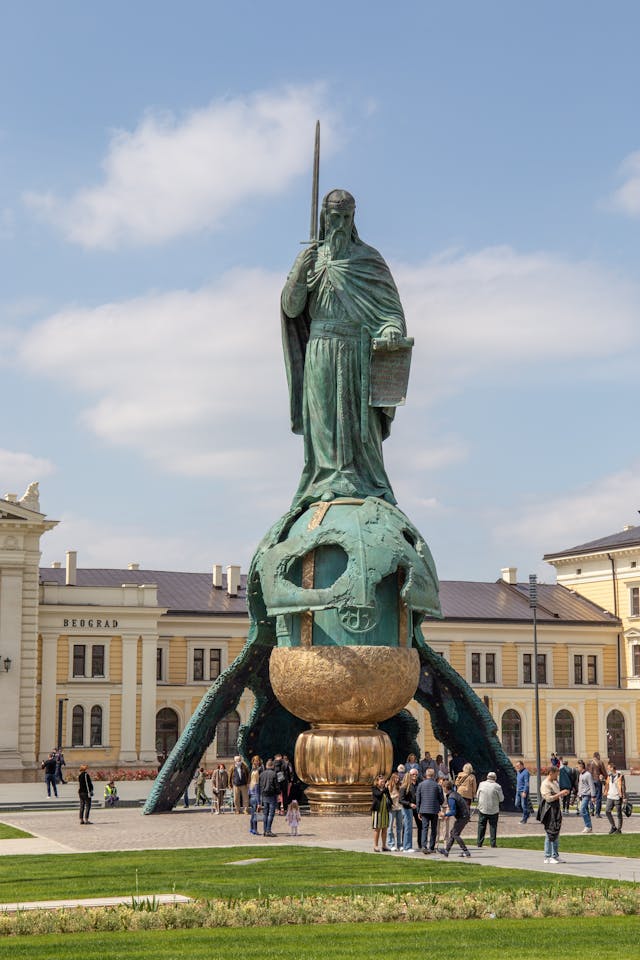
Slavic tribes from Central Europe moved into the Balkans during the 6th and 7th centuries, displacing or assimilating the earlier local populations. By the 9th century, they had come under the influence of the Byzantine Empire and Eastern Orthodox Christianity. By the 12th century, Serbia emerged as a medieval state under the Nemanjić dynasty, reaching its zenith under Stefan Nemanja, who came to power around 1166, and is regarded as the father of the medieval Serbian state. A shrewd military and political leader, he greatly expanded Serbian territory, throwing off Byzantine suzerainty and laying the foundations of a powerful, independent principality. The Nemanjić dynasty reached its zenith under Stefan Dušan, who ruled from 1331 to 1355. Dušan transformed Serbia into the most powerful state in the Balkans, conquering vast swathes of Macedonia, Albania, Epirus, and Thessaly. In 1346, he crowned himself “Emperor of the Serbs and Greeks,” and his court in Skopje rivaled the splendor of Constantinople. Monasteries became the primary centers of knowledge. Saint Sava, the first archbishop of Serbia, promoted literacy and learning, including the translation of Byzantine medical texts. Monastic infirmaries provided medical care based on a mixture of herbal remedies, spiritual healing, and humoral theory inherited from ancient Greek medicine via Byzantium.
The turning point in medieval Serbian history came with the Battle of Kosovo in 1389. On that day, a coalition of Serbian, Bosnian, and Albanian forces under Prince Lazar Hrebeljanović met the Ottoman army led by Sultan Murad I. Both Lazar and Murad were killed in the fighting, and although the battle’s outcome was militarily inconclusive, it opened the door to eventual Ottoman domination. By the mid-15th century, Serbia was fully incorporated into the Ottoman Empire, a rule that lasted nearly five centuries. Serbia became part of a vast Islamic empire, bringing new administrative systems, cultural influences, and also medical practices. Ottoman medicine, influenced by Persian and Arab traditions, emphasized hospitals (darüşşifa), hygiene, and pharmacology. Public baths (hammams) played a dual role in hygiene and social life, contributing indirectly to disease prevention. Plague outbreaks periodically devastated the population. Responses included quarantine measures and rudimentary isolation practices. In addition, from the Ottoman conquest up to the beginning of the Serbian Revolution in 1804, several Habsburg–Ottoman wars were fought on the territory of modern Serbia. The era includes successive periods of Ottoman and Habsburg rule in various parts of Serbia. During the Ottoman rule, many Serb boys from Balkan Christian families were forcibly converted to Islam and trained for infantry units of the Ottoman army known as the Janissaries.
The political awakening came at the start of the nineteenth century. In 1804, the First Serbian Uprising broke out under the leadership of Karađjorđje Petrović (Black George), a charismatic and fierce commander who led a rebellion against the Ottomans. The uprising (1804–1813) was initially suppressed. A Second Serbian Uprising followed in 1815, led by Miloš Obrenović, a far more cunning and diplomatically adroit leader than his predecessor. Rather than seeking immediate independence, Miloš negotiated with the Ottomans, gradually expanding Serbian autonomy. By 1830, Serbia was recognized as a hereditary principality under Ottoman suzerainty, with Miloš as its prince. By 1878, at the Congress of Berlin, Serbia was recognized as a fully independent kingdom.
A turbulent period followed, marked by several alternations between the two dynasties and later an unsuccessful war with Bulgaria over territorial claims. The feud between the Obrenović and Karađjorđjević dynasties divided the Serbian people and lasted for nearly nine decades. It began with Karađjorđje Petrović secretly returning to Serbia in 1817 to discuss a joint plan of action with Prince Miloš Obrenović—but Miloš had him assassinated. Throughout the century, the throne passed back and forth between the two houses. The Obrenović led the emerging state from 1817 to 1842 and again from 1858 to 1903, while the Karađjorđjević held power from 1842 to 1858 and after 1903. The transitions of power were rarely peaceful. In 1858, Prince Aleksandar Karađjorđjević was overthrown and Miloš Obrenović was reinstated with a heavily armed deputation traveling to Bucharest to bring the new prince back to Serbia.
The rivalry between the two houses was also embedded in geopolitics. The Karađjorđjević house was supported by Russia, while the Obrenović family was backed by Austria-Hungary, each family serving as a proxy for competing imperial interests. Also, the Karađjorđjević family, which had led the First Serbian Uprising, emphasized a more democratic and popular vision for Serbia, while the Obrenović were associated with centralized, modernizing rule. Serbia’s ambitions were to unify all South Slavic peoples—Serbs, Croats, Slovenes, and others—living under Austro-Hungarian or Ottoman rule. This “Greater Serbia” or South Slav nationalist vision put Serbia on a collision course with the Austro-Hungarian Empire, which controlled large South Slav populations in Bosnia-Herzegovina, Croatia, and Slovenia.
In the summer of 1900, King Alexander I Obrenovic suddenly announced his engagement to Draga Mašin, the former lady-in-waiting of his mother. Much unrest followed, and in 1903 he and Queen Draga were assassinated by a group of army officers. They were shot and their bodies mutilated and disemboweled, after which, according to eyewitness accounts, they were thrown from a second-floor window of the palace onto piles of garden manure. This resulted in the extinction of the Obrenović dynasty. After the coup, the National Assembly voted Peter Karađjorđjević as king of Serbia as Peter I.
The Balkan Wars of 1912–13 dramatically expanded Serbian territory. In the First Balkan War, Serbia joined Bulgaria, Greece, and Montenegro to expel the Ottomans from most of their remaining European possessions. In the Second Balkan War, the allies turned on each other over the division of Macedonia, with Serbia and Greece prevailing over Bulgaria. These victories roughly doubled Serbian territory and population, but they also inflamed tensions with Austria-Hungary. Austria’s annexation of Bosnia in 1908 had deeply outraged the Serbians and led to the 1914 assassination of the Austrian heir Archduke Franz Ferdinand by Serb nationalist organization the Black Hand. It set off a chain of events that plunged Europe into World War I. Serbia endured immense suffering during the conflict, losing one third of its population, compounded by a devastating typhus epidemic in 1914–1915.
From the ruins of the old empires a new state emerged. On December 1, 1918, the Kingdom of Serbs, Croats, and Slovenes was proclaimed, uniting Serbia (including Macedonia and Kosovo) with the formerly Habsburg South Slav territories. Renamed Yugoslavia (“Land of the South Slavs”) in 1929, the new state was ambitious but internally fractured. King Peter I of Yugoslavia was succeeded in 1921 by his son, Alexander I. Another turbulent period followed as the largest and militarily dominant group often clashed with Croat political leaders over the degree of centralization versus federalism. In 1934, in Marseille, France, King Alexander I was assassinated by a coalition of groups opposing his centralized dictatorship. He was succeeded by his eleven-year-old son, Peter II, under the regency of his first cousin, Prince Paul.
During World War II, Yugoslavia was invaded by Germany, Italy, Hungary, and Bulgaria, and rapidly dismembered. A puppet Independent State of Croatia was established under the Ustasha regime and pursued genocidal policies against Serbs, Jews, and Roma. Resistance movements to the Axis emerged, most notably the Chetniks led by Draža Mihailović and the Partisans led by Josip Broz Tito. The latter prevailed and, after the war, established a federation of six republics—Slovenia, Croatia, Bosnia-Herzegovina, Serbia, Montenegro, and Macedonia. He managed to keep a lid on ethnic nationalism through a combination of communist ideology, economic development, strong personal authority, and a non-aligned foreign policy that kept it independent from both Moscow and Washington. Serbia remained the largest republic in the Federal Republic of Yugoslavia. It established a centralized healthcare system, expanding access to medical services, preventive care, vaccination, and rural health, thereby greatly improving life expectancy and reducing mortality from infectious diseases.
Following Tito’s death in 1980, nationalist movements led to the disintegration of Yugoslavia. In the 1990s, Serbia, under the leadership of Slobodan Milošević, became embroiled in conflicts with Yugoslavia’s other constituent states, which declared their independence in March 1992. A three-way war among Bosnian Serbs (backed by Serbia proper), Bosnian Croats, and Bosnian Muslims (Bosniaks) claimed over 100,000 lives and produced the worst acts of mass atrocity seen in Europe since 1945.
The siege of Sarajevo lasted nearly four years—the longest siege of a capital city in the history of modern warfare. The massacre at Srebrenica in July 1995, in which Bosnian Serb forces under General Ratko Mladić murdered more than 8,000 Bosniak Muslim men and boys, was subsequently ruled by international tribunals to constitute genocide. The Dayton Agreement of November 1995 ended the Bosnian War, but left a fragile and dysfunctional peace. The Kosovo Liberation Army’s insurgency provoked a brutal Serbian crackdown, displacing hundreds of thousands of Kosovo Albanians. NATO intervened in March 1999 with an air campaign against Serbia, forcing the withdrawal of Serbian forces from Kosovo and placing it under the administration of the United Nations.
Milošević was overthrown in 2000, and Kosovo declared its independence in 2008, but Serbia refuses to recognize this, leaving the situation unresolved and delaying its admission into the European Union. Nevertheless, Serbia has begun a gradual transition toward democracy and integration with European institutions. The COVID-19 pandemic underscored Serbia’s integration into global health networks and its capacity to deploy vaccines rapidly. It revealed a society continually adapting to external influences while preserving its own deeply held traditions.
Further reading
- Armour, Ian D. “’Put Not Your Trust in Princes’: The Habsburg Monarchy and Milan Obrenović of Serbia 1881–1885.” Canadian Slavonic Papers 56 (September–December 2014): 201–237.
- Cvetković, Branislav. “The Royal Imagery of Medieval Serbia,” in Meanings and Functions of the Ruler’s Image in the Mediterranean World (11th to 15th Centuries).Brill (2022): 172–218.
- Fay, Sidney Bradshaw. “The Black Hand Plot That Led to the World War.” Current History 23, no. 2 (November 1925): 196–207.
- Hitchins, Keith. “Reviewed Work(s): ‘The Balkan Wars: Conquest, Revolution, and Retribution from the Ottoman Era.’” Slavic Review 62, no. 3 (Autumn 2003): 596–597.
- Ostrogorsky, George. “Byzantium and the South Slavs.” The Slavonic and East European Review 42, no. 98 (December 1963): 1–14.
- Rogel, Carole. “Kosovo: Where It All Began.” International Journal of Politics, Culture, and Society 17, no. 1 (Fall 2003): 167–182.
- Trivanovitch, Vaso. “Serbia, Russia, and Austria during the Rule of Milan Obrenovich, 1868-78.” The Journal of Modern History 3, no. 3 (Sept, 1931): 414–440.
- Zimmermann, Warren. “The Demons of Kosovo.” The National Interest, no. 52 (Summer 1998): 3–11.