
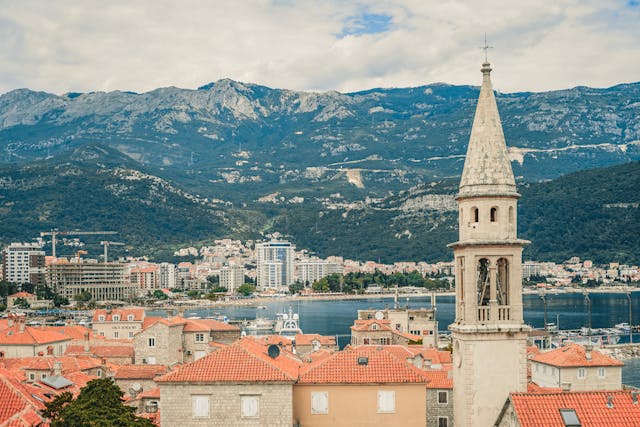
Montenegro is a small Balkan country of fewer than 700,000 inhabitants. It has rugged mountains, medieval villages, and a narrow strip of beaches along its Adriatic coastline. Venetian merchants travelling along its coast named the country Monte Negro from the dark, forested mountain peaks of its inland, and the Slavs translated this as Crna Gora, the Black Mountain. In Montenegro, the terrain’s configuration allowed local inhabitants to remain largely independent by retreating to the mountains, making it impossible for the Ottomans to conquer them. For about four centuries, the Ottomans controlled the lowlands and the coast, but the locals largely held the heights.
In 1910, Montenegro became an independent kingdom. After World War One, it was absorbed into what became Yugoslavia, controlled at first by Serbia, initially under its kings and after World War Two by a centralized communist regime. Following the dissolution of Yugoslavia, Montenegro was initially part of a rump federation with Serbia but voted in 2006 to become independent. It joined NATO in 2017 and is holding accession talks with the European Union.
What distinguishes Montenegro from its other Balkan neighbors is the compression of its landscapes. Within a country that can be driven end to end in a few hours, one encounters the Mediterranean coast with its olive trees and bougainvillea; the Karst plateau, alpine meadows, and glacial lakes of the Durmitor National Park, home to bears and wolves; the Tara River canyon, a high plateau studded with glacial lakes and surrounded by mountain peaks that hold snow well into summer; and Žabljak, the small but highest town in the Balkans.
Life in Montenegro varies dramatically by geography but moves at an unhurried pace. Locals gather in town squares, sit for long coffees, and socialize in the evening during the traditional evening stroll, the korzo. Family ties are extremely strong, and multi-generational households are common, particularly in rural and highland areas. The country tends to be split in character between the cosmopolitan Adriatic coastal towns, transformed in the summer by masses of tourists, and the inland life, which is quieter, tied to livestock herding and agriculture, and with winters that can be harsh and isolating.
On the Adriatic Shore, the Bay of Kotor is dotted with ancient towns and coastal churches. The town of Kotor is a walled medieval town that spent much of its history under Venetian rule. It features Romanesque churches, baroque palaces, and some Ottoman mosques. Farther down the coast is Budva, a lovely small Venetian-influenced citadel on a peninsula, with churches, a promenade, and views over the Adriatic, a place of beach clubs and frantic, loud music in July and August. Podgorica, the capital, has grown rapidly since the 1990s, with cafés, shopping centers, and an increasingly lively nightlife.
The cuisine in Montenegro reflects its geography, with hearty mountain food in the interior and fresher, seafood-driven cooking on the coast. Inland dishes include dry-cured, smoked ham served thin-sliced with local cheese, smoky cheese often grilled, a creamy cornmeal dish blended with potatoes, cheese, and sometimes kajmak (clotted cream), and roasted lamb and veal. Coastal and seafood cooking includes fresh fish (branzino, sea bream, tuna), black fish risotto, slow-cooked fish stew with tomatoes and wine, and oysters from the Bay of Kotor. Its famous characteristic rakija (fruit brandy) is the plum-based šljivovica, and there are local wines and beers. Dining out is inexpensive by Western European standards, and a full meal with wine at a local konoba (tavern) rarely breaks the bank.
From a medical perspective, the region was, for centuries, the frontier between the Ottoman Empire and Christian Europe. Warfare, migration, and hardship were common, and disease flourished. Epidemics of plague and other infectious diseases periodically swept through the Balkans. When more recently trained physicians introduced modern diagnostic methods and pharmaceuticals, many rural families continued to trust herbal remedies and community healers. Even today, visitors to Montenegro’s villages may encounter elderly residents who prepare herbal teas for coughs or poultices for minor injuries—remnants of a long cultural memory of healing practices.
Elsewhere, health concerns increasingly resemble those of other European nations. Cardiovascular disease, diabetes, and lifestyle-related illnesses have become more prominent as urbanization and dietary change reshape daily life. Tourism, now a major economic force along the Adriatic coast, also brings new public health considerations. Seasonal population surges require expanded medical services, emergency care, and health infrastructure.
For many years, the harsh, cold mountain environment and limited sanitation influenced patterns of disease, fostering conditions for tuberculosis and other respiratory ailments. Yet, paradoxically, the clear mountain air also attracted physicians in the nineteenth and early twentieth centuries who believed high-altitude climates could aid recovery from pulmonary disease. Across Europe, mountain sanatoria were established for tuberculosis patients, and the Balkan highlands shared in this reputation for therapeutic air.
After the First World War, structured public health initiatives emerged, leading to the establishment of hospitals, clinics, and medical schools, as well as vaccination campaigns targeting diseases that had long plagued rural communities. More recently, the combination of mountain landscapes, clean air, and coastal climate has encouraged the development of wellness tourism. Visitors seek restorative experiences in spa resorts, seaside retreats, and mountain lodges. Such pursuits echo older beliefs about the healing power of climate and nature—ideas that have persisted in medical thought from ancient Greek physicians to modern holistic health movements.