
Saty Satya-Murti
Joseph Lockhart
Santa Maria, California, United States
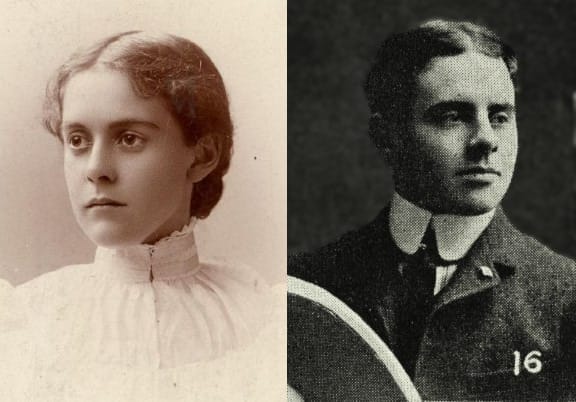
Right: William Brady University of Buffalo Graduation shot 1901. From Research Guides: 175 Years of Medicine at UB: Alumni.
Alice Hamilton (1869–1970) and William Brady (1880–1972) were well-recognized physicians of the early twentieth century. They were united by a common goal in the emerging and “untilled” field of public health in the 1920s.1 Their mission was to improve health awareness and safety among the public. Their writings had educational value and wide readership. Whereas Hamilton stayed her course, Brady gradually lost sight of his mission by disseminating both helpful and harmful information while still maintaining his popular appeal. This transition has relevance to our times.
Both were born in New York and graduated from medical schools within eight years of each other. Alice Hamilton was a pathologist and the founder of industrial toxicology and occupational medicine in the United States. In 1919, she was the first female faculty at Harvard Medical School. She consulted for governmental agencies, private industries, and collaborated with Nobel prizewinner Jane Addams. She was a friend of presidents, justices, and other luminaries. Her accomplishments are legendary and have been well chronicled.2
William Brady practiced in Western New York for about two decades before ending his practice and moving to Beverly Hills, California around 1932. For nearly sixty years, he wrote a regular widely syndicated medical and health advice column. These advice columns appeared in the Los Angeles Times and 130 other newspapers throughout the US between 1914 and 1972.3 Brady’s output was prodigious and popular, but it was also an immiscible mix of sensible and dubious advice.4
Brady in an age of tonics, nostrums, and proprietary potions
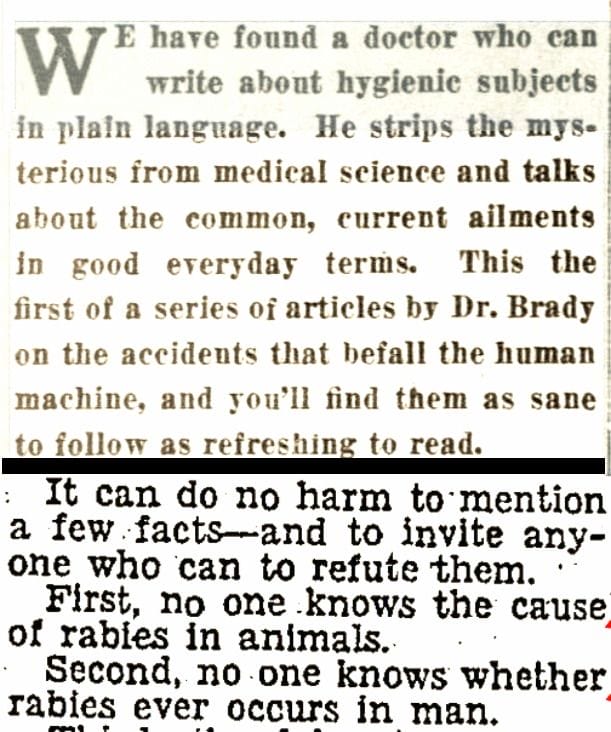
Top: A San Francisco newspaper seems to have found William Brady. From San Francisco Sunday Call, December 29, 1912.
Bottom: In the 1930s Brady started questioning universally accepted ideas and became emphatic in his denials. From Los Angeles Times, July 30, 1934.
In the early twentieth century, unvalidated and exaggerated advertisements for tonics, nostrums, and patented medicines inundated newspapers. Newspapers heavily relied on revenues from such advertisements. Most of these remedies were unverified and even dangerous. Organized medicine charged that the “alliance” between newspapers and nostrum advertisers was “criminal.”5 This milieu, plus a lack of health literacy among the public, invited a change incorporating credible health advice from qualified physicians. Brady was ready to fulfill this dire need for professional advice through his contributions to emerging newspaper syndications.
Beginning in 1912, he provided balanced generic and specific health advice that was well aligned with medical standards of the time. Until the late 1950s, a wide network of newspapers carried his popular “Here’s to Health” and “Personal Health Service” columns. He berated ill-founded fringe medical practices and encouraged healthy habits (e.g., not smoking). His writing style was often folksy, plain, and jargon-free. This impressed his editors and readers such that one newsfeed announced, “We have found a doctor who can write about hygienic subjects in plain language [who] strips the mysteries from medical science.” This earned him a reputation for avuncular trust. Readers regularly wrote back to him and paid a nominal fee for his “pamphlets” that dealt with common diseases. A travel reporter in 1950 tagged him as “very important…[the] best informed man on board.”6 In 1907, he disparaged the “Viavi Treatment,” an early 1900s American and international frenzy that promoted a vaginal douche of cocoa butter and goldenseal (woodlands wildflower herb, Hydrastis canadensis). Viavi claimed to have cured many illnesses, including tumors and sexual inadequacies. This claim was thoroughly investigated and debunked in 1907.7
In 1915, Brady recommended a plant-based diet and labeled meat as “the costliest staple” that “people eat too much of.” He identified crowded rooms with damp indoor air as facilitators of microorganisms’ spread, and he recommended masking. A common practice at the time was to periodically use enemas to force evacuate the bowels to get rid of supposed toxicity from retained stools. He advised against this practice of routine and regular cathartics (strong enemas), refuting the popular concept of autointoxication from colonic retention. He cautioned the practicing physician to be wary of exaggerated claims made by detail men promoting patented medicines. He was in favor of learning from reputable clinical journals such as the Journal of the American Medical Association (JAMA) rather than proprietary free publications. At a time when eugenic beliefs held sway within large segments of US society, he gave due and coequal credit for environment and heredity in shaping the totality of a person. He was “ready to admit that [he] may have been wrong” when he failed to recommend optometrists, who were as professionally qualified to fit glasses as physician “oculists.” His facility with colloquialisms, such as “mollycoddling, namby pambyism,” “Great Poo-Bah” (while referring to the AMA), and “laquerophile” (referring to his love of the smell and appearance of paint solvents), appealed to his readers. He used an acronym, “b.t.a.i.m” (be that as it may), well before the acronym trends of social media. These lexical liberties distinguished him from the temperate and clinical vocabulary of Hamilton.4
The transition
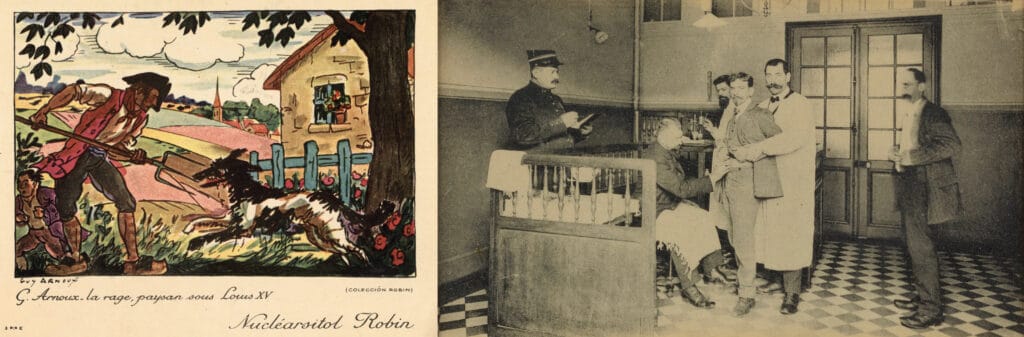
Left: Graphic portrayal of the rabies menace in France. Painting titled “Peasant under Louis XV reign” (1715–1774) defending himself against a rabid dog. National Library of Medicine Digital Collections.
Right: Man receiving rabies vaccine in a periumbilical site. From “Man Being Vaccinated,” circa 1885. Fisher-Pasteur Memorial Collection, Box 4. Science History Institute, Philadelphia.
In the mid-1930s, the knowledgeable and circumspect tenor of Brady’s columns took an erratic turn. His tirade against the existence of human rabies was a prime example. Scientists, epidemiologists, and clinicians knew about human rabies and its long endemicity in the US by the early 1900s. By 1911, the existence of human rabies in California had been well documented. In 1916, Brady allowed for the “exceedingly rare” possibility of human rabies, recommending that a rabid animal’s head be sent for a pathological examination, and Pasteur “antirabic treatment” where necessary. Starting in 1932 until his death, he began to deny the occurrence of human rabies, declaring in 1950, “This concept (of human rabies) has never been scientifically verified—no one has found or identified a germ, virus or other specific cause of such a disease as rabies in man.” He believed that Negri bodies were probably “red corpuscles.” He accused public health staff of fomenting rabies scares to gain funds for their departments. He and his physician colleagues had never encountered human rabies, and, therefore, in his mind, this absence was proof of non-existence of human rabies as a disease. Such opinions, eagerly consumed by widely distributed readership, flew in the face of contemporary medical knowledge.4,8
In 1950, he listed cervical cancer screening as an “essential” test for women “over forty,” but starting in 1965 stated that he “would not advise anyone” to undergo Pap smears or “X-ray of the breasts… once a year” after age 35 or 40. He recommended oral iodine and a morning somersault for good health. In another countercurrent view, he downplayed the need for milk pasteurization. Starting in the early 1940s, he wrote that it was uncertain if undulant fever (Brucellosis) was carried from ingestion of infected cow’s milk of unknown pasteurization status.
Brady’s unscientific beliefs about the transdermal absorbability of toxins brought him into conflict with Hamilton. The skin, Brady wrote, was an “impermeable barrier” against solvent and toxin absorption. He declared that as a “laquerophile,” he would enjoy the smell and feel of toluene and other solvents without harm. He took issue with Hamilton and others, stating, “Unbroken skin is impermeable to food, water, chemical or poison,” and concluding, “Put this in your pipe and smoke it.” An editorial in JAMA castigated him for his sensationalism and misrepresenting the requirements for insulin administration (with Brady calling them “onerous”), the role of vitamin B in reducing the need for insulin, and his “pseudotumor.”9
His virulence towards women was especially deplorable. When he dismissed Hamilton’s caution about the possibility of transdermal solvent absorption, he belittled her saying, “After all the doctor is a woman,” and tagged her as “that girl, Alice in wonderland.” He wrote condescendingly that “women [are] doing great things in medicine these days.” Another broadside was that women taking tranquilizers were “newly rich, overprivileged…idle, useless,” and in need of escape from “their dreary, parasitic existence.”4 In contrast to Brady’s crudeness, Hamilton avoided ad hominems, and at worst wryly quipped that “[the] American man …keeps business and politics to himself,” and hands over to women only what he is “profoundly disinterested in.”2
In later years, an aging Brady adopted a contrarian, abrasive style and often disregarded newer scientific information. Perhaps this gave his columns a few extra years of life and sales. Late in life, missing his “honest family doctor days,” he mused about giving up his “health column racket.”4
Despite peer disapproval, Brady dished out questionable health advice and incendiary declarations.10 At times he acted like amodern family doctor; in others he sounded like a late nineteenth-century horse and buggy doctor, suspicious of germ theory and organized medicine. In contrast, Hamilton stayed true to her science, moored in her ethics and equally active and responsible for public health, education, and policy, She maintained methodological rigor and besmirched none with her words while ensuring occupational safety. Stemming from a shared background in time, space, and mission, they both became well known, but one of them for all wrong reasons.
The beginning of “infodemics” and the credibility paradox
Today, institutional websites, artful “influencers,” and media outlets overwhelm us with health information independent of newspaper columns. Even so, the integrity of science as a discipline remains vulnerable because of unreliable health advice, misrepresentation by news and social media, and lack of critical appraisal skills by the public. The potential to deviate from epistemic norms, even from once respected institutions and individuals, is still alive today. It has taken an amplified and sophisticated guise in the form of predatory journals, sycophantic chatbots, unfettered social media, and questionable mandates from regulatory agencies.11
Hamilton’s work was universally accepted. She maintained a subdued level of political activism even into her nineties. Washed-up as he may have become, Brady, too, retained his readership and remained saleable till his death. Is he relevant today?
Yes, because the themes and ethics of public health skepticisms, vaccine controversies, unproven medications, hereditarian debates, gender disdain, and his signature style for addressing them remain viable.
End notes
- Winslow, C.-E. A. 1920. “The Untilled Fields of Public Health.” Science 51 (1306): 23–33.
- Hamilton, Alice, 1943. Exploring the Dangerous Trades: The Autobiography of Alice Hamilton, M.D. Little, Brown and Company; Jacobson, Anne. 2019. “Alice Hamilton: Physician and Scientist of the Dangerous Trades,” Hektoen International 15 (2); Sicherman, Barbara. 1984. Alice Hamilton: A Life in Letters. Commonwealth Fund, Harvard University Press.
- Weiner, Richard. 1997. “The Doctors: An Historical Overview of Syndicated Columnists, from Dr. William Brady to Dr. George Crane.” American Journalism 14 (3–4): 530–38.
- Brady’s health columns spanned 58 years across many national newspapers. They are too numerous to cite here. The authors will be happy to share specific newspaper clippings on request. Much of the information about William Brady’s published writings is accessible from the Los Angeles Public Library Newspaper Archives, newspaperrchive-com.lapl.idm.oclc.org; Newspapers.com; ProQuest Historical Archives of The Los Angeles Times, The New York Times, and The San Francisco Chronicle; and The California Digital Newspaper Collection (CDNC) based at the University of California, Riverside, https://cdnc.ucr.edu/. In 1916 he authored Personal Health: A Doctor Book for Discriminating People. Philadelphia, London, W.B. Saunders. In 1962 he published An 80 Year Old Doctor’s Secrets of Positive Health. Prentice-Hall. These contain personal reflections also. He wrote occasionally to the Journal of The American Medical Association. It is unclear if there are any biographies about him.
- Bjork, Ulf Jonas. 2022. “Newspaper Medicine: Medical Journals Attack the Press, 1898-1909.” Journalism History 48 (2): 124–41.
- Brady, William. 1912. “Dodging Draughts and Catching Colds.” San Francisco Call, December 29; Archambault, GH. 1950. “Greets The Liner Caronia: Extends Royal Welcome as the Ship Completes 1st Quarter of Superluxury Cruise.” New York Times, February 5.
- Brady, William. 1907. “The Viavi ‘Treatment.’” JAMA 48 (24): 2041; “Viavi Treatment.” 1907. California State Journal of Medicine 5 (4): 73–78. 18734053. PubMed. https://pubmed.ncbi.nlm.nih.gov/18734053
- Wilson, Carol Green. 1945. “A Business Pioneer in Southern California: Part III: Power Fron the Hills.” The Quarterly: Historical Society of Southern California 27 (2–3): 92–114; Sawyer, W. A. 1911. “Rabies in California.” California State Journal of Medicine 9 (7): 294.
- “The Misrepresentations of William Brady.” 1937. Journal of the American Medical Association 109 (16): 1282.
- “False Prophet.” 1946. New England Journal of Medicine 235 (25): 914–15; “Editorial. Brady—Bunk or Debunk?” 1946. Journal of the Southern California State Dental Association. (Los Angeles.) 13: 8.
- Molnar, Frank J., et al. 1999. “Assessing the Quality of Newspaper Medical Advice Columns for Elderly Readers.” Canadian Medical Association. Journal: CMAJ (Ottawa, Canada) 161 (4): 393–95; Oxman, Matt, et al. 2022. “Quality of Information in News Media Reports about the Effects of Health Interventions: Systematic Review and Meta-Analyses.” F1000Research 10 (January): 433; Laine, Christine, et al. 2025. “Predatory Journals: What Can We Do to Protect Their Prey?” The Lancet 405 (10476); Kang, EunKyo, HyeWon Lee, Juyoung Choi, and HyoRim Ju. 2026. “The Quality of Evidence of and Engagement With Video Medical Claims.” JAMA Network Open 9 (1): e2552106.
SATY SATYA-MURTI, MD, FAAN, is a clinical neurologist and health policy consultant. Following retirement, Saty has spent time researching cognitive biases, the social underpinnings of clinical medicine, Progressive Era medicine, and forensic sciences. He enjoys solar cooking, volunteering, and grandparenting,
JOSEPH (JERRY) LOCKHART, PhD, ABPP, is board certified in forensic psychology, and is a Fellow of the American Academy of Forensic Psychology. Jerry has extensive experience in clinical, forensic, and correctional psychology. He has published and presented on the reliability of forensic assessments, including bias reduction in clinical and forensic decision-making. He enjoys reading the history of science and improving his Spanish for clinical and personal use.