Rao Uppu
Baton Rouge, Louisiana, United States
Every scientist harbors a quiet dream—whether openly admitted or privately held—of winning a Nobel Prize. Early in my career, I naïvely asked my late mentor, Professor William A. Pryor, a leading figure in free-radical research whose work helped shape modern oxidative biology, why he had never received one. His answer stayed with me.
He reminded me that a Nobel Prize is not the sole measure of a scientist, nor something that can be planned, pursued, or staged. Scientific work follows its own unpredictable course, and recognition often depends on forces beyond merit alone. Then he added, almost gently: “But if you do win one, celebrate it.”
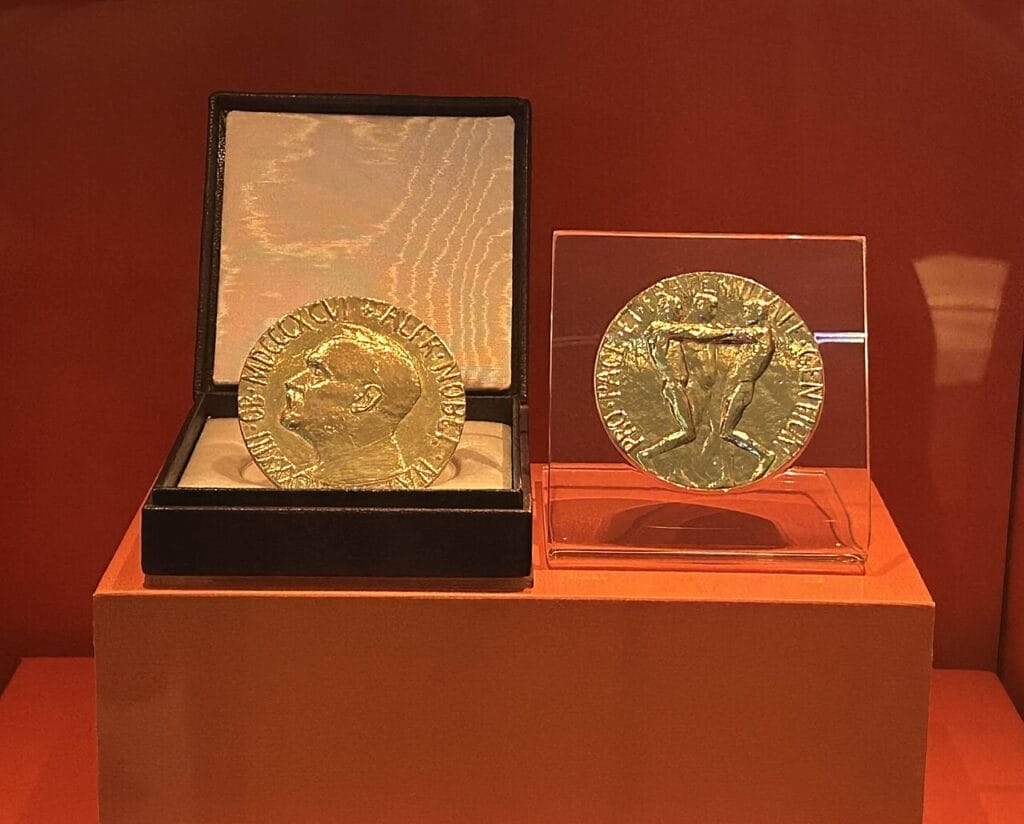
Years later, that reflection returned to me as I watched public controversies develop surrounding the symbolic use and movement of Nobel medals. It prompted a deeper question: what rights does a person who has earned a Nobel Prize actually have over it?
Ethically, one expects a laureate to treat the prize with the seriousness it carries. Legally, however, the medal is also a physical object—like a ring or any other personal property—and in practice it can be sold or auctioned, even if the honor itself cannot be transferred.
A well-known example comes from science. In 2014, the molecular biologist James D. Watson, who shared the 1962 Nobel Prize in Physiology or Medicine for the discovery of DNA’s double-helix structure, put his Nobel medal up for auction at Christie’s in New York. Watson said he wanted to raise funds for scientific research and other causes after facing professional isolation following controversial remarks. The medal ultimately sold for a sum measured in the millions. The buyer was Alisher Usmanov, an Uzbek-born Russian businessman and billionaire. Usmanov explained that he felt “a situation in which an outstanding scientist has to sell a medal recognizing his achievements is unacceptable,” and he subsequently returned the medal to Watson.1
One might ask why such a sale was carried out so publicly at all. Watson could, in principle, have transferred the medal privately, yet the auction itself became part of the story. In such cases, the movement of the medal is not merely a transaction but a kind of public performance, one that can amplify both value and meaning. Usmanov’s decision to return the medal likewise carried symbolic weight, transforming the episode into something more than commerce. It invites the question of whether similar gestures—whether donation, display, or return—shape public perception not of the metal itself, but of the honor it represents.
The permanence of Nobel recognition raises another dimension beyond physical ownership. History offers examples in which the honor itself becomes ethically complicated, yet remains institutionally intact. Julius Wagner-Jauregg, who received the 1927 Nobel Prize in Physiology or Medicine, treated neurosyphilis by deliberately infecting patients with malaria, using induced fever as therapy. The work later became controversial—not as falsification, but as a focal point for debate about medical risk, ethics, and his later association with eugenic views.2 Yet his Nobel Prize was never withdrawn. In such cases, the medal remains with the laureate, and so does the title, even as the moral meaning of the achievement shifts over time.
So, if someone presents or even gives away the medal in a political or symbolic moment, the deeper issue is not whether it is physically possible—it often is—but what it means ethically, and whether it confuses the public into thinking the prize itself (the status of being a Nobel laureate) can be transferred. It cannot.
Part of the reason such acts provoke unease is that certain objects carry meanings far beyond their material form. A national flag, for example, may be used casually in one country and treated with strict reverence in another. What is legally permissible is not always free of moral or cultural consequence. The Nobel medal occupies a similar space: privately held, yet publicly charged.
In a deeper sense, this is not unlike how an ordinary stone can become an idol—not because the stone itself changes, but because the human mind invests it with significance. The object becomes a vessel for belief. A Nobel medal, too, acquires an aura that exceeds its gold. It comes to represent genius, legitimacy, and achievement in the public imagination.
Over the years, I have occasionally misplaced honorary pins and requested replacements, and the organizations rarely mind. Yet replacements are issued only to the honoree, not to someone else—even a family member acting in good faith. These objects may be small, yet they carry a significance beyond their size. The objects may be reproduced; the honor they signify cannot be transferred.
One might imagine the same principle, in exaggerated form, with a Nobel medal. To its holder, the medal may feel like a treasured possession, much like a rare stamp valued for its singular ownership. Yet the medal’s meaning does not reside in possession but in the achievement it signifies. Detached from that meaning, the object may be admired or exchanged, but its honor remains inseparable from its origin. Removed from its rightful story, even such an extraordinary object could be misread or invested with misplaced significance. The confusion arises because possession can appear, to the public mind, as though it carries honor with it.
Yet the Nobel Prize does not work that way. The medal may move. The achievement does not. Metal may change hands. Meaning does not.
History quietly reinforces this distinction. In several instances, laureates who declined—or were compelled to decline—under political pressure did not lose the recognition itself. Governments could obstruct ceremonies, withhold medals, or impose consequences, but they could not nullify the judgment underlying the award. The honor, once conferred, remained part of the historical and intellectual record even when its physical symbols were never received. In this sense, the Nobel distinction exists independently of possession. Artifacts may be delayed, denied, or later restored; the achievement they signify does not depend on custody. The medal may have an owner; the achievement has only an author.
References
- Kolata, G. 2014. “After $4.75 Million Auction, Watson Will Get Nobel Medal Back.” NPR, December 9, 2014. Accessed February 20, 2026. https://www.npr.org/sections/thetwo-way/2014/12/09/369690594/after-4-75-million-auction-watson-will-get-nobel-medal-back
- Tsay, C.J. 2013. “Julius Wagner-Jauregg and the Legacy of Malarial Therapy for the Treatment of General Paresis of the Insane.” Yale Journal of Biology and Medicine 86: 245–254. PubMed Central.
RAO M. UPPU is Professor of Environmental Toxicology and Chemistry at Southern University and A&M College in Baton Rouge, Louisiana. His work spans environmental chemistry, molecular toxicology, and the ethical dimensions of scientific practice and public trust.
3 responses
Lucid writing and well articulated thoughts and explanations. Nobel prize is a desm of many researchers and in most cases it goes to the well deserved cases though it can’t be said about categories like peace, books, and even economics. Here politics do play a role and I wish Dr Rao mention about it in the article. Of course as rightly stated every medal has an owner but the achievement has only an author.
Dear Dr Mallikarjun Rao Uppu,
Heartiest Congratulations on your excellent writeup on the significance of the Nobel prize : physical possession and beyond.
I am very proud of your professional achievements and accolades and consider myself to be privileged to be a colleague during your formative years at the National Institute of Nutrition, Hyderabad,India.
Hats off to your patience and perseverance. I wish you recive all the accolades and honours which you richly deserve.
Raghunath Manchala
Appreciate the author’s narration of the dream of the Nobel man, Prize and pioneering the work