Annabelle Slingerland
Leiden, Netherlands
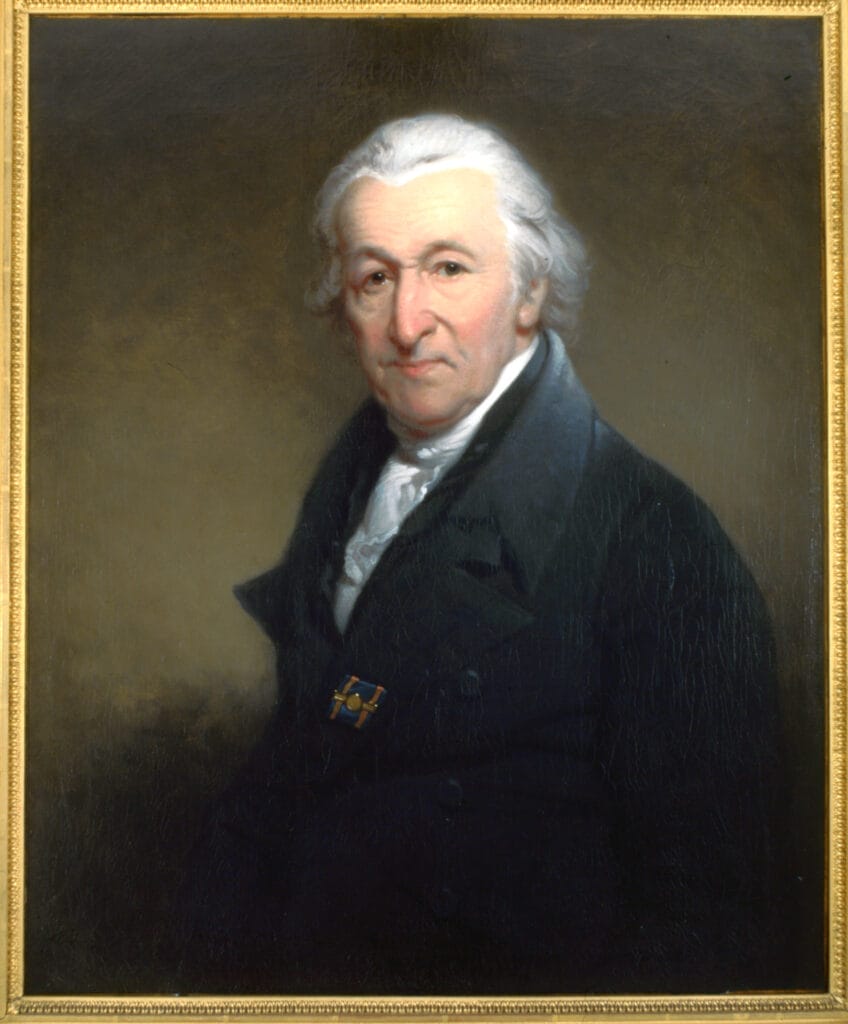
Martinus van Marum, who was born in 1750 during the era of the Republic of the Seven United Netherlands, went on to enjoy a remarkable career in science. His father, Petrus van Marum, was a graduate engineer from Groningen who had started a pottery-factory in Delft, married Cornelia van Oudheusden, and had Martinus baptized in the New Church.
Little would the couple know that their son Martinus would have a brilliant career. He left the Latin School cum laude, and after Petrus sold his factory, returned to Groningen with them, graduated in medicine and philosophy, and defended his thesis on plant physiology in the presence of stadholder Prince Willem V in 1773.
Martinus was greatly influenced by Petrus Camper, professor of botany. As the odds of ever succeeding him looked slim, he decided to work as a physician in Haarlem, a city known for its many intellectuals. He turned his attention to physics, especially electrostatics, and in 1781 happily married Joanne Bosch, daughter of one of his patients who ownedthe press of the Holland Society of Science, and allowed for Martinus and Joanne’s extensive international scientific summer travels and published diaries thereof.
At this time, the political situation had changed. Napoleon occupied the coastline of the Netherlands, incorporated the Dutch army into the French, and blocked trade with Britain. In 1810 he made his younger brother, Louis Bonaparte, king of Holland, which accordingly became part of the French Empire. Its citizens had to pay taxes, and all universities other than Leyden and Groningen were closed. But Martinus van Marum not only survived but had a continued career until 1837 when he died in his late eighties.
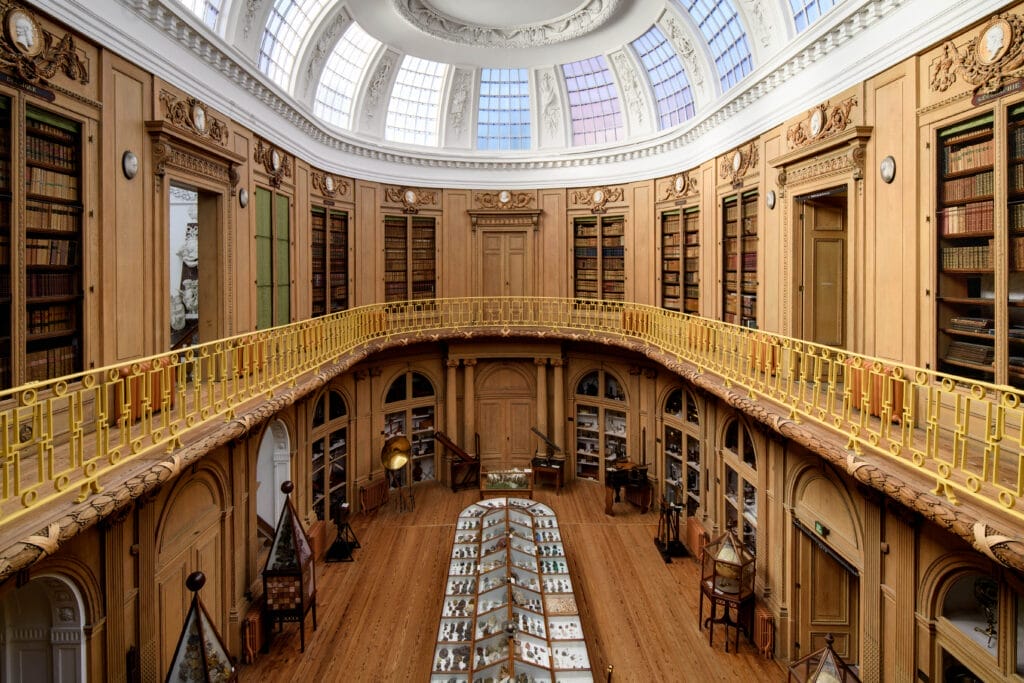
As Haarlem’s city lector in philosophy and mathematics, correspondent tothe French academic society, and concierge at the collections and library of Pieter Teyler van der Hulst, Martinus saw possibilities for making a variety of innovations. He joined the board of trustees for the collections of Teyler, who descended from an English Mennonite family. He convinced and bypassed some of the other members of the board and turned Teyler’s house and adjacent building into a museum of which he was the first director (1784). Joanne’s father would lead one of Teylers’ cabinets.
Tyler had been a salesman in textile, and, touched by the Enlightenment, strongly believed that the rights to pursue freedom and happiness would eventually create a better world. He envisioned art, science, and theology as its ingredients and had built an extensive collection. Upon his death, his will indicated that his five friends aided those living in poverty and founded two organizations dedicated to religion, art, and science (1779).
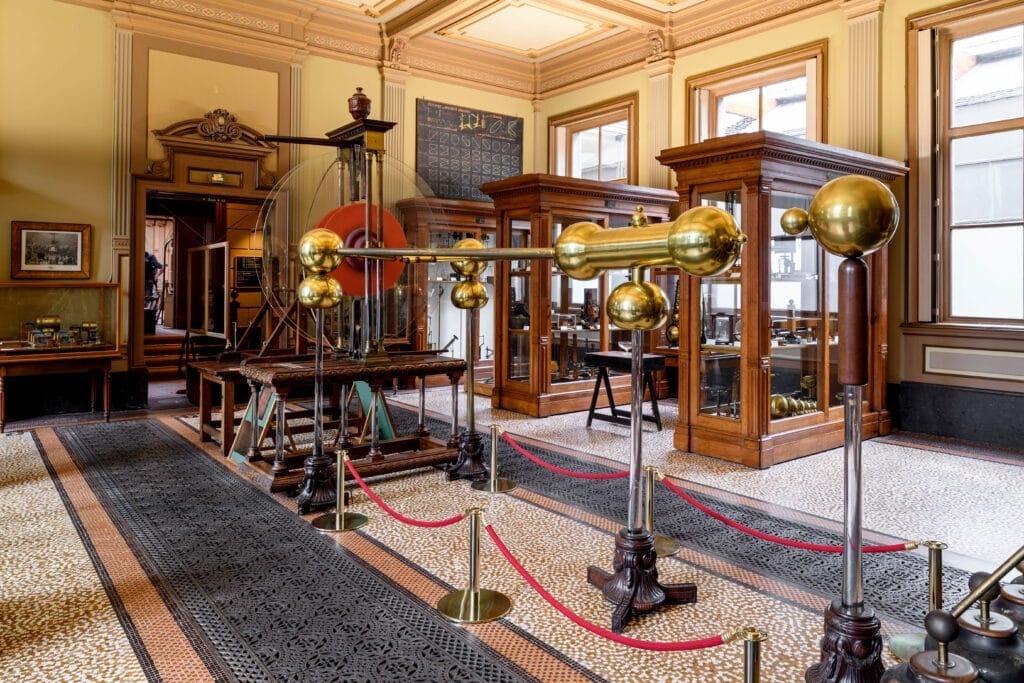
Sidelining other members, Martinus experimented in a specially designed room with “the large electrostatic generator” (1785) built under his supervision and was able to test electricity on plants, animals, humans, and theories. He, himself, others and a ten year old got exposed to demystify that electricity would increase blood flow. He concluded—if at all—it would be the fear of electricity that lead to a higher pulse rather than electricity itself. He also started to embrace the theory of Benjamin Franklin that there was but one electrified fluid, not two. He was far ahead of his time and was the first to observe and publish electromagnetism, colors in electric sparks while hydrogen was around, explosions, the ordering of metals, the formation of nitric dioxide, ozone, and the exceptions to Boyle’s Law on gases such as the properties of ammonium when liquefied.
Initially interested in the qualitative phlogiston thesis of the German physician Georg Ernst Stahl, he agreed that in each substance there is an intangible “burnt” substance, “phlogiston,” that would leave after combustion or fermentation. Yet, when calx (oxidized metal) weighed more than the original, and, having met with the quantitative hypothesis of Antoine-Laurent Lavoisier in Paris, he pursued experiments where the interaction with oxygen explained combustion and respiration. Mass stays, and is neither created, nor destroyed. With his befriended scientist Gerhard Kuyper, writing on the findings of their experiments, he also, years before Lavoisier, published “Sketch on the Theory” in 1787.

By 1798, his interest had shifted to paleontology, fossils, minerology, and René Just Haüy’s system of crystallography. He founded the Paleonthological-Minerological Cabinet, he purchased the famous “mosasaur-” (a fossil of an extinct marine lizard), the “zondvloedmens-” (a fossil taken for a human from the Biblical Flood), and in, extensive correspondence with Haüy, pear wooden models of crystals.
When Adriaan van Zeeburgh at Teylers indicated that Teylers’ charity needed support too, van Marums moved his focus to the Royal Botanical Garden of Napoleon, buying it in 1803, and studied exotic plants and seeds in the laboratory as well as exhibited interesting drawings and published catalogues.
He established one scientific connection after the other and became an active member of 37 (inter)national associations. He organized and attended meetings in scholarly circles such as the Parisian Académie des Sciences, the Society of Dutch Scientists in Chemistry (1790), the Holland Society for Science (1794), the Royal Society of London (1798), the Dutch and National Association for Scientists (1804), and Liberate et Concordia (c. 1813). Further facilitating the experiments of Volta, Priestly, and Pfaff, the wealth of his private and professional letters magnetized many, including Goethe and Cavendish.
In 1808, Louis Bonaparte asked van Marum, poet Hieronymus de Bosch, pastor and historian Martinus Stuart, and mathematician-physicist Jean Henri van Swinden to found a Parisian Académie des Sciences analogue, today’s Royal Academy of Science (KNAW). Visiting Teylers in 1811, Napoleon instructed a more societal and social orientation.
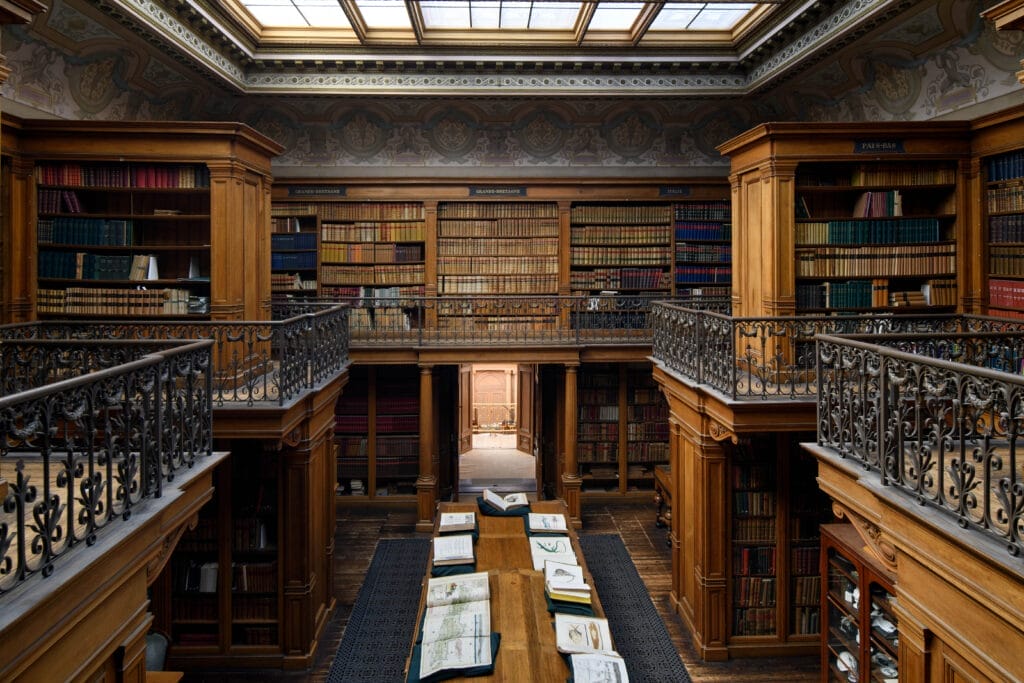
To van Marum, collections had entertaining educational value. Popularizing scientific findings via public demonstrations, publications, and lectures (1777–1803), he drew audiences to Teylers, got new theories embraced, increased public knowledge and interest in taxidermy, Linnaeus’s Hortus Cliffortianus, “tulip mania,” and—absolute crowd favorite—“the Largest Electrostatic Generator.” “Gentleman-evenings” exposed the library collection: Greek and Latin authors, richly illustrated travelogues, and the (unheard of, almost complete) Dutch Society of Science and Royal Society of London publications.
To improve population health, he recommended air systems for warships, air purifiers for buildings, portable fire extinguishers, lightning rods, breathing apparatuses for drowning, dampening baths for cholera, and the improved pressure cooker to serve the poor, to name but a few. He helped design laws for higher education (1815) and advised on dikes for rising water in large rivers (1821).
In 1821, Joanne died, and an unmarried relationship with his housekeeper Josina Keer led to a bastard son eight years later. In 1909, the later Noble Laureate, Professor Hendrik Antoon Lorentz, became the director of the Physics Laboratory at Teylers, going on to mentor Albert Einstein. The “Lorentz-Einstein” theory, or today’s theory of relativity, and their international peace and human rights activism, planted their seeds. Teyler’s aspirations still resonate in full circle.
Since 1987, the KNCV awards the “Van Marumpenning” to those who have brought chemistry into the societal spotlight. In 2018, the National Heritage in Chemistry designated Teylers as a chemical landmark.
As Weichmann would state, van Marum “electrified.” Many of his discoveries have been directly or indirectly incorporated into the knowledge of contemporary society. He is hardly known for seeing patients, but saved many before getting ill. The Teylers Foundation, Museum, and its Societies survived and thrive. In 2025, as the oldest Dutch museum, it was the most visited.
Acknowledgements
Saskia van Manen, Koninklijke Hollandsche Maatschappij der Wetenschappen (KHMW).
Luuk Eilers, Montesqueu Institute, for the extended version of the biography of Martinus van Marum, and apt correspondence.
Heleen van Halsema and team, as well as the directors, supervisory board, and back office of the Teylers Museum, Haarlem, for their openness, cooperation, and lending of illustrations. https://teylersmuseum.nl/en/organization
Further reading
- Chisholm, Hugh. “Marum, Martin van.” Encyclopaedia Britannica 11 (1911). Cambridge University Press.
- Dibner, B. “The Great van Marum Electrical Machine.” The Natural Philosopher 2(1963): 67-103.
- Hackmann, W.D. “The design of the turboelectric generators of Martinus van Marum, F.R.S. A Case History of the Interaction between England and Holland in the Field of Instrument Design in the Eighteenth Century.” Notes and Records of the Royal Society of London (1971).
- Hackmann, W.D. “The researches of Dr. Martinus van Marum (1750-1837) on the influence of electricity on animals and plants” Med. Hist. 16, no. 1 (1972): p11-26.
- Hooykaas R. “La Correspondence de Haüy et de van Marum.” Bulletin de la Société française de minéarologie et de cristallographie 72 (1949).
- Hosselet, L.M.L.F. “Martinus van Marum: A Dutch Scientist in a Revolutionary Time.” Eindhoven University of Technology Research Reports (1988).
- Neill, Patrick. Journal of a horticultural rout through some parts of Flanders, Holland, and the North of France (1817): 188. Teylers Museum.
- Pfaff. “Lettre à Mr. Volta concernant des expériences sur la colonne électrique faites par lui et le prof. Pfaff, dans le laboratoire de Teyler” 1801.
- Sadoun-Goupil, Michelle. “La Correspondance de Claude-Louis Berthollet et Martinus van Marum (1786-1805).” Revue d’histoire des sciences 25(1972), no. 25
(3): p. 221-252. - Stillings, D.“Martinus van Marum and the Great Electrical Machine of Haarlem.” Medical Instrumentation. 9, no. 4: p195-196.
- Strien-Chardonneau, Madeleine van. “La correspondance d’André Thouin (1747-1824) et de Martinus van Marum (1750-1837), 1796-1818.” Lias, Sources and documents relating to the early modern history of ideas 24, no. 1 (1997): 67-123.
- “Sur la cause de l’électricité des substances fondues et refroidies avec Adriaan Paets van Troostwyk.” Journal de physique, de chimie, d’histoire naturelle et des arts (1788).“Description des froittoirs électriques d’une nouvelle construction” (1791).
- Weiss, Martin P.M. Showcasing Science: A history of Teylers Museum in the Nineteenth Century. (History of Science and Scholarship in the Netherlands). Amsterdam University Press, 2019. After his thesis The Masses and the Muses. A history of the Teylers museum in the nineteenth century. University of Leiden, 2013. Also available as an ebook. Review: Nieuwland, Ilja. Isis, a University of Chicago Press Journal 115, no. 2 (2024). Review: Maas, Ad. Essay review: “Een eeuw op mijn kop. Tijdschrift voor Wetenschap- en Universiteitsgeschiedenis.” Revue d’Histoire des Science et des Universités 7, no. 4 (2014): p251-261.
- Willink, Tjeenk. Martinus van Marum Life and Work. Dutch Society of Sciences I-VI. (1969-1976). Editing R.J. Forbes. Koninklijke Hollandsche Maatschappij der Wetenschappen (KHMW).
Literature in Dutch
- Digitaal Wetenschapshistorisch Centrum, (Digital Web Centre for the History of Science in the Low Countries). Nieuw Nederlandsch Biografisch Woordenboek, deel X, 587.
- Haan, Johns Abraham Biren de. De Geschiedenis van een Verdwenen Haarlemsch Museum van Natuurlijke Historie. Het Kabinet van Naturaliën van de Hollandsche Maatschappij der Wetenschappen, 1759-1866. (1941).
- Hooykaas, R. “van Marum en Haüy.” Chemisch Weekblad 46, no. 7 (1950):105-109.
- Laisier M. “Martinus van Marum. Schets der Leere” Facsimile, Koninklijke Nederlandse Chemische Vereniging, 1787. Chemisch Historische Groep. https://chg.kncv.nl/geschiedenis/biografieen/m/marum,-m.-van.
- Maas, Ad. Essay Review: “Een Eeuw op Zijn Kop.” Studium, Tijdschrift voor Wetenschaps- en Universiteitsgeschiedenis Revue d’Histoire des Sciences et de Université 7(4), 2014: 251-261.
- Sijmons, R.. “De kleine Van Marum Encyclopedia, oftewel verklarende woordenlijst.” Part of the equally named exhibition Teylers Museum, 1987-8.
- Snelders. H.A.M. “Martinus van Marum.” Kox. A.J. Van Stevin to Lorentz. Portretten van achttien Nederlandse Natuurwetenschappers. 10. Uitgeverij Bakker, 1990.
- Snelders, H.A.M.. “Van flogistontheorie naar Lavoisiers zuurstofleer.” De geschiedenis van de scheikunde in Nederland. 1 (IV) (1993): 62-77.
- Soest, C.H.J. van. “De werkzaamheden van Martinus van Marum als chemicus tussen 1781 en 1798.” Chemisch Weekblad 48, no. 31 (1952): 558-567.
- Stichting Vrienden van Teylers Museum. “Van Kastelein tot Directeur. Teylers Museum in the 20th Century” (1975-2000).
- Wayenburg, B. van. Vonken & Schokken, statische elektriciteit in Teylers Museum. Nieuw Amsterdam Uitgevers i.s.m. Teylers Museum, 2007.
- Wiechmann A., Palm J.C. Martinus van Marum (1759-1837), elektriserend geleerde in tijden van Verlichting en Revolutie. Joh. Enschede en Zonen, 1987.
- By Martinus van Marum: Extensive list, to be obtained upon request.
ANNABELLE SLINGERLAND, MD, DSc, MPH, MScHSR, received her medical degree from Amsterdam University and Amsterdam University Medical Center and her degrees in Public Health, Health Services Research, and Genetics from the Erasmus University in Rotterdam. She has authored numerous papers in high impact journals and in Hektoen International on diabetes, famous hospitals, and other aspects of medical history.