
Mannerism in art is characterized by the work of innovators who tried new approaches to their discipline—such as Pontormo, Rosso Fiorentino, Parmigianino, El Greco, Spranger and Goltzius. Physicians, by contrast, remained rooted in the ancient humoral theory of Hippocrates and Galen, continuing to understand health as a balance between the four bodily humors, making diagnoses by consulting astrological charts, and treating their patients by bloodletting, purging, and herbal remedies.
Yet this period also saw some challenges to classical medical authority, as some anatomists and physicians began to scrutinize the long-dominant Galenic system. By analogy with their colleagues in art, they could also be regarded as “medical mannerists.”
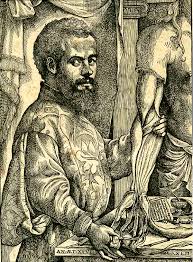
- Andreas Vesalius (1514–1564) challenged centuries of erroneous anatomical teaching with his De Humani Corporis Fabrica (1543) based on human dissections. This new empirical spirit was shared by his contemporaries Realdo Colombo and Gabriele Falloppio. After them, anatomy theaters became sites of scientific inquiry.
- Leonardo da Vinci (1452–1519), in addition to his famous paintings, advanced knowledge of anatomy. He made anatomical sketches based on dissecting 30 cadavers and researched the role of the spinal cord, the eye, and the olfactory nerve.
- Girolamo Fracastorio (1476–1553): physician, poet, and scholar in mathematics, geography, and astronomy. Early student of the transmission and epidemiology of syphilis.
- Ambroise Paré (1510–1590) was the French military surgeon who used silk thread ligatures instead of cautery to stop bleeding after amputation. He also successfully healed wounds by using a mixture of turpentine, egg yolk, and rose oil instead of cautery or burning oil.
- Paracelsus (1493–1541), the Swiss physician and alchemist who rejected the humoral theory in favor of chemical explanations for disease. He used mineral-based medicines and specific remedies for specific diseases. He also proposed that diseases arise from specific external agents and should be treated with targeted remedies rather than by general balancing of the humors.
- Theodor Zwinger (1533–1588): Swiss physician, wrote Theatrum Humanae Vitae (1565), a massive compendium of knowledge covering philosophy, mathematics, natural history, geography, medicine, and mythology, organized thematically into over fifty carefully structured and cross-referenced to make it readable and navigable, with maps and illustrations added to aid understanding.
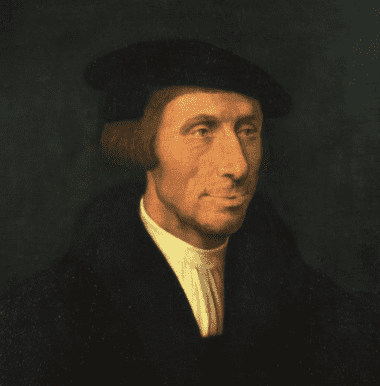
- Thomas Linacre (c. 1460–1524): personal physician to King Henry VIII of England. He was the founder and first president of the Royal College of Physicians of England. He became proficient in Latin and Greek, translated many of Galen’s medical treatises, and attracted a following of scholars that included John Colet, William Grocyn, and William Latimer.

The Mannerist period witnessed new medical challenges such as the devastating syphilis epidemic that emerged in Europe around 1495. Physicians debated its origins and tried various treatments such as mercury compounds. At the same time, other remedies were being introduced from the New World. Most physicians continued to practice Galenic medicine, but the seeds of modern scientific medicine were slowly beginning to be planted.