Óscar Lamas Filgueira
Valencia, Spain
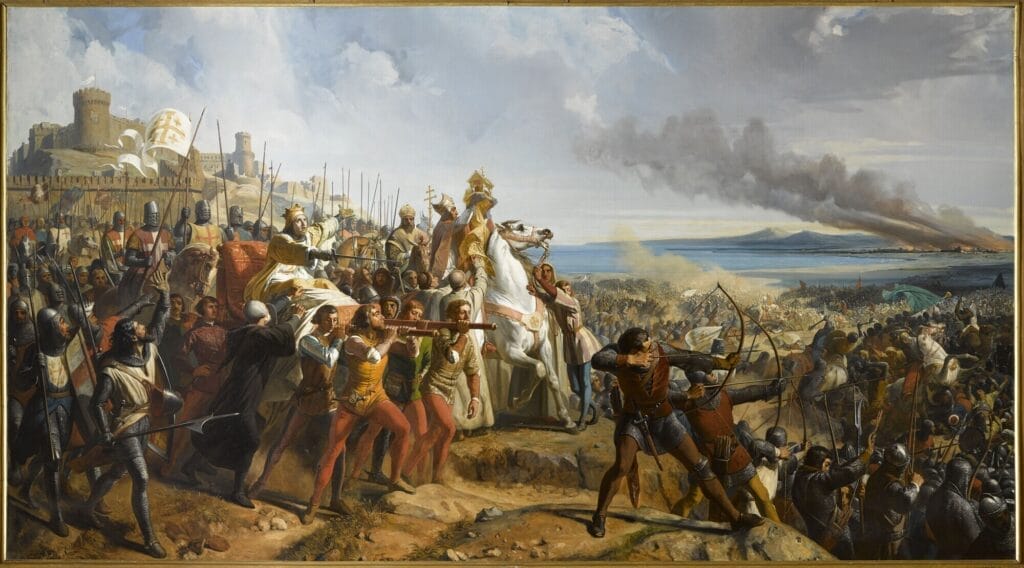
Baldwin IV (1161–1185), known as “the Leper King”, was king of Jerusalem during the late twelfth century. Despite developing leprosy in childhood, he ruled during a period of intense military and political instability and personally led his forces to a decisive victory against Saladin at the Battle of Montgisard in 1177. The following narrative is an imagined reflection from his perspective.
I do not remember the day my illness began. I remember instead the day I stopped feeling pain. We were playing at war, as children do, striking one another with sticks and laughing afterward. The others cried out when they were hurt; I did not. At first, I believed this was courage. Later, I understood it was absence.
It was William who noticed. He took my arms in his hands and examined them closely. His eyes darkened. I was still a child, but in his silence, I learned that something in me no longer belonged to the world of the healthy. From that moment on, I knew my body would not obey me as it did others.
When they told me the name of the disease, I did not understand its weight. Leprosy. A word spoken with fear, as though uttering it might draw one closer to the abyss. I soon learned its meaning: a body that unravels, flesh that falls asleep, wounds that do not hurt yet refuse to heal. I learned, too, that lepers neither touch nor are touched.
I was crowned king of Jerusalem at thirteen. At an age when others learn to wield a sword, I was learning how to sustain a body that was already beginning to betray me. My hand weakened, my fingers deformed, my face hardened. Each morning, I tested which parts of me had failed overnight. To rule was, at the same time, to patrol the frontier of my own flesh.
At court, many awaited my fall. Not for my mistakes, but for my illness. They knew I would have no children, that my body would not extend the line. They looked at me as one looks upon a man already dead. I knew it, too. But as long as I breathed, I remained king.
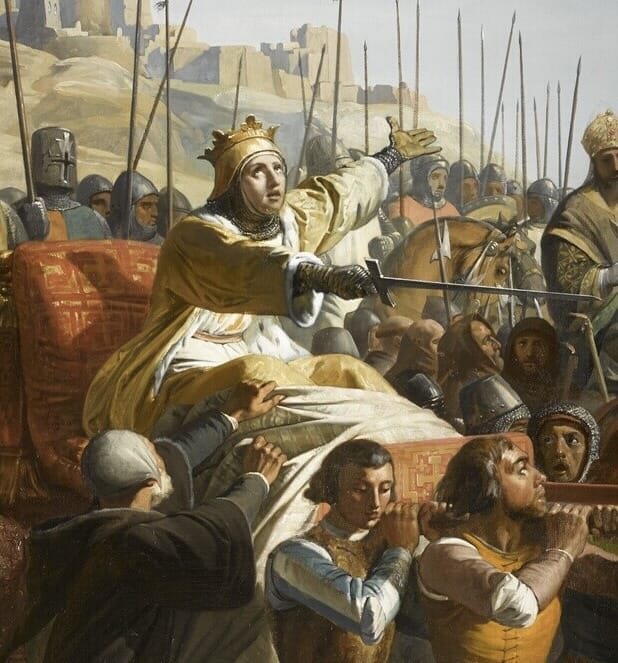
The leprosy advanced silently. Sensation left my feet, then my hands. Ulcers opened beneath my armor, blood soaking the fabric— I did not notice until later. Pain arrived late, but it arrived. At times I thought my body was another battlefield, one where victory was never assured.
When Saladin advanced toward Jerusalem, many believed I would remain behind. What could an ill king do against an overwhelming army? But I could not rule from the shadows. If my body was condemned, I would at least choose where and how I would expose it.
I was sixteen when I rode out to meet the enemy. My forces were few; my suffering great. We carried the True Cross and marched. At Montgisard, I saw fear in my men’s eyes. I felt it as well—not only the fear of death, but of watching everything I had upheld dissolve with me. I dismounted and knelt. The sand burned against my wounded face. I wept. Not from weakness, but because a body weary of resistance must sometimes yield for a moment. I wept for my diseased flesh, for my fragile kingdom, for a life that had always been struggle. Then I rose.
They helped me mount my horse. My deformed hands grasped the reins. The armor pressed against open sores. Every movement reminded me of what I was losing. And yet, I advanced. I could not offer my men a strong body, but I could offer an unbroken will. We charged and we prevailed.
I never fully understood that victory. Perhaps it was faith, perhaps the enemy’s error, perhaps desperation. I only know that, for a moment, illness did not dictate the ending. My body—marked and broken—stood at the front.
I was not king despite my illness. I was king within it.
ÓSCAR LAMAS FILGUEIRA is a 6th year medical student at Universidad Católica de Valencia, Spain. His writing explores the dialogue between art, history, and medicine, with a particular interest in narrative medicine.