
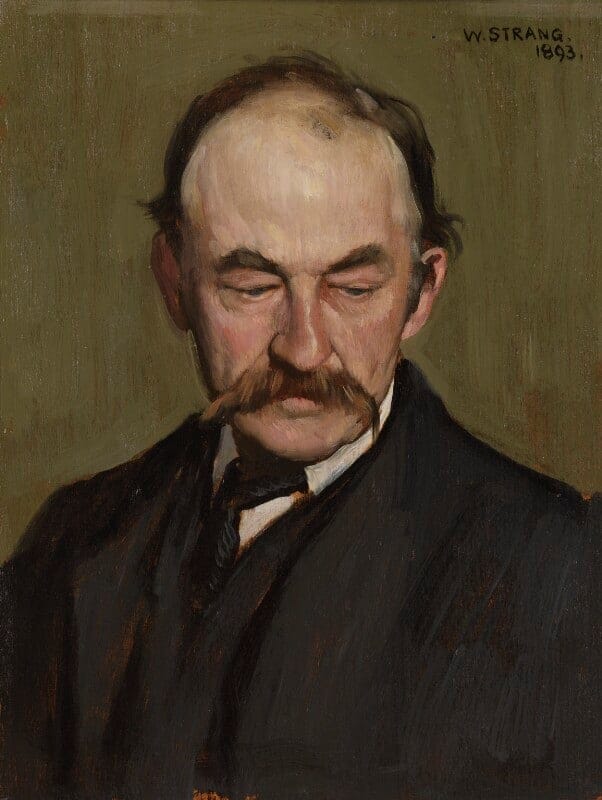
In his widely read novels, Thomas Hardy describes life in late nineteenth-century England, when truly effective medical remedies were exceedingly few and doctors were greatly limited in what they could achieve. Conditions were worse in rural areas, where poverty was an additional factor in determining the outcome of illnesses. Although doctors in Hardy’s novels typically have minor roles, they highlight various facets of rural medicine and contrast it with medical practice in the city.
In Jude the Obscure, the physician Vilbert regards himself as a public benefactor but is an itinerant quack-doctor, well known to the rustic population, and “absolutely unknown to anybody else, as he, indeed, took care to be, to avoid inconvenient investigations.” Cottagers were his only patients, and he was more obscure than the city quacks with capital and an organized system of advertising. He traversed enormous distances on foot. Exemplifying his practice was his selling a pot of colored lard to an old woman as a certain cure for a bad leg, “the woman arranging to pay a guinea, in instalments of a shilling a fortnight, for the precious salve, which, according to the physician, could only be obtained from a particular animal which grazed on Mount Sinai and was to be captured only at great risk to life and limb.”
In The Woodlanders we read about Dr. Edred Fitzpiers, a well-educated physician who settles in a rural village and marries the refined daughter of a timber merchant. However, he cannot resist the allure of other women, most notably a wealthy widow, with whom he conducts an unfortunate affair. His knowledge is theoretical and cosmopolitan but shallow and pretentious, lacking the authenticity found in some of the rural characters.
In The Return of the Native, Mrs. Yeobright walks across the heath, collapses from exhaustion, and is bitten by an adder. Discovered by the locals, she is carried to a nearby home and dies despite the efforts of a “medical practitioner practicing surgery,” who is the only one in the district. He thinks it is exhaustion that killed her, but he did try to save her using adder’s fat, an old infallible remedy used by viper-catchers—though he wonders if some other ointment might be just as good.
Michael Henchard in The Mayor of Casterbridge, wishes to hire the town’s “richest, busiest doctor” to care for his wife Susan when she falls ill. This unnamed physician is a different person than the Dr. Chalkfield who serves briefly as mayor and whose death is announced without comment in chapter thirty-four.
The most significant medical event In Far from the Madding Crowd is the death of Fanny, abandoned by Troy and dying in a workhouse from complications of childbirth, one of the several illustrations of inadequate care for the poor.
In Tess of the d’Urbervilles, Tess’s father has a fatal heart condition, and John Durbeyfield’s frequent drunkenness is a burden for the family. Tess’s unbaptized baby dies shortly after birth from lack of medical care, and Tess’s suffering and emotional trauma underscore how women were offered little relief or understanding.
Most of Hardy’s country doctors, though often shown as figures of authority, straddle the divide between the educated classes and the common folk. They are bound by the same limitations as their patients, living in a world where older patterns of illness and suffering still held greater sway than the advances of modern science.