
Stephen McWilliams
Dublin, Ireland
In Michael Crichton’s novel The Terminal Man (1972), Harry Benson undergoes brain surgery at the hands of Dr. Roger McPherson, head of the prestigious Neuropsychiatric Research Unit, Los Angeles.1 By implanting electrodes deep in Benson’s brain, McPherson plans to cure him of the violent seizures that require him to be guarded by police, even to enter the hospital. But as Benson masters control over the electrodes himself and subsequently escapes, it becomes evident that meddling with nature can sometimes bring about unforeseen consequences.
Crichton is probably best known for his novel Jurassic Park (1990), subsequently adapted by Steven Spielberg into the 1993 blockbuster film of the same name.2 But Crichton—a graduate of Harvard Medical School and creator (with Spielberg) of the enormously successful television series ER—more often than not wrote about medicine, usually with a keen eye on not-quite-invented-yet-but-almost technology and the sage advice that we be careful what we wish for. In The Terminal Man, he cautioned specifically against maverick brain surgery, but he was by no means the first to do this.
The obvious example is Mary Shelley’s Gothic novel Frankenstein (1818).3 Here, the eponymous hero (the scientist, not his monster) sets off for the University of Ingolstadt to study natural philosophy with a particular interest in chemistry, subsequently drops out of his education, and embarks instead on an extra-curricular laboratory experiment to create life in a corpse synthesized from miscellaneous body parts. His creation comes to life, but flees, and Frankenstein descends into madness. As with Crichton’s modern cautionary tales, Victor Frankenstein only considers the moral implications of his endeavors after they are complete; by then, he is too exhausted to atone for them.
In the 1931 film version starring Colin Clive and Boris Karloff, we see Frankenstein (whose Christian name is changed to Henry) build the monster from dead body parts and then transplant a brain into it. Unlike in the book, the cinematic plot relies on Frankenstein making the further moral transgression of using a criminal’s brain, which he has stolen from his university lecturer. Ultimately, Frankenstein’s desire to play God and create life is his undoing, and in this the theme of botched brain surgery plays an important role.
Several episodes of the television series House, M.D. (2004–2012) starring Hugh Laurie feature brain surgery as core parts of the plot. Typically, some vivid neurological symptom will present in a patient, and the brilliant but irascible Head of Diagnostic Medicine will use it to deduce an elusive illness, all while he leans on his cane popping Vicodin pills. As the drama ratchets upwards, the patient might easily find themself on the operating table as holes are drilled in their skull.
But goriest of all is the brain surgery performed by Dr Hannibal Lecter. The film Hannibal (2001), based on Thomas Harris’ 1999 book of the same name, sees the carnivorous psychiatrist (Anthony Hopkins) perform a craniotomy on a wakeful albeit sedated FBI agent, and then remove small pieces of his frontal cortex to sauté in front of him at the dinner table.4 The grotesque scene remains one of the most infamous depictions of brain surgery in mainstream cinema as Lecter calmly, politely, and literally consumes the essence of what makes his “guest” human. Unlike Frankenstein who seeks to create life, Hannibal blatantly desecrates it.
In a quote commonly attributed to Sean Connery, the Bond thespian remarked, “I’m an actor—it’s not brain surgery; if I do my job right, people won’t ask for their money back.”5 It is the typical comment anyone will make when downplaying the complexity of what they do: just compare it to brain surgery. Or else choose rocket science, which seems to be the only comparably esoteric professional undertaking. The point is that certain activities like brain surgery are only practiced by an elite group of very clever people, which makes it all the more surprising to learn how old brain surgery actually is.
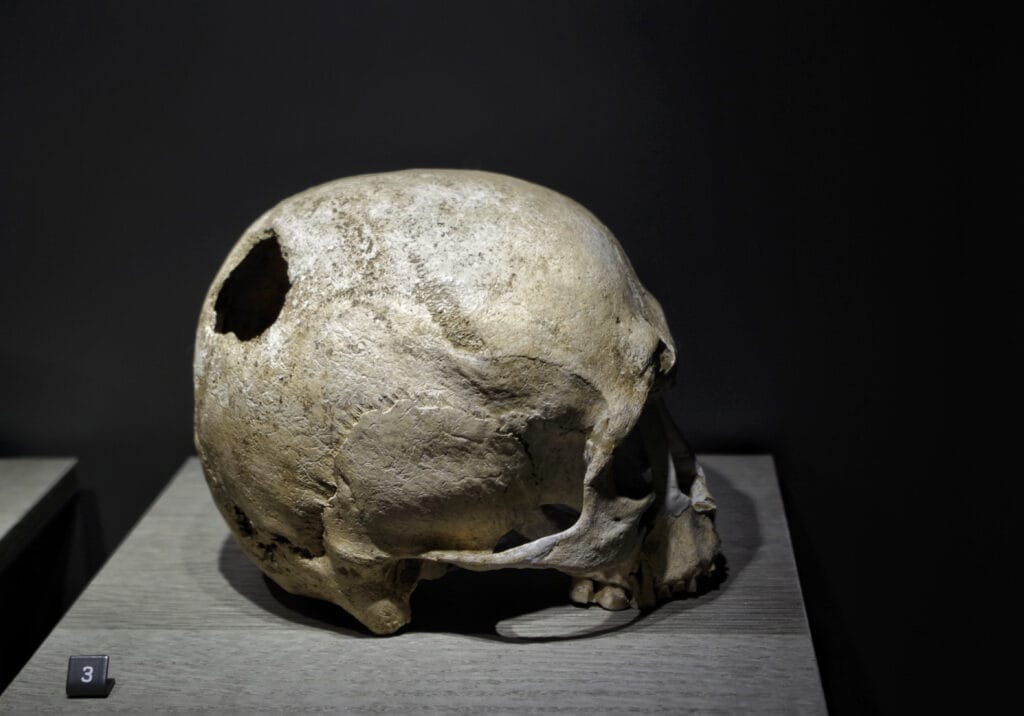
No one really knows exactly when humans began performing brain surgery, but there is evidence that it dates back to the Stone Age. The invasive practice of “trepanation” (or “trepanning”) was on the surgical menu as far back as 5,000 BC, according to archaeological studies of Neolithic skeletons.6 Essentially, an implement of some description would have been employed to make a hole in the skull for ritual, religious, or therapeutic reasons.7 Primitive drills would have comprised of sharpened stone or the teeth of large cats, sharks, or other predators, and the resultant holes would have been rather clumsy, with uneven, jagged edges.
No single region of the world can claim ownership of trepanation. Everyone, it seems, was at it.8 The ancient Egyptians were rather partial. Hippocrates and Galen described it in ancient Greece and Rome respectively. The Dutch artist Hieronymus Bosch, among others, depicted it in his now 500-year-old paintings of medieval Europe. Chinese records dating back to the third century reveal that the surgeon Hua Tuo offered the procedure to the Han warlord Cao Cao to cure his headaches.9 Unsurprisingly, Cao Cao is said to have declined; it was literally something he needed like a hole in the head. In Peru—long before the days of social media—the Incas would typically carve a hashtag, allowing a square of bone to be removed using a blade made of copper or flint.7 In Mexico, the Aztecs used a sharpened version of the glassy volcanic rock obsidian to make a hole in the skull. And, by the seventeenth century, the practice had spread as far afield as the Pacific islands of Polynesia.
Naturally, trepanation was a painful procedure that carried a lot of clinical risk. Often, things did not end well for the patient. Many died of blood loss or infection, although bone regrowth in archaeological skulls suggests that at least some patients survived the ordeal.8 Indeed, some patients had the procedure repeatedly; for example, it is said that the French surgeon Jean-Jacques Bouestard performed the procedure on a single patient over fifty times during a two-month period in the middle of the eighteenth century.7 There was no general anaesthetic in those days, so the unfortunate individual might instead have been intoxicated with alcohol, or herbal or fungal sedatives along with natural painkillers. Then, the skin would have been cut and then folded back to reveal the underlying tissues (all of which would be restored to their original position immediately after the surgery). The hole in the skull would reveal the meninges that cover the brain, and, finally, the brain itself underneath.
As time moved on, the instruments gradually became more complex. In medieval Europe, a mechanical trepans was used, typically a metal- or stone-tipped stick wrapped in the string of a bow that could be pulled back and forth, causing the stick to rotate and thus drill into the skull. By the late 1570s, this instrument had become a little more refined, with metal gears that yielded a neater birr hole. Eventually, special frames were attached to steady the procedure. The seventeenth century saw the development of clockwork-spring and hand-cranked devices so that the floating disc of bone could simply be lifted out and likely put back again afterwards. Sometimes the removed piece of bone was even worn as a lucky charm.
So, what was the purpose of trepanation? Generally, it was used for medical conditions where the external cause was not obvious, such as to treat headaches, epileptic seizures, encephalitis, brain tumors, or hematomas.7,8 It was employed on the battlefield to manage head injuries that involved, for example, depression fractures of the skull. In medieval Europe, trepanation was used (misguidedly) to treat psychiatric conditions such as psychosis, depression, and mania, while it was also thought that the provision of a hole in the skull was helpful for the release of demons during exorcism. In regions of South America, it was even believed that the procedure could bring someone back to life.
In hindsight, the whole procedure of trepanation was almost entirely quackery that caused far more problems than it ever solved. By the eighteenth century, it began to lose popularity in Western medicine as a range of more scientific medicinal treatments emerged for most of the illnesses trepanation was purported to relieve. Modern neurosurgeons drill into the skull when needed, but technology allows a much more subtle approach with indications—the removal of tumors or hematomas, for example—being much more specific. The old trepanation techniques are now thankfully consigned to the annals of history.
It is unsurprising, though, that brain surgery has inspired writers and film directors to this day. The brain is not just any organ in the body, but is the seat of the personality, memory, consciousness, and conscience. Its inherent mystery fascinates us all, but its fragility also makes us vulnerable; any attempt to meddle with it is fraught with danger. Those who do are given god-like status—exceptionally clever, perhaps emotionally distant, but certainly the bearers of significant moral responsibility.
References
- Crichton, M. The Terminal Man (1972, 1994). London: Arrow.
- Crichton, M. Jurassic Park (1990). London: Arrow.
- Shelley, M. Frankenstein or The Modern Prometheus (1818, 1831, 2007). London: Vintage.
- Harris, T. Hannibal (1999). London: Arrow.
- Sean Connery Quotes. BrainyQuote. https://www.brainyquote.com/quotes/sean_connery_594982.
- Charles, A (2017). Evolving Story: Trepanation and Self-trepanation to Enhance Brain Function. Arquivos de Neuro-Psiquiatria. 75(5):307-313.
- Parker, S. Medicine: The Definitive Illustrated History (2016). London: Dorling Kindersley. 16-17.
- Hobert L, Binello E (2017). Trepanation in Ancient China, World Neurosurgery. 101:451-456.
- Rapp Learn, J. Drilling Deep: How Ancient Chinese Surgeons Opened Skulls and Minds. Smithsonian Magazine (5 December 2016).
STEPHEN MCWILLIAMS is a consultant psychiatrist at Saint John of God University Hospital Dublin, associate professor at UCD School of Medicine, and honorary senior lecturer at RCSI University of Medicine and Health Sciences. His books include Fiction and Physicians: Medicine through the Eyes of Writers (Liffey Press, 2012) and Psychopath? Why We Are Charmed by the Anti-Hero (Mercier Press, 2020).