
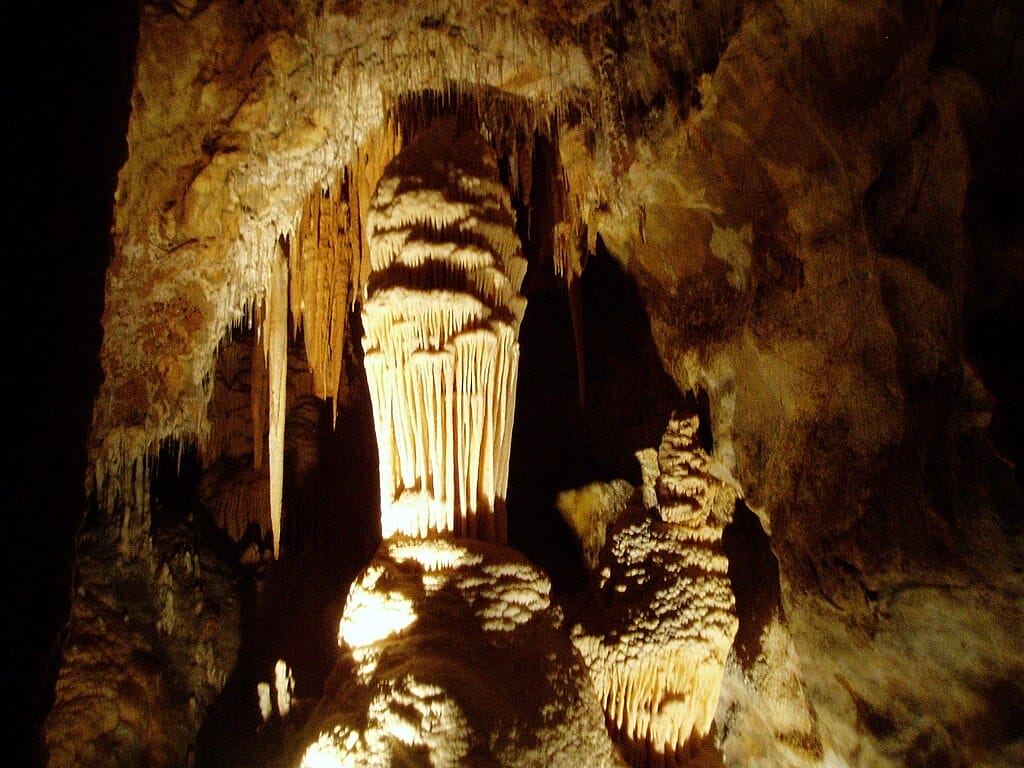

As freshmen at the university, we were advised to join a society or club in order to expand our horizons through what later became known as a liberal education. So, my classmate Pete convinced me to join the speleological society and suggested we should explore the Jenolan Caves, a major tourist attraction in New South Wales. Equipped with a tent, a ground sheet, and food to cook on an open fire, we hitchhiked our way to the caves. Pete explained these were constituted on three levels, and mentioned nonchalantly that about a month earlier, a couple explored the caves and were never seen again. Clearly, these were not real speleologists!
We walked from level one to two with no difficulty. We then crawled through an unpleasant, narrow squeeze hole to the bottom level. There, Pete gave me a miner’s lamp and left me to explore, explaining that if I were to get lost, I should move in increasing circles to reach the exit. But then my lamp went out. I found myself in utter darkness. I panicked and began to shout, but there was no reply. At last, Pete reappeared and nonchalantly announced that he had finished his exploration, and we could go back. We returned through the squeeze hole to sunlight. We cooked that night by a campfire, then tried to sleep, even though the wallabies nibbled at our tent all night. It was my first and last experience with speleology.
Yet speleology is the respectable scientific study of caves and subterranean environments. It encompasses geology, hydrology, biology, and archaeology to understand cave formation and its features and ecosystems, while also referring to the recreational activity of exploring caves, mapping them, studying stalactite formations, and documenting cave life. Medically, it has branched out into speleotherapy, the treatment of asthma, bronchitis, chronic obstructive lung disease (COPD), certain skin diseases, stress reduction, and anxiety. The concept originated in the nineteenth century, when physicians in Eastern Europe and the Balkans observed that miners in salt-caves suffered lower rates of respiratory ailments. In particular, the Polish physician Feliks Boczkowski famously noted that workers in the Wieliczka salt mines enjoyed unusual protection from chronic bronchitis and asthma. It led to the idea that salt caves, with their constant temperature, high humidity, and aerosolized mineral particles could soothe inflamed airways and improve mucociliary function. Some tuberculosis specialists considered caves as potential sanatoria, envisioning underground clinics where stable, cool air might aid patients just as alpine sanitariums did above ground. Later, the medical promise of caves extended beyond salt deposits to emphasize that caves offered remarkably stable climates with steady temperatures, low levels of allergens, and reduced pollution.
Caves have also been regarded as a promising source of new antibiotics, echoing the discovery of penicillin and streptomycin. In laboratory studies, cave-derived actinomycetes have shown antibacterial and anticancer activity. Caves have also been useful for studying sleep disturbances, hormonal shifts, altered psychological states, and the physiology of spaceflight, submarine missions, and other isolated environments. Cave studies have also advanced trauma medicine, as cave rescues require specialized knowledge of hypothermia, immersion injury, crush syndrome, and prolonged confinement stress. Thus, speleology has also become foundational for advancing the understanding of wilderness medicine, telemedicine, and emergency medicine.
Speleology also illuminates the limits of human physiology, as it is fundamentally adapted to sunlight, variable climates, and open spaces. Cave-associated diseases arising from lack of sunlight and poor ventilation can lead to histoplasmosis, leptospirosis, hantavirus infections, and rabies from bats. In particular, the inhalation of contaminated dust can cause severe pulmonary illness in immunocompromised individuals. Some aspiring explorers, however, remain safe: the Jenolan Caves are currently closed for major repairs. Planned reopening is not until the second half of 2026, and even that date has yet to be confirmed.