Mitchell Batavia
New York, New York, United States
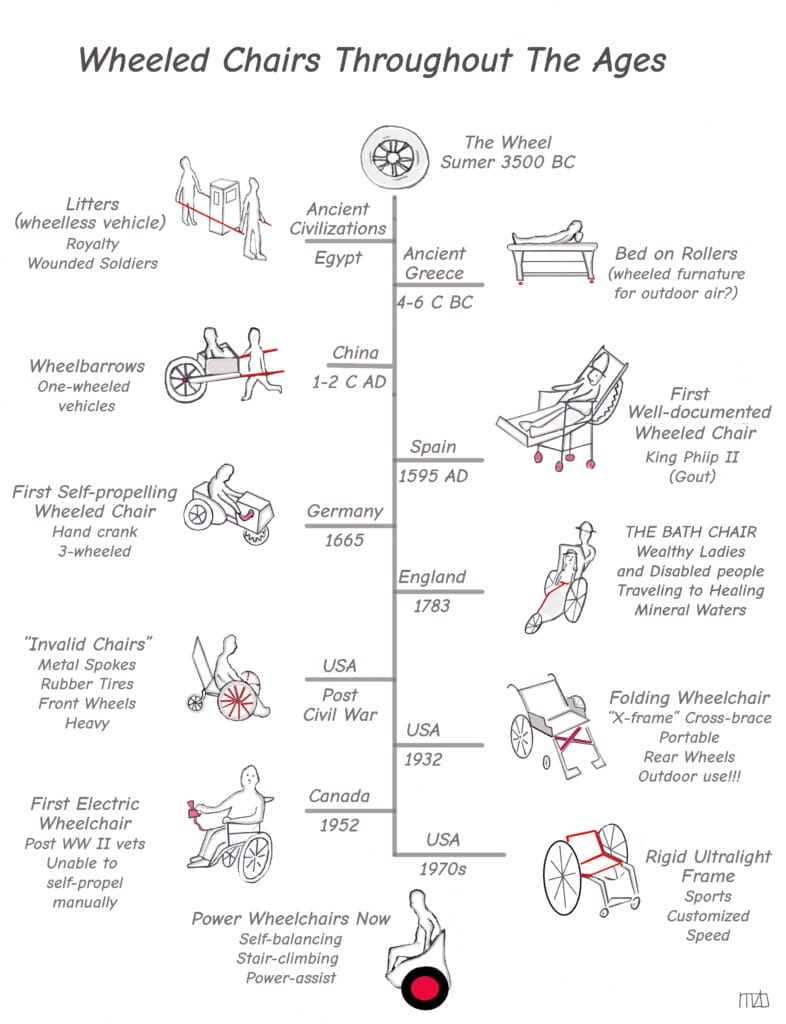
Wheeled chairs, which have enabled people with disabilities, injuries, and illnesses to engage more fully in society, have a long and somewhat imprecise history, spanning an evolution from wheelless vehicles such as litters to multi-wheeled mobile structures.1-3 Evidence of a beginning can be found on a fifth century BC Greek vase, which depicts a child lying in a bed with small rollers. Rolling furniture such as beds may have been used to help move the sick to fresh, outdoor air.2
Wheelbarrows were the next technology to evolve. First invented in China in the first to second century AD3 and later introduced to Europe in the twelfth century during the Crusades, these single-wheeled devices were used to transport not only supplies during wars but also wounded soldiers.1,4 Evidence of their use can be found in Lucas Cranach the Elder’s The Fountain of Youth (Germany, 1546),1,5 which includes a non-ambulatory person being transported in a wheelbarrow to the titular fountain.
However, the world’s earliest evidence of a chair with wheels may be found etched into an AD 525 Chinese sarcophagus2 that portrayed a man sitting on a three-wheeled chair, though there are few details documenting the chair or who the sitter was.
About 1,000 years later, King Philip II of Spain’s “Gout Chair” (1595) was the first well-documented wheeled chair. As detailed in illustrations, the fully furnished mobile vehicle was comprised of four small wheels, adjustable arm rests, elevating leg rests, and a reclining back. The chair was pushed by a servant.1,3
The first independently self-propelled wheeled chair, which did not require others to push, was invented by a young German watchmaker with lower limb paralysis in 1655. The vehicle looked a bit like a soap box derby car and employed gears (probably familiar to a watchmaker) and hand cranks.4
A watershed moment in wheeled mobility occurred in 1932, when Everest and Jennings (E&J) of the United States invented the first folding “X-frame” wheelchair: a steel, tubular, collapsible chair with large rear wheels that made traveling outdoors and portability in cars feasible.1,3,4 Earlier, post-Civil War “invalid chairs”, influenced by the carriage and bicycle industry, were considered heavy, bulky, and difficult to maneuver, sporting large, metal spoked wheels with rubber tires1 in the front that were best suited for in-home use. Perhaps society had more of an institutional mindset at the time.6 The E&J invention, in contrast, was lighter and allowed people with disabilities to get out of the house and into their communities and workplaces.1,6 In fact, Everest’s motivation for the invention was employment: “When I tried to earn a living, I found my greatest difficulty was the lack of a usable folding wheelchair.”6
The next big event in wheeled mobility occurred in 1952 when a Canadian engineer, seeing a need among veterans whose injuries would not permit manual propulsion, invented the first electric wheelchair that could be operated using a joystick, despite an individual’s poor upper limb function.6 Over the years, electric chairs, now referred to as motorized or power chairs, have dramatically evolved, using sensors and smart technology to overcome physical barriers, such as steps, and enabling those with even the most devastating motor impairments to independently navigate their environment.4
Since the twentieth century, the wheeled chair has exponentially advanced, spurred on by the development of antibiotics4,6 and survivors of war,3 motivated by adaptive sports (such as wheelchair basketball and racing),4,6 and liberated by technology4 (gyroscopes, sensors) and new lightweight materials 6 (titanium, carbon fiber). These vehicles have evolved to become lighter,6 faster, smarter, more personalized (e.g., in choice of colors),4 and more powerful.
The future of wheeled mobility in the twenty-first century and beyond looks bright with the introduction of artificial intelligence and computer vision, both of which can assist power wheelchair users in navigating complex environments, detecting and avoiding obstacles, and automating travel.7 Individuals with mobility challenges will be further enabled to realize participation and inclusion in our society4—and it all started with a wheel.8
Bibliography
- Kamenetz HL. A brief history of the wheelchair. J Hist Med Allied Sci. 1969;24(2):205-210. doi:10.1093/jhmas/xxiv.2.205.
- Slawson MC. Wheelchairs through the ages. The Surgeon’s Call 23, no. 1, 2018. National Museum of Civil War Medicine. July 9, 2019. https://www.civilwarmed.org/surgeons-call/wheelchairs/. Accessed December 9, 2025.
- Madeley-Carr S. Rolling over the history of wheelchairs. Essential Aids. October 16, 2020. https://www.essentialaids.com/blog/rolling-over-history-wheelchairs.html. Accessed December 9, 2025.
- The History of the wheelchair. Science Museum. July 17, 2024. https://www.sciencemuseum.org.uk/objects-and-stories/history-wheelchair. Accessed December 9, 2025.
- The Fountain of Youth (Cranach). Wikipedia. https://en.wikipedia.org/wiki/The_Fountain_of_Youth_%28Cranach%29. Accessed December 9, 2025.
- Woods B, Watson M. The social and technological history of wheelchairs. Int J Ther Rehabil. 2004;11(9). doi:10.12968/ijtr.2004.11.9.19587.
- Sahoo S, Choudhury S. AI advances in wheelchair navigation and control: a comprehensive review. J. Process Manag., New Technol. 2023, 11 (3-4):115-132.
- Babakir R. Invention of the wheel (c.3500 BCE). OurIraq. February 5, 2024. https://ouriraq.org/article/invention-wheel-c3500-bce. Accessed December 9, 2025.
MITCHELL BATAVIA PT, MA, PhD, is an associate professor at New York University with degrees in physical therapy, motor learning, research, and graphic design. He has penned five books, four short stories, and numerous editorial and educational cartoons. He is author of The Wheelchair Evaluation: A Clinician’s Guide (Jones & Bartlett). This essay is dedicated to the memory of disability activist Andrew I. Batavia.