
Christopher Duffin
London, England
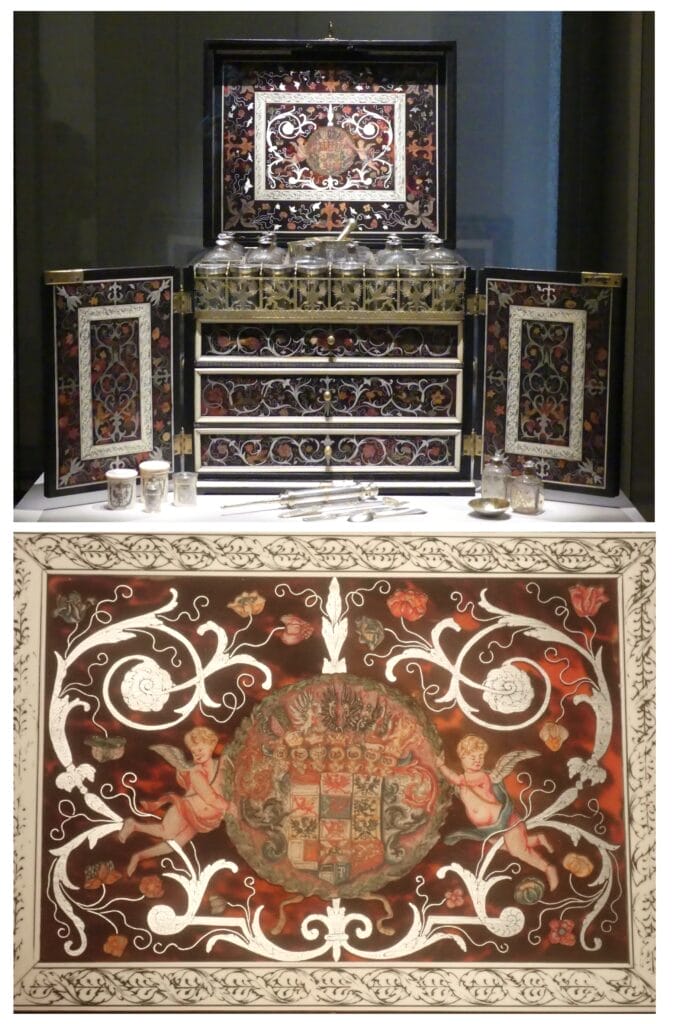
Small, portable apothecary cabinets were once popular for household, travel, and campaign purposes, but few have survived from the seventeenth and eighteenth centuries. Several are exhibited in German museums,1 including one spectacular example in the Bayerisches Nationalmuseum in Münich.
The cabinet represents a fusion of artistic media. The goldsmith was Joseph Herterich (c. 1642–1711), a productive and highly respected artisan in Augsburg, while Johann Daniel Sommer (born 1642) of Künzelsau was probably responsible for the carpentry.2
Constructed in 1692, the cabinet (Fig. 1) is in the form of a cuboid box (34.5 x 38.8 x 32.2 cm) with a hinged lid and two front doors. Brass handles provide a means of portability. Three drawers lined with green velvet and gold braid contain pharmacy instruments, and an upper, open compartment is stocked with larger utensils and a series of containers. The main body of the structure is crafted from ebony and walnut. The internal door and drawer panels as well as the outer casing are sumptuously decorated with elaborate, superb marquetry. The inlay has a tortoiseshell background and combines transparent horn, fine filaments of tin, and a variety of wood veneers depicting different flowers (such as tulips, carnations, and pansies) and animals (including dogs, hares, and birds) framed in a network of acanthus tendrils. Two Lions Rampant decorate the inside of the doors, and coiled snakes adorn the exterior. The perforated, lattice-like brass grill fronting the upper compartment is composed of alternating images of the Brandenburg Eagle and the Pomeranian Griffin.
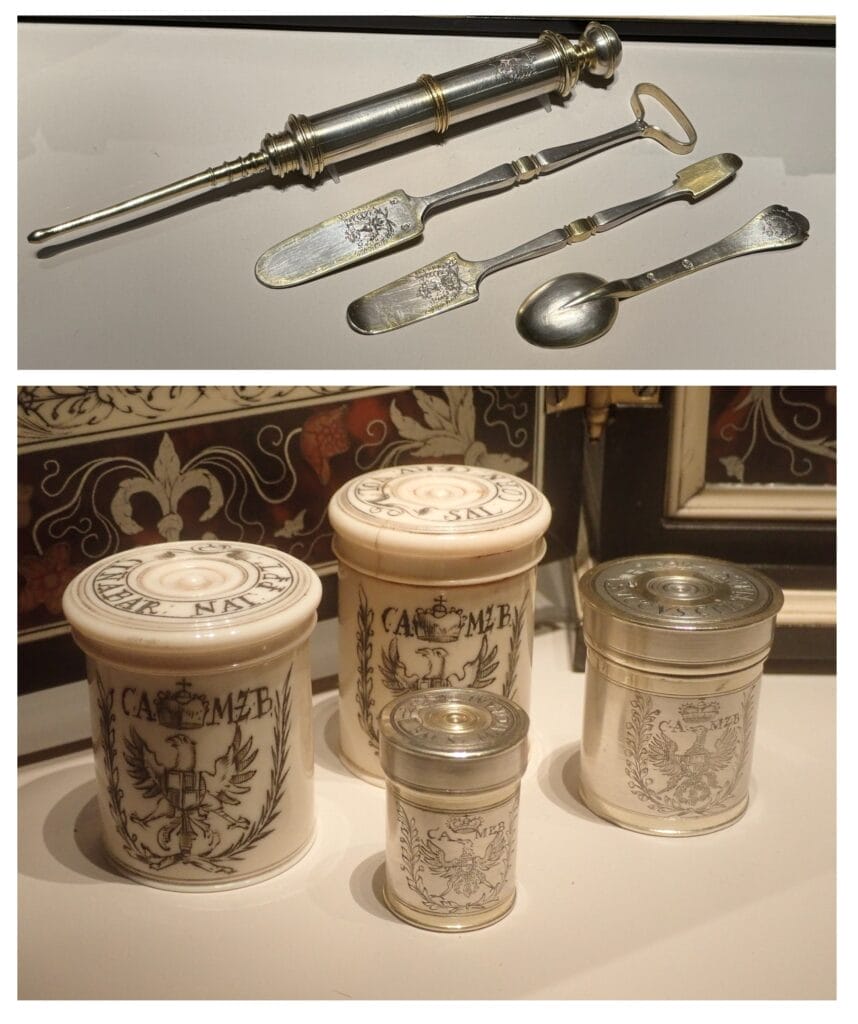
The center panel on the inside of the lid is particularly eye-catching (Fig. 1); a coat of arms is held aloft by two putti and framed in ivory. This, together with the monogram C-A-M-Z-B, engraved on many of the drug containers (Fig. 2), identifies the owner as Margrave Karl August of Brandenburg-Kulmbach (1633–1731). A minor member of the House of Hohenzollern, Karl August was unmarried and childless. A canon of Magdeburg, he lived in Neustadt an der Aisch (Bavaria) and, after living a rather lavish lifestyle in his youth, was financially more constrained in later life. He was forced to pawn many of his valuables, amongst which may have been the apothecary cabinet.3
The contents of the cabinet include pharmacy instruments, many in silver, such as a mortar and pestle, double-sided tongue scraper, spatula, enema syringe, a hand scale with weights, and various spoons (Fig. 2). The drug containers include fifteen large and twenty-three smaller bottles with squared shoulders, thirteen cylindrical standing vessels, thirty-five round boxes made of turned ivory, and some items of pharmaceutical glassware.4
The front row of silver-lidded glass jars in the open upper tray, just behind the brass grill, are dedicated to some interesting items of materia medica. Several of these were believed to act as panaceas or universal remedies—wonder drugs, acclaimed by almost all physicians for their supposed therapeutic efficacy against virtually any malady. Mithridatium was the brainchild of King Mithridates VI Eupator of the ancient Anatolian realm of Pontos (120–63 BC), situated on the southern shores of the Black Sea. Suspicious of potential assassination plots against him and fearful of being poisoned, Mithridates is reputed to have ingested non-lethal doses of various toxins to build up resistance to their effects. According to the second-century Roman historian Marcus Junianus Justinus:
During his boyhood his life was attempted by plots on the part of his guardians […] but when these attempts failed […] they tried to cut him off by poison. He, however, being on his guard against such treachery, frequently took antidotes, and so fortified himself, by exquisite preventives, against their malice, that when he was an old man, and wished to die by poison, he was unable.5
The recipe was recorded by Celsus, a second century Greek philosopher, and included thirty-four botanical ingredients bound together with honey. This antidotal mixture was still being prescribed in the 1780s.
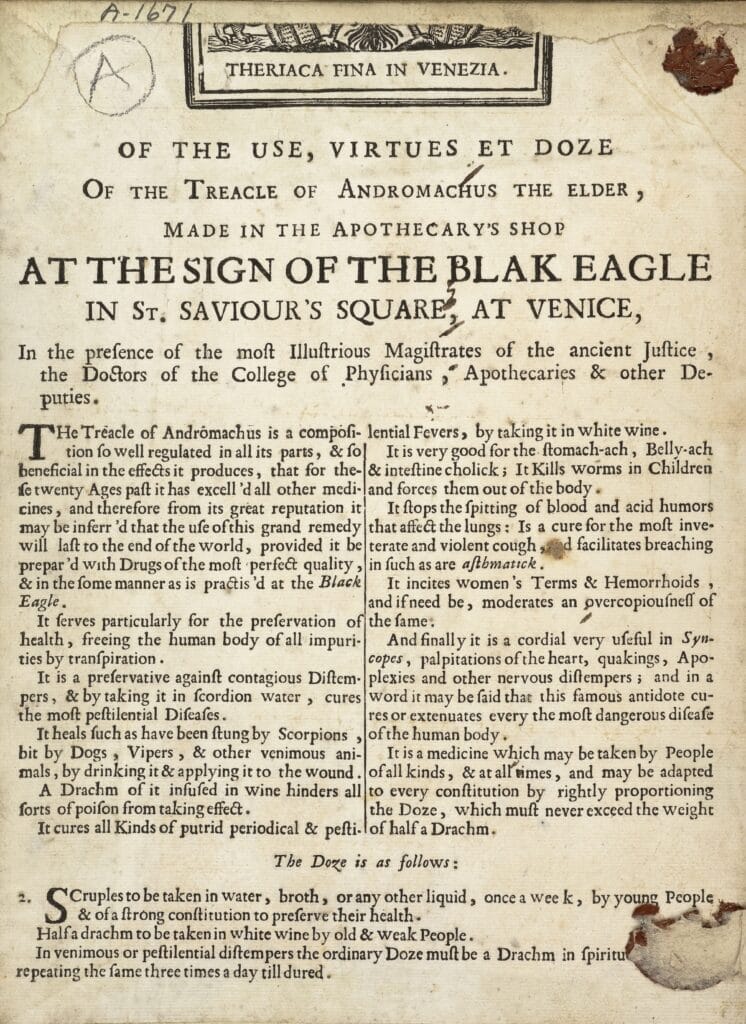
Theriaca Andromachus is also represented in the cabinet. Also known as Venice Treacle, this mixture is a modified version of Mithridatium containing sixty-four ingredients. Andromachus was a Greek physician who attended the Emperor Nero during the first century. Andromachus’ main innovation was the addition of four vipers, cut into small pieces. The whole mixture was mixed with Attic wine, heated in a clay pot, cooled, reduced to a powder, and then allowed to mature (for a period of twelve years, according to Galen’s recommendation).6 Quality control and oversight of manufacture was ensured by the strict formulation of the recipe in public, especially during the sixteenth century. The advertising handbill in Fig. 3 illustrates the therapeutic diversity claimed for this preparation.
A third popular, supposedly alexipharmic wonder drug is represented by a storage jar for bezoars. These are natural gastrointestinal concretions formed around indigestible matter trapped in the gut. They occur in a wide range of mammals but are particularly associated with the bezoar goat (Capra aegagrus). First employed in Persian and Arabic medicine, bezoars were introduced into Western medicine during the twelfth century. Increasingly popular and expensive, bezoar was an acclaimed antidotal medicine, but was also used as a lithontriptic, as a cordial to strengthen the heart, and in the treatment of a wide range of conditions including melancholia, leprosy, epilepsy, elephantiasis, scabies, and erysipelas.
Other jars stored Confectio de Hyacinthe, an opium-based electuary used to strengthen the heart and brain and in the treatment of smallpox, measles, fevers, cramps, colic, worms, and unspecified problems during pregnancy.
Amongst the ivory boxes is one dedicated to the storage of Salt of Hartshorn (Sal. Corn. Cerv.; Fig. 2). According to Nicholas le Fèvre (1615–1669), this was another example of a panacea or universal medicine. He recommended it to treat epilepsy, apoplexy (strokes), lethargy, and neurological disorders; to resist poisons, pestilence, fevers and malarial chills; and to cleanse the liver, spleen, mesenteries, pancreas, kidneys, bladder, belly, and lungs.7 Clearly, containing so many panaceas, this pharmacy cabinet was equipped to deal with any medical condition—nothing was left to chance!
References
- Mundt, B. Der Pommersche Kunstschrank des Augsburger Unternehmers Philip Hainhofer für den gelehrten Herzog Philipp II von Pommern. München: Hirmer Verlag, 2009: 285-287.
- “Magnificent pharmacy of Margrave Karl August of Brandenburg-Kulmbach.” Haus der Bayerischen Geschichte archive. https://archiv.hdbg.de/bup/d/d04b02.htm
- Baumstarck, R. & Seling, L. Silber und Gold: Augsburger Goldschmiedekunst für die Höfe Europas. München: Hirmer Verlag, 1994: 437.
- Ibid, p. 436.
- Iustinus, Marcus Iunianus. Epitome in Trogi Pompeii Historias. Milan (publisher not indicated), 1476 (unpaginated).
- Griffin, J.P. Venetian treacle and the foundation of medicines regulation. British Journal of Clinical Pharmacology; 2004; 58 (3): 317-325.
- Le Fèvre N. A compendious body of chymistry. London: printed for Tho. Davies and Theo. Sadler, 1662, p. 150.
CHRISTOPHER J. DUFFIN is an award-winning palaeontologist and pharmaceutical historian, now a Scientific Associate at the Natural History Museum in London.