
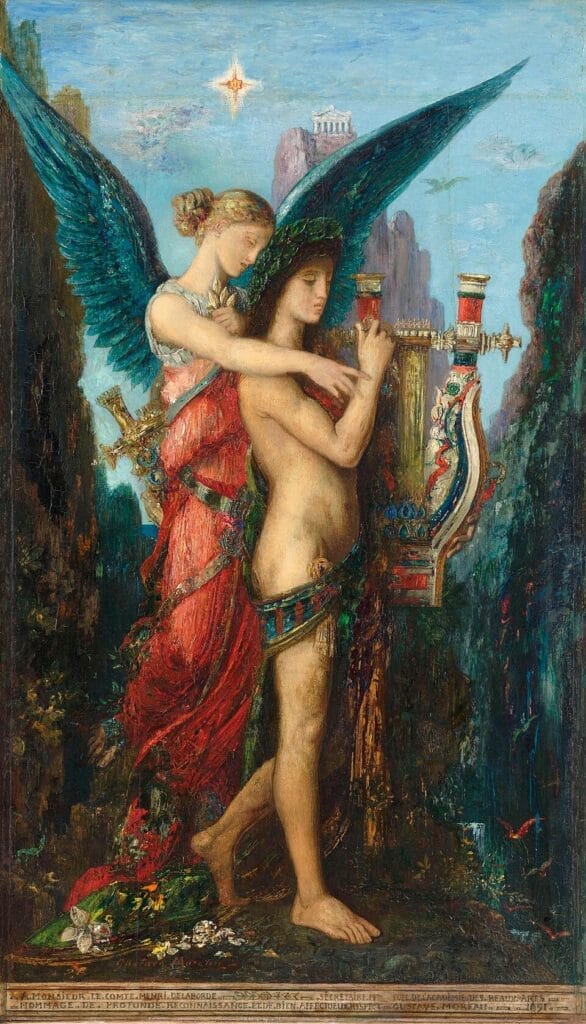
Even the most educated members of our generation who have read many of the ancient Greek classics may not be familiar with Hesiod’s works, the Theogony and the Works and Days. Written at about the same time as Homer’s Odyssey and Iliad (around 700 BCE), they reflect the Greek rather than the Hebrew or Mesopotamian version of the creation of the world. Although they are not medical texts, they offer many insights into ancient Grecian views on health and disease.
The Theogony describes the creation of the world, how it was fashioned from Chaos or nothingness, a primordial void or gap, a yawning emptiness that precedes all things. From Chaos arise three entities: Gaia, the primordial personification of the Earth (Terra is her Roman equivalent), Tartarus (the underworld abyss), and Eros (desire or attraction). Gaia gives rise to Uranus (Heaven), who becomes her offspring as well as her mate. Together they produce twelve Titans (six females and six males, of which Cronus is the youngest), three Cyclopes, and the three Hecatoncheires (monstrous giants, each with one hundred arms and fifty heads). Uranus hated these children and pushed them back into Gaia’s womb, causing her terrible pain and preventing their entrance into the world.
In revenge, Gaia releases from her womb Cronus, one of the Titans, who castrates Uranus. He generates a second generation of gods, which includes Zeus as its youngest member, as well as Poseidon. Having seen what happened to his father Uranus, Cronus decides to swallow his children, but Zeus escapes. He castrates Cronus, and throws his organs of procreation into the sea, where they produce Aphrodite and other third generation (Olympian) gods. Humans in Hesiod’s version are created by these gods—first in Cronus’ and later in Zeus’ time. The period in which Cronus ruled was called the Golden Age because the people of the time had no need for laws or rules; everyone did the right thing and was immortal.
Zeus in the Theogony leads his Olympian siblings in a ten-year war against the elder Titans, defeats them, and casts them into Tartarus. Prometheus, a Titan, was initially unharmed because he had been loyal to Zeus. Later he steals fire from Mount Olympus and is punished by being chained to a rock, where his liver is devoured by a vulture every day but grows back every night. Zeus punishes humans for receiving the fire, commanding Hephaestus to mold from earth the first woman, unnamed but assumed to be Pandora, a “beautiful evil” whose descendants will torment the human race.
Central to Greek medicine in Hesiod’s Theogony’s catalog of the gods are Apollo, who later became god of healing, and Asclepius, his son, the god of medicine, who were both revered in medical contexts. Hesiod’s portrayal of these deities helped establish their authority over health and healing, reinforcing the idea that medical knowledge was sacred and divinely inspired.
In the other book, the Works and Days, Hesiod blends the myths of Prometheus and Pandora into explanations why humans must toil and suffer from disease. He likewise attributes disease to divine punishment for humankind, to Zeus commanding Hephaestus to create Pandora, who by opening a box or jar releases all the evils upon the world.
Hesiod presented the myths as a direct address to his brother, Perses, with whom he was embroiled in a dispute over inheritance. This sets the stage for a broader discussion on justice, labor, and the human condition itself. He offers a detailed agricultural calendar, with month-by-month guidance on farming tasks, warnings against idleness, dishonesty, and poor planning. In addition, he promotes work and healthy competition over conflict and dishonesty and offers a mythological account of humankind’s decline from a Golden Age to progressive loss of virtue, injustice, moral decay, and unhappiness. By emphasizing the importance of moderation, morality, and respect for the gods, he makes his works a unique and enduring text of ancient literature and ethics that remains relevant even in modern times.