
Lilian Gleave
Cork, Ireland
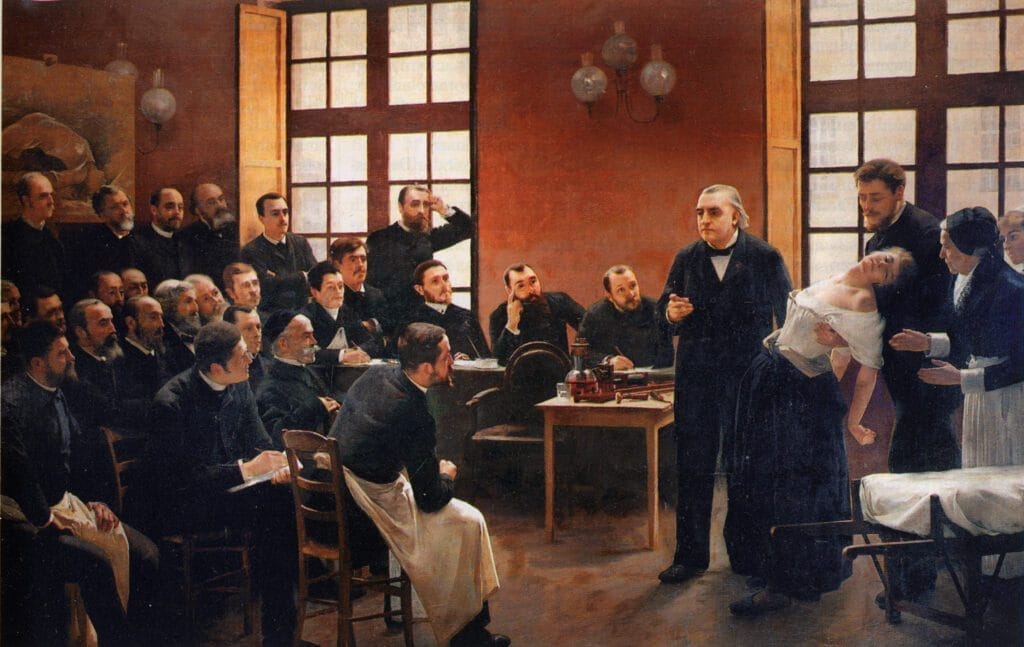
While some students of Jean-Martin Charcot like Sigmund Freud and Joseph Babinski achieved enduring fame, the legacy of others is just as foundational. In André Brouillet’s 1887 painting A Clinical Lesson at the Salpêtrière,1 a man stands by the window, his head supported by his hand, lit from behind. Some medical historians assert that figure is Alix Joffroy (1844–1908).2
Joffroy trained at Charcot’s Salpêtrière. He learned histology and pathological anatomy with Alfred Vulpian3 and then studied with Rudolf Virchow in Berlin before returning to Paris at the outbreak of the Franco-Prussian War,4 where he served as a medical intern at Lariboisière’s Hospital during the siege of Paris and the subsequent Paris Commune.5 He earned his doctorate in 1873; his thesis was “De la pachyméningite cervicale hypertrophique.”4 Those early choices set the pattern for a career of careful clinicopathological work.
Joffroy emphasized cellular observation in the study of spinal and bulbar disease. Working with Charcot, he correlated motor symptoms with lesions of anterior horn cells, a line of inquiry that helped distinguish progressive muscular atrophy from other muscle diseases and later advanced the understanding of amyotrophic lateral sclerosis. He applied the same microscope-driven logic to infantile paralysis, labio-glosso-laryngeal syndromes, syringomyelia, and peripheral neuritis.3 Those studies argued that nerve cell lesions are primary and that anatomy explains clinical patterns.
Joffroy also described clinical signs that once carried his name. Textbooks record Joffroy’s sign: absent forehead wrinkling on up-gaze in patients with thyroid ophthalmopathy.4 These bedside maneuvers are less often taught now,3 but they show a clinician who translated histology into clear, testable bedside observations.
After Charcot’s death, Joffroy took important academic roles.4 He worked at the Salpêtrière,3 became professor of pathological anatomy,3 founded an experimental psychology laboratory4 in the late 1890s, published widely, and chaired major medical societies in Paris (serving as founding president of the Society of Neurology of Paris, for example).3 He served as a bridge between neuropathology and neuropsychiatry.
Seen in Brouillet’s painting,1 Joffroy’s posture reads like a pathologist at work: a scientist who pauses between microscopic inquiry and macroscopic observation. That pause contains a lifetime of careful dissections, of linking cell to symptom, and of insisting that visible lesions explain the speaking body.
References
- Brouillet, André. Une leçon clinique à la Salpêtrière. 1887. Painting.
- Harris, J. C. “A Clinical Lesson at the Salpêtrière.” Archives of General Psychiatry 62, no. 5 (2005): 470–472. https://doi.org/10.1001/archpsyc.62.5.470
- Tiberghien, Dominique. “A Pioneer in Neuropathology: Alix Joffroy (1844–1908), J.-M. Charcot’s Pupil.” Neuromuscular Disorders: NMD 20, no. 3 (2010): 207–213. https://doi.org/10.1016/j.nmd.2009.10.004
- Teive, H. A. G., Coutinho, L., Germiniani, F. M. B., Camargo, C. H. F., & Walusinski, O. Alix Joffroy (1844-1908). Journal of neurology, 272(7), 470. (2025). https://doi.org/10.1007/s00415-025-13198-7
- Tiberghien, Dominique. “The Letters of Alix Joffroy (1844–1908), a Medical Intern at Lariboisière’s Hospital at the Time of the Commune of Paris.” Journal of Medical Biography 24, no. 1 (2014): 76–84. https://doi.org/10.1177/0967772013513102
LILIAN GLEAVE is a second-year medical student at University College Cork, Ireland.