Christopher Duffin
London, England
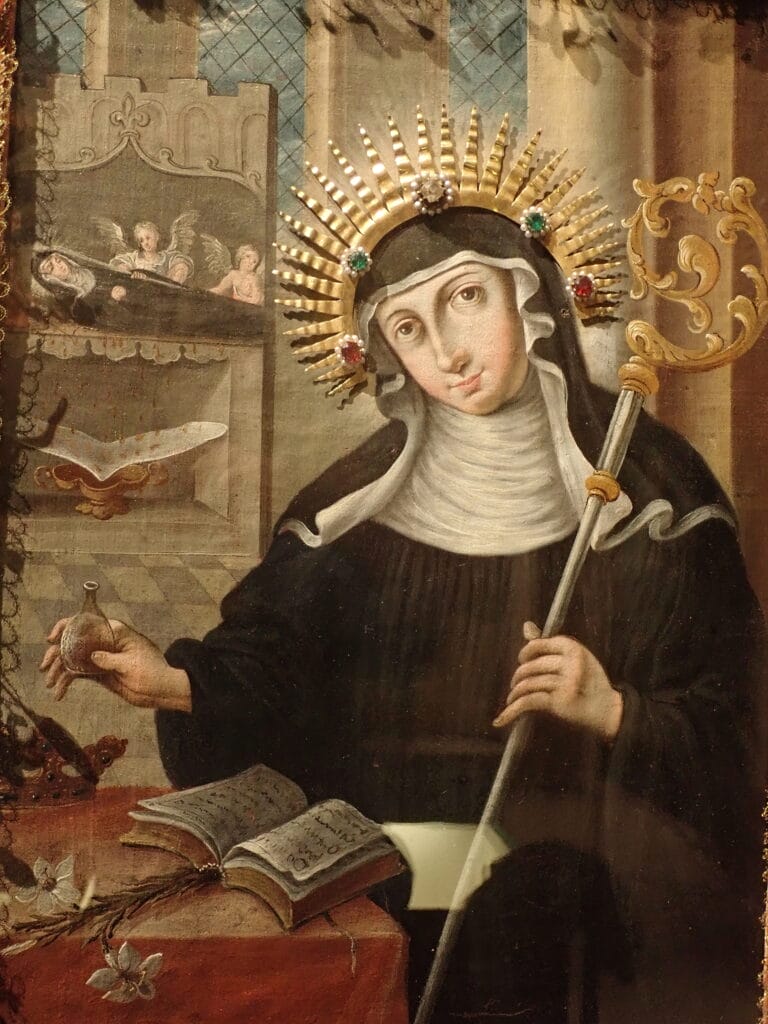
Born in what is now Devon around 710, Walburga (also spelled Walpurga) was educated at Wimborne Abbey in Dorset, eventually becoming a nun there. In the 740s she joined her brothers, Willibald and Wunibald, who responded to a call from their uncle, St. Boniface (680–755), to become part of the Anglo-Saxon evangelical missionary effort in Germany. The brothers founded several monasteries in southern Germany. At the deaths of Willibald in 751 and Wunibald in 760, Walburga rose to become superintendent at the Heidenheim monastery. Surviving records are unclear, but she died on February 25 in either 777 or 779. Almost 100 years later (between 870 and 879), her remains were moved from Heidenheim to Eichstätt. In 893, Abbess Liubila requested Erchanbald, then Bishop of Eichstätt, to open Walburga’s tomb so that they could transfer some of her remains to the newly established monastery at Monheim in Bavaria. This was duly permitted by royal assent. When the rocky tomb was opened, “the bones were found pure and clean, and moistened with a holy oil or dew, which no impurity would touch or soil.”1 This observation led to belief in Walburga’s oil.2
In 1035, a Benedictine abbey was founded in Eichstätt. It took over care of Walburga’s shrine from a community of canonesses. Apart from two brief interruptions, the “oil” has been flowing annually from St. Walburga’s tomb ever since, ostensibly beginning around October 12, the date of transfer of Walburga’s bones, and ceasing around February 25, the day of her death. It is scrupulously and reverently collected by the nuns of St. Walburga’s Abbey as it drips from the ceiling of the burial cavity and is channelled via silver guttering for final collection in gilded bowls. Chemical analysis reveals it has virtually the same composition as local tap water.3 Having passed over the remains of St. Walburga, however, the fluid has been transformed into a third-class relic.
Once collected, the nuns dilute the “oil” with holy water and bottle it in small glass vials; these have effectively become the emblem of the saint and figure in the various images of her (Fig. 1). These bottles have been made available to pilgrims for centuries, but the heyday of production was the eighteenth century, which saw a resurgence of popular piety in the Austro-Bavarian region. Usually plugged with sealing wax to prevent evaporation and sometimes covered with a decorative damask or brocade doily, the bottles are housed in a wide variety of containers including small boxes, chests, and personal and household altars made of ivory, metal, or turned wood and decorated by the nuns. Perhaps the most common are small silver filigree or brass containers (Fig. 2) for use as pendants on rosaries and protective convulsion chains known as Fraisketten.4

St. Walburga’s oil has been credited with miraculous healing powers. These have been documented in a series of Miracle Books associated with the expanding cult of Walburga published from 1620 to 1792. The earliest of these was written by the Ingolstadt Jesuit Jakob Gretser (1562–1625) and recorded fourteen healings during the period 1617–1620. These covered birth difficulties, eye injuries, hearing disorders, blindness, epilepsy, mental illness, paralysis, open wounds, and accidents.5 The St. Emmeram Benedictine, Anselm Goudin (1677–1742),authored a constantly updated series of Miracle Books in 1708, 1716,1720 and 1724. He recorded ninety-nine miraculous healings between 1704 and 1719. In the earliest editions of his work, the cures are arranged in alphabetical order, but this is replaced by a head-to-toe arrangement in later versions.
His 1716 work records the cure of damaged eyes, angina, blindness, burns, smallpox, life-threatening hemorrhage, colic, swallowed foreign objects, fevers, and birthing problems. Applications included swallowing the oil, applying it to the globe of the eye by means of a feather, and dripping it into the ears.6
The following quotations provide examples from his 1724 work7:
- In 1721, Lord Ambrosius Josephus Leihn, bookkeeper of the Toscan rulers in Bohemia […] after devout use of the Holy Oil was cured of his severe gout and terrible stinging pains.
- Likewise, at Alten Detting, Mr. Franciscus Ker was so struck by the […] power of God that he was speechless; but after consuming Holy Oil and following the confident commands of St. Walburga, he was not only able to confess in detail but gradually regained the ability to speak clearly.
- Margaretha Klenin of Allersperg also visited St. Walburg[a] several times on May 1, 1714 […] She suffered a stroke and was unable to speak for eight days. After she had consumed the Holy Oil with confidence, she immediately regained her senses, and since then, she has felt no more of this illness.
- The same miraculous sign also occurred in the year 1710 in Marchaurn with a 7-year-old daughter who was mute from her youth but who, at the inspiration of the Holy Oil, was first able to babble in a childish way and then gradually with full clarity, all the necessities of her life.
Drinking samples of Walpurga’s oil was recorded as having cured dizziness and pains in the eye, chest, foot, back, head, and hand.
The recorded cures were experienced by people from all walks and stations of life from peasants to the nobility, from babies to the elderly, and are roughly evenly divided between men and women. Many of the cures were attested to by carefully recorded witness statements. Common threads occurring through the experiences include an appeal to St. Walburga, administration of the healing oil, and rejoicing, praise, and thanksgiving upon recovery, often accompanied by votive offerings. Many of the testimonies assert that the person was never again bothered by that condition.
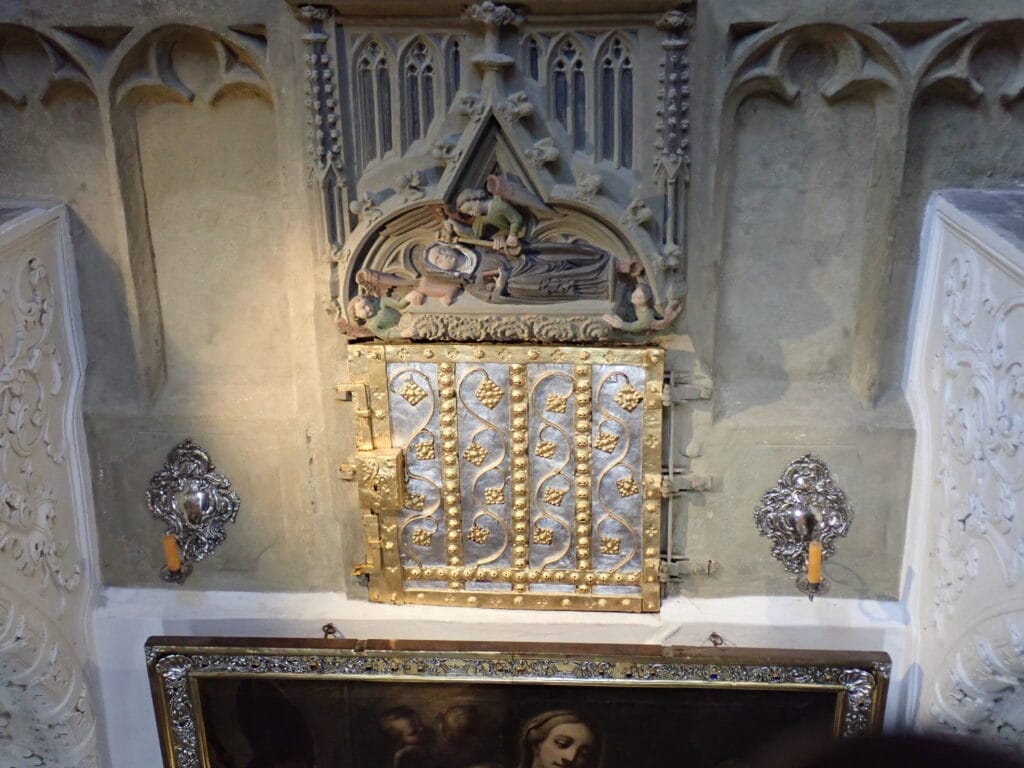
The Abbey of St. Walburga at Eichstätt is a popular pilgrimage site today, and its nuns continue to collect and distribute the healing oil. The crypt containing some of Walburga’s remains is protected by a robust gold and silver door (Fig. 3).
References
- Toovey, J. Lives of the English Saints. Family of St. Richard the Saxon. London: James Toovey, 1844, 90.
- Riezler, S.R. von. Walburg. Allgemeine Deutsche Biographie; 40, 1896: 645-646.
- Benecke, M. Mumien in Palermo: Als Kriminalbiologe an den dunkelsten Orten der Welt. München: Bastei Lübbe, 2016, 96-97.
- Duffin, C.J. Convulsion Chains. Jewellery History Today; Issue No. 41 (Spring 2021): 6-7.
- Gretser, J. Fons olei Walpurgini apud Eystettenses explicatus atque defensus. Ingolstadt: Elisabetham Angermariam, 1620.
- Goudin, A. Benedictinisches Welt-Wunder: Vorgestellt In der Heil. Groß-Britannischen Königl. Princessin und Jungfräulichen Abbtissin Walburga, Auß dem Heil. Benedictiner-Orden; Wie auch, In dem übernatürlichen Oel-Fluß […]. Regensburg: Johann Baptist Lang, 1716.
- Goudin, A. Benedictinisches Welt-Wunder Vorgestellt in der Heil. Gross-Brittanischen Königl. Princessin und Jungfraulichen Abtissin Walburga. Aychstätt: Frank Strauss, 1724: 399, 400, 404.
CHRISTOPHER J. DUFFIN is an award-winning palaeontologist and pharmaceutical historian, now a Scientific Associate at the Natural History Museum in London.