Kevin R. Loughlin
Boston, Massachusetts, United States
In one of the most famous Bible verses of the Old Testament, the Lord instructs Moses to tell Pharaoh, “This is what the Lord says: By this you will know that I am the Lord: With the staff that is in my hand I will strike the water of the Nile, and it will be changed into blood.”1 Thus begins the biblical description of the ten plagues to punish the Egyptians for their 400-year enslavement of the Israelites. The ten plagues were: water turning to blood, frogs, lice, flies, livestock pestilence, boils, hail, locusts, darkness, and the killing of firstborn children.2
For years, biblical scholars and secular historians have debated possible explanations for the Egyptian plagues. While clerical experts argue that they were purely supernatural acts of God, modern historians, with reliance on scientific scrutiny, argue that either the eruption of a volcano or transient climate change in the region could provide plausible natural phenomena as the source of the plagues.
The Santorini caldera
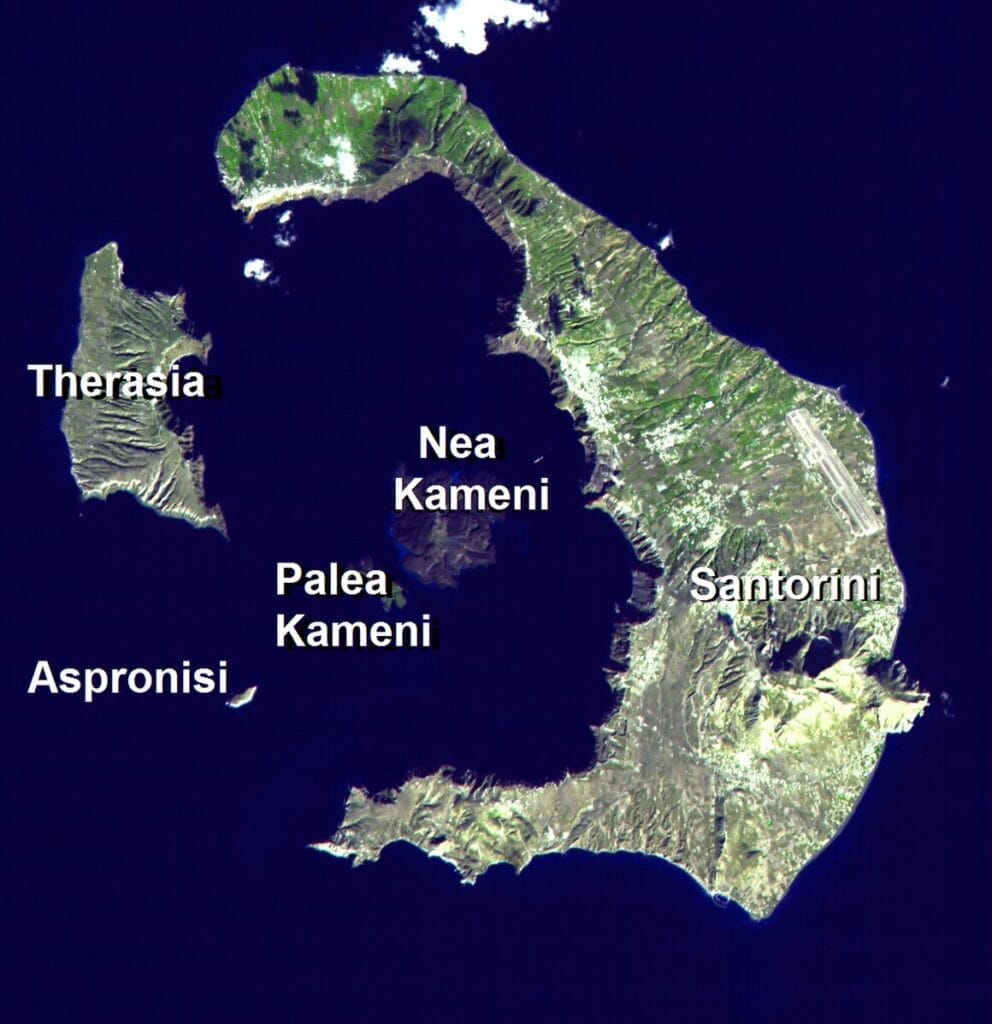
The Santorini caldera consists of five islands. The main island, Santorini, known as Thera in antiquity, is joined by Therasia, Aspronisi, Nea Kameni, and Palea Kameni (Fig 1). The caldera represents the remnants of an ancient volcano.3 Geologists estimate that the volcano erupted eleven times throughout history, with the earliest eruption occurring around 1600 BC. Biblical experts cite the Greek historian, Herodotus, who estimated that the Egyptian plagues occurred about 1550 BC during the reign of Pharaoh Ahmose I, so the timelines of the two events are a pretty good match.4
In his 2005 book The Plagues of Egypt: Archeology, History and Science Look at the Bible, Siro Ignino Trevisanato postulates that the volcanic eruption triggered a cascade of natural events that manifested as the ten plagues.5 He suggests that volcanic ash caused the Nile to become acidic and that the ash contained the mineral cinnabar, which can turn water red.2 Others, like John S. Marr, argue that red algae could have sucked oxygen out of Egypt’s waterways, killing the fish and turning the water red.6 Marr and his colleague Curtis Malloy suggest that the lack of oxygen and the lack of fish as a food source forced the frogs out of the Nile and onto the land where they died. Marr and Malloy further speculate that the remains of the fish and frogs perpetuated the growth of a variety of insects.
The fifth plague, a disease that affects only hoofed animals, may have been transmitted by a species of flies, Culicoides, which affect cattle and sheep.6 The sixth plague, boils on the skin of animals and humans, manifested next.
An interesting piece of potentially corroborating evidence was uncovered in 1886 when the mummy of Thutmose II (1509–1479 BC) was found to have scars of some type of infection, which were still visible after being embalmed.4 Did this represent the sequelae of boils?
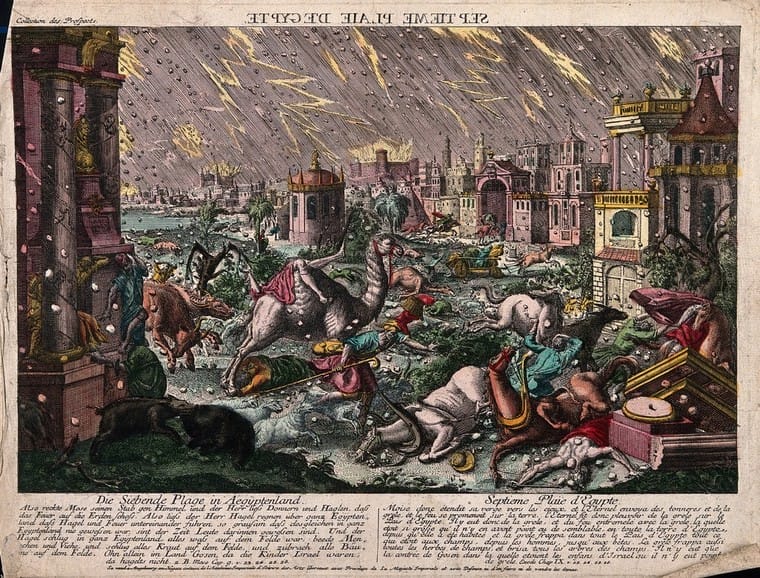
The seventh plague, the hailstorm, was an unusual event for Egypt, but not impossible. Modern meteorologists confirm that rare but severe weather patterns have occurred historically throughout the Nile Delta. This has been confirmed by the American Meteorological Society.7
The hail devastated the seasonal food supply, which then was followed by the eighth plague, the swarms of locusts that devoured the crops. The ninth plague was the three days of darkness, which Marr contends was caused by a sandstorm, known to occur in the region. The confluence of locusts, hail, and sandstorms ruined all the crops, which became contaminated with bacteria and mold.
The tenth and final plague was the death of the firstborn. This is somewhat harder to explain by natural phenomena. One explanation is that after this period of food shortages, when the granaries were opened, the privileged firstborn sons would have been given the contaminated grain first with subsequent deaths.
Climate change
An additional natural explanation for the Egyptian plagues has been climate change. Waxman posits that research on stalagmites suggests a dry period toward the end of the rule of Pharaoh Ramses II (1279–1213 BC).8 Although this does not coincide specifically with the estimated time period of the plagues, it suggests the possibility of intermittent periods of climate change during that era that could have facilitated the sequence of events that resulted in the plagues.
Ehrenkranz and Sampson9 propose that an aberrant El Niño-Southern Oscillation (ENSO) weather pattern brought unseasonable warmth to the ancient Mediterranean region, including the coast of Egypt, which initiated the events of the biblical sequence of plagues. Further evidence of ancient periods of isolated episodes of climate change mediated by El-Nino-Southern Oscillation is provided by Li and Hu.10
This climate warming would have caused heavy rainfall and subsequent mosquito-borne outbreaks of Rift Valley fever virus (RVFV), malaria, and dengue, with an explosion of swarming locusts and a severe red tide, which caused the deaths of many fish.9
Ehrenkranz and Sampson9 further postulate that water temperatures of 20 degrees Celsius or more in the Nile would have facilitated massive algal blooms and toxins, resulting in the bloody appearance of the water and the death of fish. The increased water temperatures, likewise, would have stimulated the activity of frogs and caused them to flee toward land. Anaerobic bacteria growing in frog carrion would have provided a breeding ground for small insects and flies.
Concurrent Rift Valley fever virus in ruminants and West Nile Virus (WNV) in equine species would explain the fifth plague. After hatching, some fly larvae burrow into the skin of livestock and humans and manifest as nodules or boils.11 This may explain the biblical observation that Egyptian “magicians could not stand before Moses because of the boils.”12
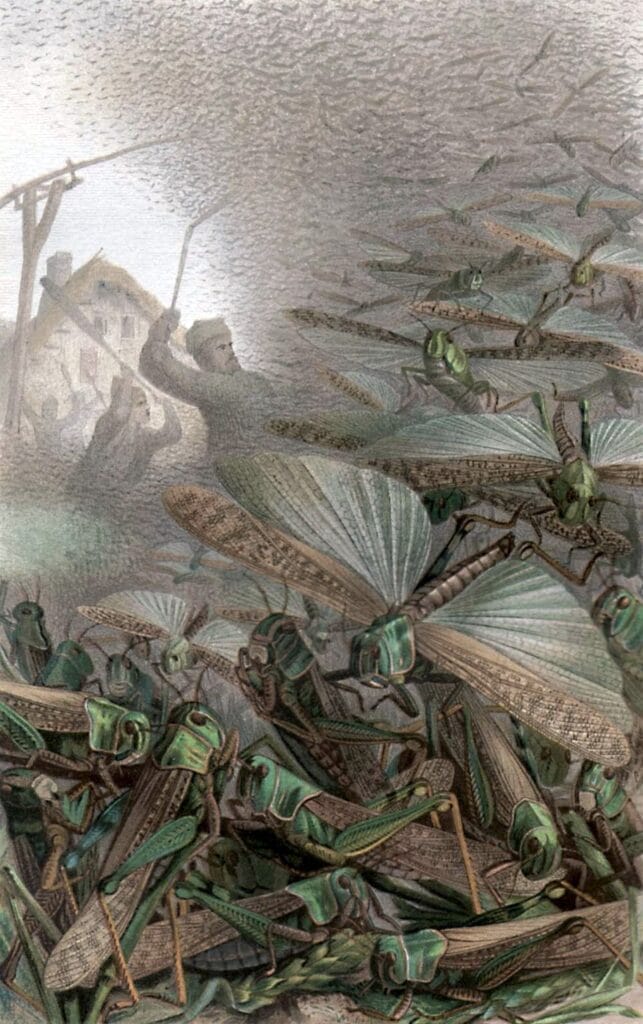
Ehrenkranz and Sampson have further postulated9 that rising temperatures in the late spring could have caused a supercell storm including hailstorms as described in the seventh plague. They contend that violent storm winds blowing from the desert would have delivered swarms of desert locusts (Schistocerca gregaria) onto the Egyptian coast during the eighth plague (Fig 2).
It is then considered likely that as violent storm winds subsided, prevailing winds from the sea laden with moisture would have returned to the Nile Delta and encountered the cool desert air left by the eighth plague to create a dense fog.9 This fog would have obscured sunlight and created the “days of darkness” reported as the ninth plague.
For the tenth and final plague, again hardest to explain by natural phenomena, it has been speculated9 that with the moisture and elevated ambient temperatures, mosquitoes would multiply and disseminate RVFV and WNV to Egyptian inhabitants. The most vulnerable would be younger, non-immune Egyptians, including firstborn children.
Scripture versus science
Some would contend that the reader must make a choice between scripture and science. However, wiser readers might reply that this is not an either/or proposition. There is still much of modern science that remains a mystery, no less important than to answer how the universe began, if in fact, it had a beginning. Perhaps the greatest quality that an expert, cleric, or scientist can possess is humility. The Passover story remains the most important component of the Jewish tradition and its cause remains a mystery, as it should.
References
- Exodus 7:14-29.
- Utaraite N. Turns Out, The 10 Plagues of Egypt Might’ve Actually Happened Because Of A Volcanic Eruption And This Person Explains It All. Bored Panda, Nov 22, 2019. https://www.boredpanda.com/ancient-egypt-volcanoes-santorini-thera/. Accessed August 17, 2022.
- Santorini caldera. Wikipedia. https://en.wikipedia.org/wiki/Santorini_caldera. Accessed August 3, 2025.
- The Ten Plagues of Egypt. Biomedical Scientist, Jan 23, 2024. https://thebiomedicalscientist.net/2019/01/07/ten-plagues-egypt. Accessed August 12, 2025.
- Trevisanato SI. The Plagues of Egypt: Archeology, History and Science Look at the Bible. Georgia Press, 2005.
- Raver A. Biblical Plagues: A novel theory. NY Times, April 4, 1996.
- Quinn S. 10 Plagues of Egypt: What Modern Scholars Say About Them. History Collection, June 21, 2025. https://historycollection.com/10-plagues-of-egypt-what-modern-scholars-say-about-them/
- Waxman OB. Did the 10 Plagues of Egypt Really Happen? Here Are 3 Theories. Time, April 18, 2019. https://time.com/5561441/passover-10- plagues-real-history.
- Ehrenkranz NJ and Sampson DA. Origin of the Old Testament Plagues: Explications and Implications. Yale J. Biol. Med. 2008;81(1):31-42.
- Li X, Hu S. Persistently active El-Nino-Southern Oscillation Since the Mesozoic. Proc. Nat. Acad. Sciences. 2024;121(45)e2404758121.
- Morsy T, Fayad ME et al. Some myiasis producers in Cairo and Gaza abattoirs. Egyptian Society Parasitology. 1991;21;539-546.
- Eduncbola LD. Cutaneous myiasis due to tumba-fly, Condylobia anthropophasa, in Ilorin, Kwara State, Nigeria. Acta Tropica 1982;39:355-362.
KEVIN R. LOUGHLIN, MD, MBA, is a retired urologist and an emeritus professor at Harvard Medical School.