
Christopher Duffin
London, England
If you find yourself in Heidelberg, you would be well advised to tackle the invigorating walk up to the sixteenth-century castle on the eastern margins of the old city, with its commanding views over the Neckar Basin, or to take the more sedate option of the cable car. The nine-euro entry fee to Schloss Heidelberg also covers a visit to the stupendous exhibits of the Deutsches Apotheken-Museum, accessed from the castle courtyard. The German Museum of the History of Pharmacy was first opened in Munich in 1938, but its home was destroyed during World War II. The collections, thankfully removed for safekeeping, were eventually moved to Heidelberg in 1957. Here, the exhibits are now housed in ten rooms, one of which is in the aptly named “Apothecary’s Tower.” The major exhibits are accompanied by instructive information boards in both German and English.
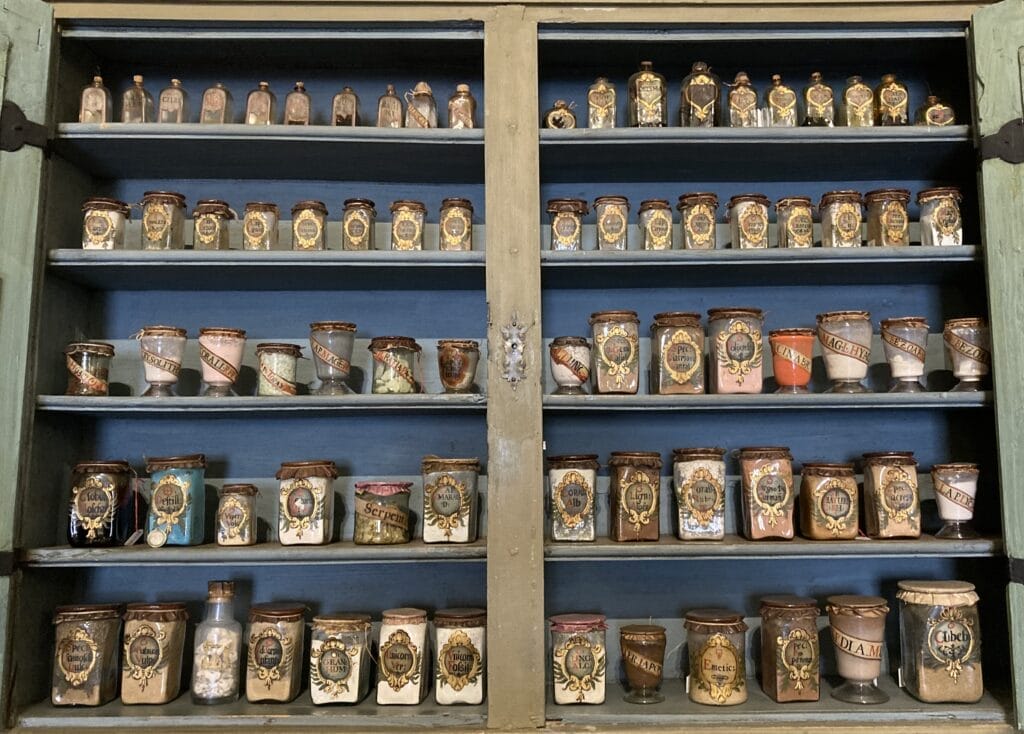
In the reception area, the visitor is greeted by two eighteenth-century sculptures—St. Damian and St. Cosmas, the patron saints of pharmacists and physicians respectively. Reception also houses a beautiful apothecary’s cupboard from the Carmelite monastery at Schongau. The double-tiered structure dates from around 1740, has hand-painted compartment doors, and contains over 180 contemporary glass containers complete with contents (Fig. 1). Displays in the second room give a broad-stroke survey of pharmacy from classical antiquity to the twenty-first century. The room is dominated by a baroque “officina” or workshop from the Benedictine abbey at Schwarzach, with its shelves lined with contemporary storage vessels. The room also contains a small display focusing on faith and healing.

Room Three is an area for educational activities and temporary displays, while Room Four houses the reconstructed Crown Pharmacy of Ulm, dating to around 1820. The fifth room houses a series of tastefully arranged displays of materia medica where raw materials, processed derivatives, and representative containers illustrate the wide range of zoological, botanical, and geological medicaments utilized in the historical past (Fig. 2).
Next comes the largest display area, which houses the magnificent workshop from the Ursuline Convent at Klagenfurt, first used in 1730. The centerpiece is an enormous walnut-topped workstation. The shelves accommodate a wide range of fifteenth- to seventeenth-century faience and majolica vessels from Faenza, Savona, and Venice, and also seventeenth- and eighteenth-century containers of German origin. Room Six also contains the seventeenth-century Court Pharmacy of Bamberg, again replete with contemporary vessels and pharmacy tools.
Room Seven presents a collection of storage equipment including large vessels, racks, and other items of furniture together with a range of processing instruments such as mortars and scales. A cupboard with the original drawers from the Town Pharmacy of Mosbach dates from the seventeenth century.
The rather narrow eighth room is home to a wall-mounted series of decorated plaques and pharmacy emblems. Some date from the seventeenth century (e.g. Court Pharmacy of Füssen, 1696), while the emblem of the three spoons of Bauhaus design is from the 1920s.
Room Nine is a space for rotating temporary exhibitions, while a walk down some delightfully uneven steps takes the visitor to the display of laboratory equipment in the Apothecary’s Tower. The exhibits include a huge collection of technical glasses arranged on shelves around the walls of the tower, examples of distillation equipment, and furnaces.
The wide range of exhibits holds something of interest for every visitor. Several items caught my eye in particular, such as the esthetically pleasing as well as functionally important glass drug containers in the apothecary’s cupboard from Schongau (Fig. 1). Several types and sizes are present, all clearly labeled and hand-decorated, often with gold paint, and some also have the appropriate alchemical symbol above the name of the drug. Many still have contemporary materials within.
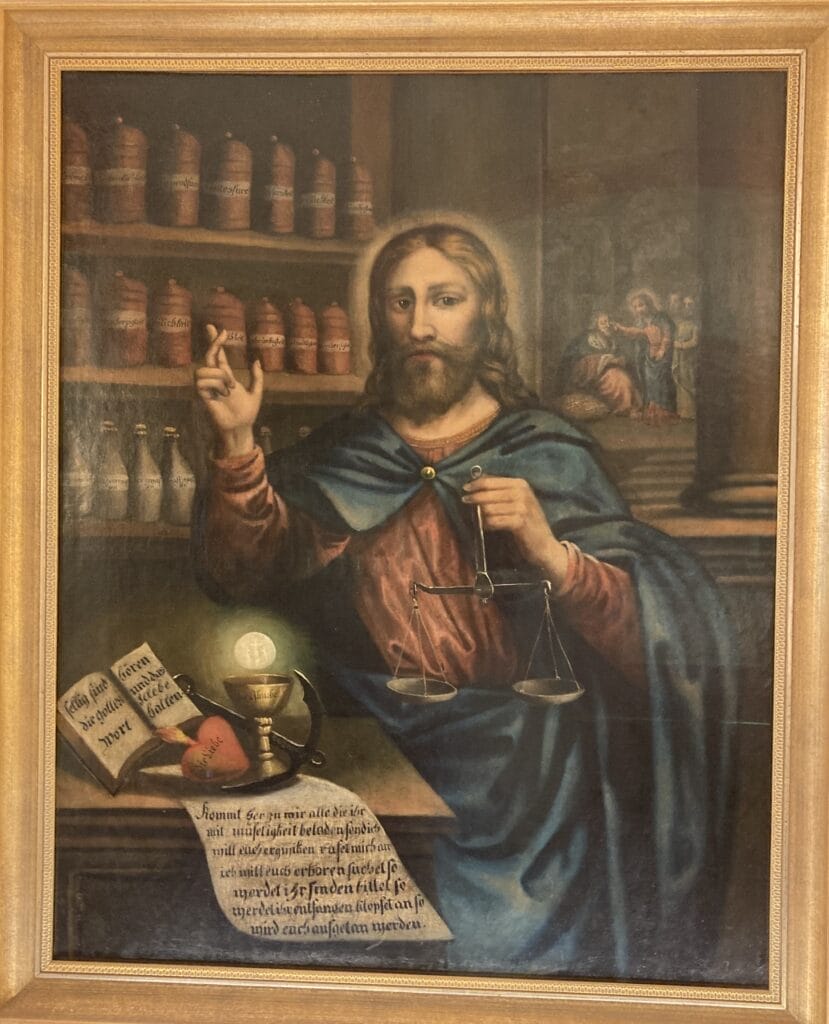
Paintings depicting Christ as apothecary are a peculiarly Austro-German genre (Fig. 3). Jesus is presented as the pharmacist of the soul seated in a heavenly pharmacy. The apothecary scales represent the Last Judgment and the three theological virtues of the Christian faith—faith, love, and hope—are represented on the prescription table by the chalice, heart, and anchor respectively. The shelves are stocked with containers housing a wide range of medicines for the soul comprising characteristics such as patience.
I particularly appreciated the displays of materia medica. Raw materials are exhibited alongside a range of appropriate containers chosen from the long history of drug storage. In the case exhibiting musk and ambergris (Fig. 2), contemporary prints illustrating the origins of the samples emphasize the importance of having dedicated devices for transportation, weighing, and processing with the use of labeled mortars so as to prevent cross contamination.
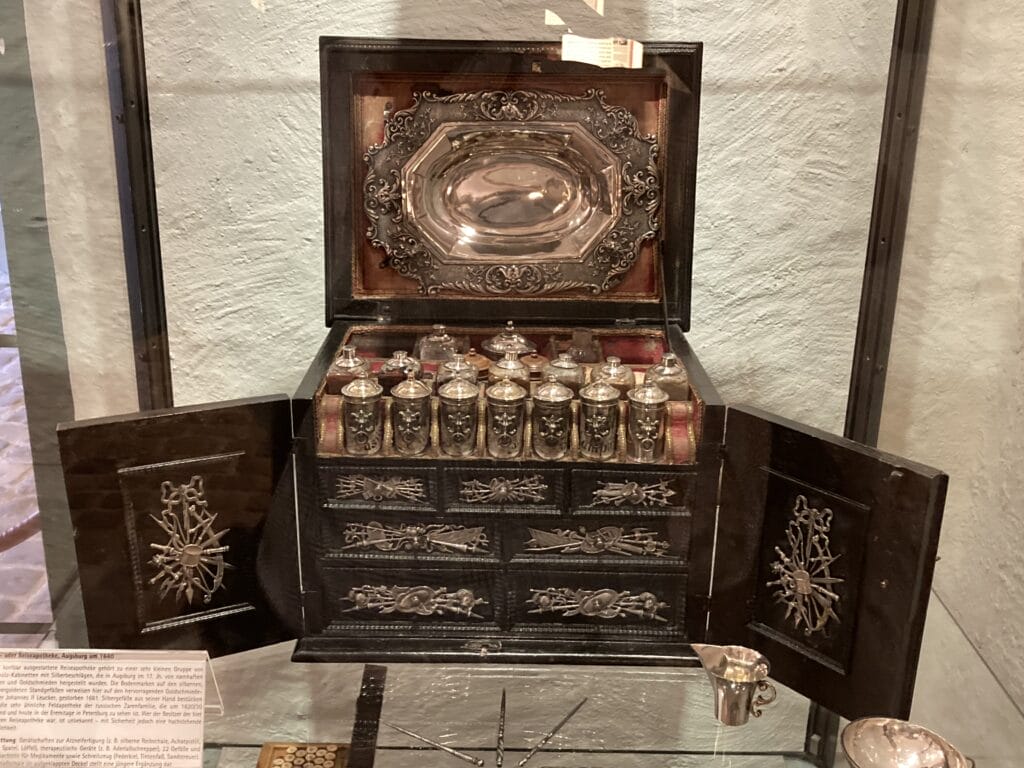
A compact, sumptuously embellished traveling pharmacy cabinet (Fig. 4) consisting of ebony overlaid with silver was made in Augsburg by the silversmith Johannes Leucker II, who died in 1661. In addition to the twenty-two silver drug vessels, the cabinet contains writing equipment, an agate pestle, and silver mortar. This artisan produced a similar cabinet for the Russian tsars; it is now held in the Hermitage collections in St. Petersburg.
The pharmaceutical museum in Heidelberg Castle is well worth a visit; informative and tastefully arranged displays are sure to excite the imagination in any historian of pharmacy.
CHRISTOPHER J. DUFFIN is an award-winning palaeontologist and pharmaceutical historian, now a Scientific Associate at the Natural History Museum in London.