
Daniel Patrone
Oneonta, New York, United States
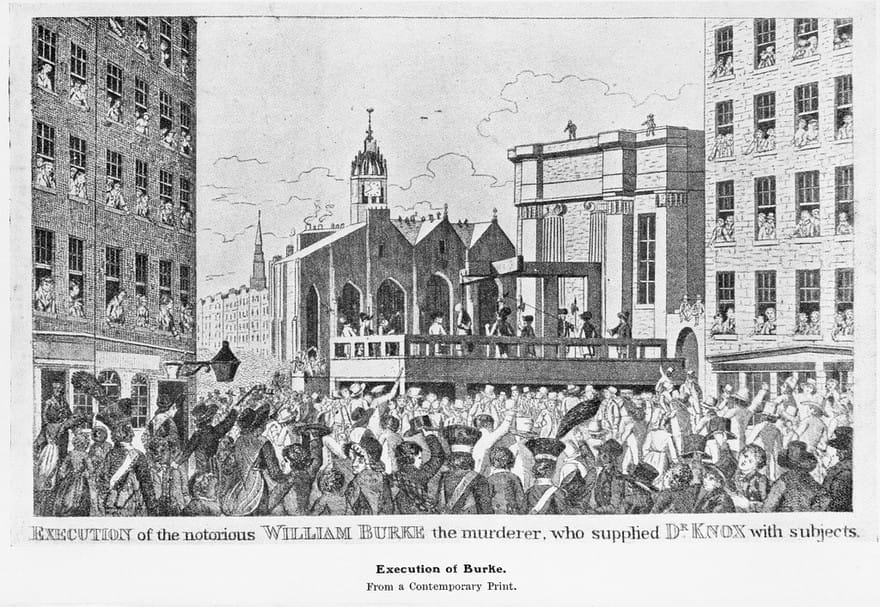
In the early nineteenth century, the rapid advancement of anatomical science created a surging demand for human cadavers. Given the woefully inadequate legal supply of cadavers, this demand fueled the rise of a lucrative but illicit industry of graverobbers or “resurrection men” who supplied bodies to anatomists through unscrupulous means. In some cases, the supply of corpses extended beyond grave robbing, resulting in outright murder. The most infamous case is that of Burke and Hare, two Irish immigrants in Edinburgh, who reasoned that murder was at least as profitable as grave robbing once they realized that Dr. Robert Knox, a prominent anatomist, was willing to pay for bodies with few questions asked.
After the discovery of their final victim in 1828, Burke and Hare were arrested. Hare turned witness for the Crown and was released in exchange for his testimony against Burke. Burke ultimately confessed to sixteen murders and was sentenced to public execution, with his remains ordered for dissection.
The story of Burke and Hare has been widely documented in popular culture and academic histories. These accounts frequently highlight the massive and enthusiastic crowd that gathered to witness Burke’s execution. Estimates vary, but most reports place its size between an impressive 20,000 and 35,000 people. One pamphlet published at the time claimed that locals charged between five shillings and two guineas for window seats overlooking the event.1 It goes on to say that when Burke was led to the scaffolding, cries erupted from all directions: “Burke him, Burke him!” Following his hanging, the demand for justice turned toward Hare: “Bring out Hare!” and “Now for Hare!” These cries continued even after Burke’s body was cut down at nine o’clock, culminating in the crowd offering three cheers “for humanity.” Concerned about maintaining order, authorities abandoned plans to have a hymn sung from the scaffold.2
The historian Owen Dudley Edwards in his book Burke and Hare asserts that Burke and Hare’s Irish identity was not a part of the public discourse surrounding the case at the time,3 though this perspective differs from those of later commentators and historians. Edwards asserts that the public at the time understood the Burke and Hare affair through the lens of the extent and nature of the criminal acts, not the criminals’ ethnic identities. He writes that “neither the Edinburgh mob nor the Edinburgh polite world had any particular desire to shuffle the horror away from Edinburgh to alien scapegoats.”4 According to Edwards, the Irishness of Burke and Hare only became a significant factor in racialized histories of the later nineteenth and early twentieth centuries.
A unique perspective on Burke’s execution and the role that Irish identity played in it survives in an unpublished document in the archives of the Royal College of Surgeons of Edinburgh: a firsthand account from within the crowd, recorded by Thomas Hume in 1888 in an autobiographical notebook about his student years. As a University of Edinburgh student, Hume was acquainted with members of the anatomy school where Knox taught. He describes his horror at one of Knox’s lectures when he recognized the body on the table as that of James Wilson, known to the students as “Daft Jamie” and “Retainer at the College Gates,” who was later identified as one of Burke and Hare’s victims.5 Hume was also among the students who later shielded Knox from an outraged public after his connection to the murders was exposed. Though his account, written long after the event, contains some inconsistencies and differs from other historical sources, it is a rare and important student-centered perspective on the Burke and Hare affair. While Hume’s account does not challenge Edwards’ claim, it does show that the gruesomeness of the crimes could not likely have completely obscured relevance of his ethnicity to his contemporaries.
Anticipating a massive turnout, Hume describes arriving at Burke’s public execution site at 4 A.M., while the gallows were still being erected “with candle light.” He soon noticed the arrival of a “posse of Irishmen,” whose numbers steadily grew as more arrived in “successive detachments.” These Irish attendees formed “a dense cordon around the scaffold,” preventing any “townsman or rather Scotsman” from encroaching beyond a certain boundary. Inquiring about this unusual formation, Hume writes that one of the Irishmen responded: “We got notice that they meant to collect round the scaffold & by hootings & execrations give ‘him’ (evading any mention of the name) as bad a time of it as they could; so as we thought it was bad enough for the poor Devil as it was, we are determined to keep them at a ‘decent’ distance.”6 The Irish cordon did not seek to disrupt the execution or contest Burke’s guilt; they merely sought to protect him from abuse at the hands of the crowd while the sentence was carried out.
At the time, the areas in Edinburgh around Cowgate, Grassmarket, and West Port were known as “Little Ireland,” home to as many as 10,000 Irish immigrants by the early 1800s.7 Like so many of his countrymen, Burke had settled there to work on the construction of the Union Canal, which linked Falkirk and Edinburgh. But when the project was completed in 1822, employment opportunities dwindled. As their numbers grew, the Irish working class in Edinburgh’s “Little Ireland” faced increasing underemployment, poverty, discrimination, and social marginalization. Lisa Rosner argues compellingly in The Anatomy Murders that this socio-economic context is crucial to understanding the conditions that contributed to both the possibility and success of the crimes.8

In this context, Hume’s account of the Irishmen’s actions at Burke’s execution suggests how, despite his heinous crimes, Burke was still regarded as one of their own—someone vulnerable to abuse and mistreatment, deserving of protections and respect as justice was carried out. This feature of Hume’s account deserves notice. Public executions and their moral implications were the subject of intense debate throughout the nineteenth century. Intellectuals and politicians of the era questioned the effects of these “circus-like” spectacles on those who attended them, particularly the “dangerous classes,” and critics argued that executions were a form of entertainment, desensitizing the public to violence and eroding their moral character.9 Morally-based criticisms of public executions, however, focused primarily on the impact such events may have on the spectators. They paid little attention to the treatment or experience of the condemned that was inextricably part of the public event. What the public debates in the nineteenth century overlooked—but what the Irish workers in Hume’s account recognized—was how public executions, in a system rife with prejudice and discrimination, affected the treatment of the condemned in their final moments and the communities to which they belonged.
Hume’s recollections do not challenge Edwards’ claim that Burke’s Irish ethnicity, as explanatory of his crimes, was an invention of later prejudiced and racialized thinking. It does, however, challenge the idea that Burke’s actions alone united Edinburgh’s entire population against the crimes themselves while ignoring the identity and experiences of the murderer. Importantly, Hume’s account also highlights a blind spot in political and moral debates about public executions at the time. It reminds us that, apart from consequences on the moral character of the public, the injustice committed against marginalized people in the criminal justice system, even those who were unquestionably guilty of the most heinous of crimes, still did matter, even if only recognized at the time by those who shared that marginalized experience.
References
- Paisley, John. A Correct Account of the Life of Willm Burke. G. Caldwell, 1829, 7-8. Available at https://digital.nls.uk/chapbooks-printed-in-scotland/archive/104187013#?c=0&m=0&s=0&cv=0&xywh=-1014%2C-121%2C3210%2C2380.
- Ibid., 7-8.
- Edwards, Owen Dudley. Burke and Hare. Polygon Books, 1980.
- Ibid., 2.
- Hume, Thomas. College Remembrances, Being a Chapter in the Autobiography of Thomas Hume Pater Familias. 1888. Royal College of Surgeons Edinburgh Archives, 9.
- Ibid., 15.
- Rosner, Lisa. The Anatomy Murders. University of Pennsylvania Press, 2010, 67.
- Ibid.
- Bennett, Rachel. Capital Punishment and the Criminal Corpse in Scotland, 1740-1834. Palgrave Macmillan, 2018. 17-19.
DANIEL PATRONE is a philosopher and bioethicist in the Philosophy Department at SUNY Oneonta. He specializes in research ethics and the intersections of normative ethics and the history of medicine.