
Christopher Duffin
London, England
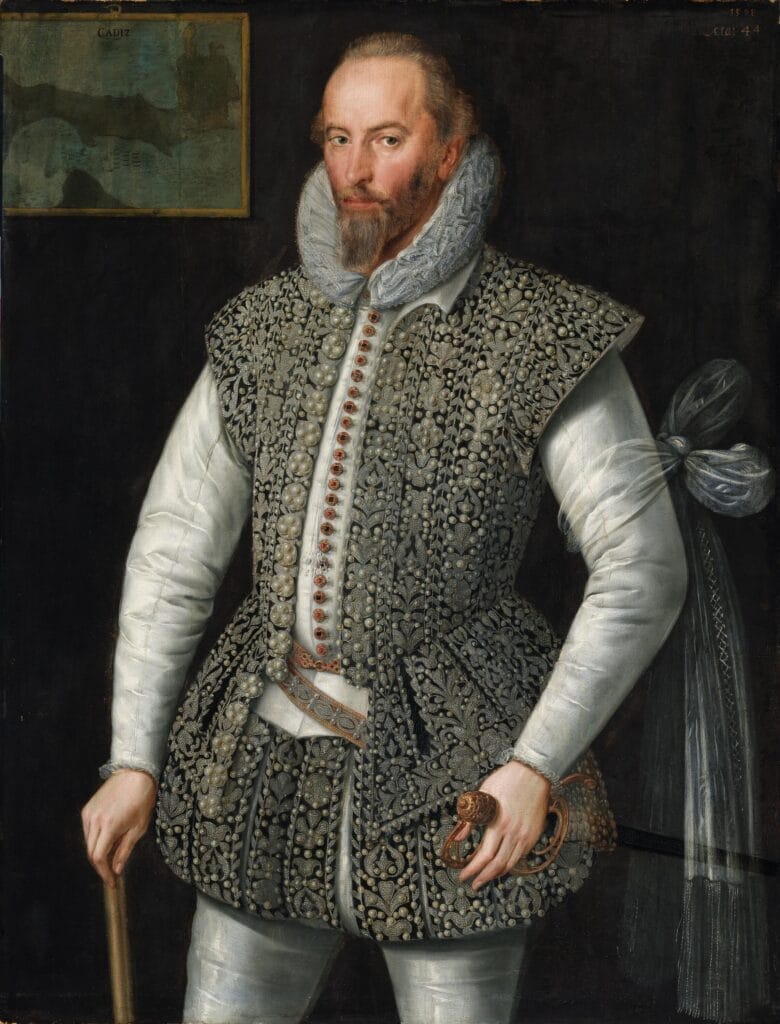
Sir Walter Raleigh (1552–1618; Fig. 1) was a prominent character in Elizabethan England. A one-time favorite of the Queen, he led a rich and varied life as an adventurer and explorer, statesman, soldier, and author. Less well-known is his interest in alchemy and medicine.
In 1591, Raleigh married one of the Queen’s ladies-in-waiting, Elizabeth Throckmorton (1565–1647). He should have sought the Queen’s permission but neglected to do so. This angered Elizabeth I, who briefly imprisoned both of them in the Tower of London. As part of an attempt to regain her favor, in 1595 Raleigh led an expedition to present-day Guyana and eastern Venezuela in search of the legendary El Dorado. His published account of this venture, which made some rather exaggerated claims, contains observations concerning the medicinal uses of local materials by the indigenous people. He notes, for example, that gold was traded for green stones (piedras hijadas or jade), known in English as “spleene stones.” Also referred to as lapis nephriticus, this was used as a diuretic in a bid to treat urinary calculi. He also comments on the juice of a root known as tupara, which “quencheth maruellously the heart of burning feauers, and healeth inward wounds, and broken veines, that bleed within the body,” as well as the use of garlic juice in the treatment of wounds caused by poisoned arrows and the medicinal uses of armadillo.1
Although his standing with the Queen was restored, on her death in 1603 Raleigh was implicated in the Main Plot, a conspiracy seeking to remove her successor, James I (1567–1625) from the throne. Charged with treason, Walter was again consigned to the Tower. Released on pardon in 1616, his death sentence was later reimposed whereupon he was returned to prison, eventually to be executed by beheading on October 29, 1618. His periods of incarceration gave him ample opportunity to pursue his interests. In addition to writing his (incomplete) Historie of the World, he became more actively involved in scientific experimentation. Although imprisoned in the Bloody Tower, Raleigh had considerable freedom of movement about the premises. He was permitted the use of a hen house in the Lieutenant of the Tower’s Garden as a makeshift laboratory. In the equipping of this valuable resource, he was assisted enthusiastically by Henry Percy (1564–1632), 9th Earl of Northumberland, who was consigned to the Tower in 1605 following implication in the Gunpowder Plot. Sometimes known as the “Wizard Earl” because of his interest in alchemy and scientific experimentation, the Alnwick Castle accounts for 1606–1607 show expenditures for a wide range of building materials, tools, and other goods “towardes the makinge of a Styll house in the Towre.”2 The main product of the still was aqua vitae, a strong aqueous solution of ethanol produced by multiple distillations of old wine. The ethanol was esteemed as a medication in its own right (to treat eye diseases, epilepsy, palsy, ringworm, toothache, etc.), in addition to a range of non-medical applications.3
The Earl also had a well-stocked library that featured many scientific and alchemical texts.4 Although more modest in size, Raleigh’s book collection also included numerous medical titles featuring authors such as Galen, Avicenna, Wecker, Laurentius, and Paracelsus.5
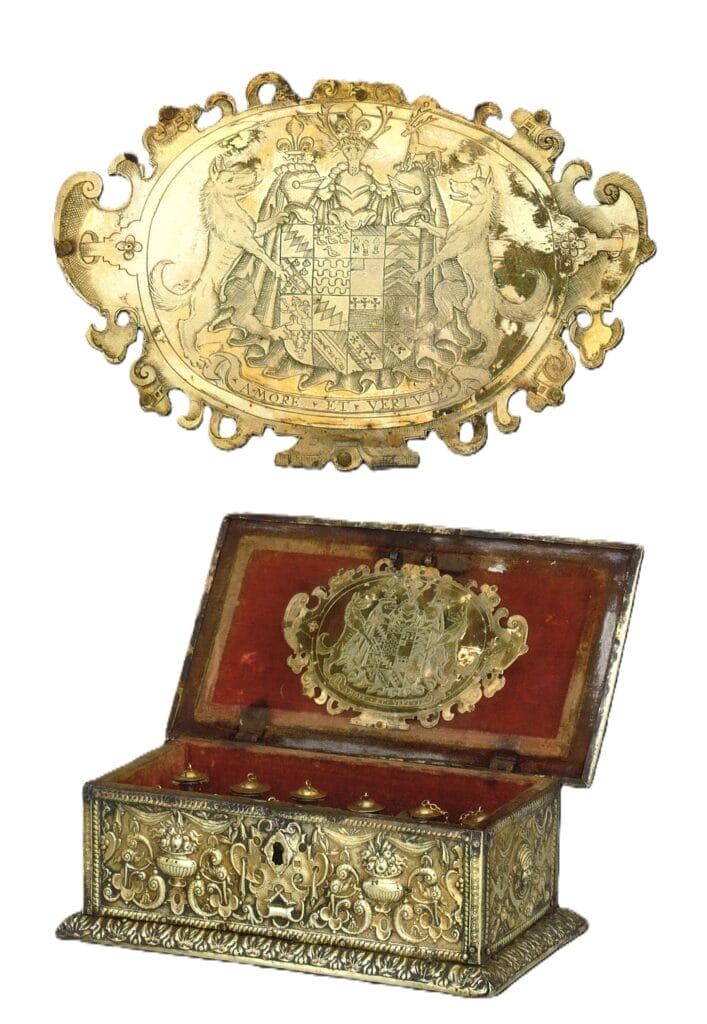
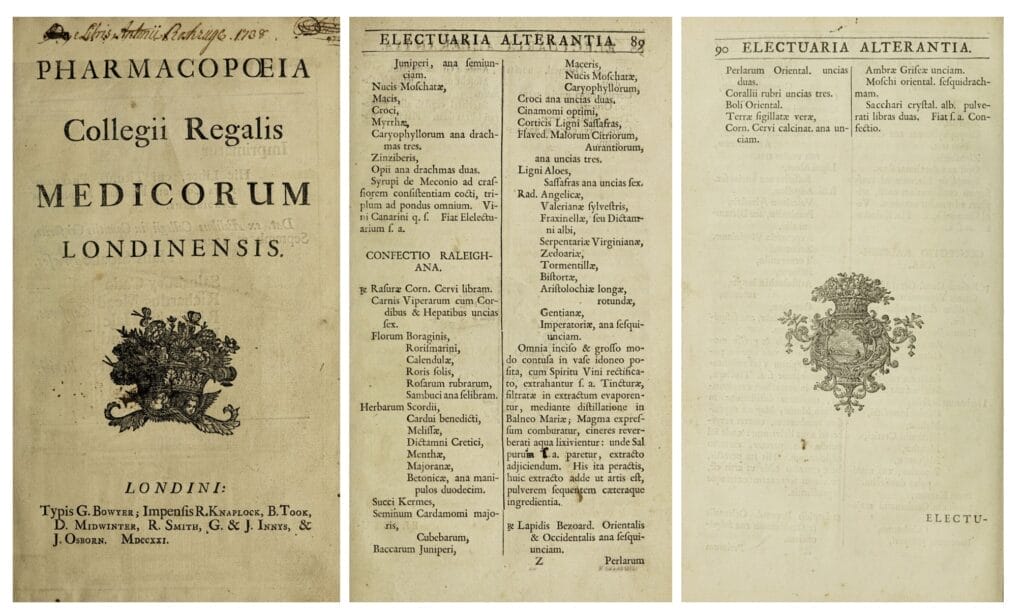
There are several fortuitous survivals illustrating Raleigh’s engagement with medicine. His traveling medicine chest (Fig. 2), verified by analysis of the coat of arms displayed inside the lid, is held in the Lisbon Pharmacy Museum.6 Several manuscripts, including one in his own hand, record medical recipes attributed to him, including some of his own invention.7 Probably the most famous is his Great Cordial Water. This was a preparation made from herbal ingredients together with bezoar stone, ambergris, “unicorn horn”, musk, terra sigillata, and “magistery of pearl”, with the addition of tinctures of coral and gold. Many of the components were praised for their supposed cordial (strengthening of the heart) and alexipharmic (antitoxic) properties, giving it a contemporary reputation as something of a cure-all. Indeed, when Prince Henry Frederick (1594–1612), heir to James I, contracted typhoid fever, his mother (Anne of Denmark, 1574–1619) requested some of the cordial from Raleigh to treat her son. Nicaise le Febure (1610–1669) later gave a detailed analysis of the cordial and, making some additions (including nutmeg, mace, and viper flesh) to the recipe, extended its potential uses (Fig. 3).8 It was in this form that it was adopted as Confectio Raleighana by the Royal College of Physicians in the 1712 edition of the Pharmacopeoia Londinensis.9
Handwritten copies and selections from Raleigh’s notes seem to have been in circulation after his death. A second cordial recipe attributed to him appears in the anonymous Queen’s Delight, an early cookery manual. “A Cordial Water of Sir Walter Raleigh” appears in a section headed “Choice Secrets Made Known.”10 The recipe calls for a gallon of strawberries steeped in a pint of aqua vita and then sweetened for taste—effectively a strawberry liqueur.
Another medicinal preparation attributed to Raleigh is the Balsam of Guiana. It is not clear what this consisted of, but he did recommend it be incorporated (together with tobacco leaves and other ingredients) into a balm designed to treat wounds.11
Thus, there is considerable evidence attesting to Sir Walter Raleigh’s enduring interest in medicine. While on his adventures, he noted aspects of indigenous materia medica. In prison, he embarked on a program of chemical experimentation and was able to consult volumes from both his own and Henry Percy’s library. His name is associated with several medical preparations. Even as his death sentence was being carried out, he is said to have used a medical analogy; feeling the blade of the executioner’s axe, he remarked, “This is a sharp medicine, but it is a sound cure for all diseases!”12
References
- Walter Raleigh. The discouerie of the large, rich, and bevvtiful empire of Guiana with a relation of the great and golden citie of Manoa (which the spanyards call El Dorado) and the prouinces of Emeria, Arromaia, Amapaia, and other countries, with their riuers, adioyning. London: Robert Robinson, 1596: 24, 59, 61.
- John William Shirley. The Scientific Experiments of Sir Walter Ralegh, the Wizard Earl, and the Three Magi in the Tower 1603-1617. Ambix 1949;4(1-2):52-66.
- Conrad Gessner. The treasure of Euonymus conteyninge the vvonderfull hid secretes of nature, touchinge the most apte formes to prepare and destyl medicines, for the conseruation of helth. London: Iohn Daie, 1559: 83-88.
- Gordon Batho. The Library of the Wizard Earl. The Library 1960; 5th ser, 15: 246-261.
- Walter Oakeshott. Sir Walter Ralegh’s Library. The Library 1968;23(4):285-327.
- Christopher Duffin. Establishing the provenance of a medicine chest belonging to Sir Walter Raleigh (c. 1554-1618). Pharmaceutical Historian 2017;47(2):33-38.
- Christopher Duffin. Some medical receipts by Sir Walter Raleigh (c. 1554-1618). Pharmaceutical Historian; 2021;51(4):129-143.
- Nicaise le Febure. A Discourse upon Sir Water Rawleigh’s Great Cordial. London: J. F. for Octavian Pulleyn Junior, 1664.
- Royal College of Physicians. Pharmacopoeia Collegii Regalis Medicorum Londinensis. London: G. Bowyer, 1721: 89-90.
- Anonymous. A Queen’s Delight. London: J. Winter for Nat. Brook, 1668: 84-85.
- Wellcome MS 749-13: 8.
- William Oldys. The Life of Sir Walter Ralegh, from his birth to his death on the scaffold. London: publisher not identified, 1740: 524.
CHRISTOPHER J. DUFFIN is an award-winning palaeontologist and pharmaceutical historian, now a Scientific Associate at the Natural History Museum in London.