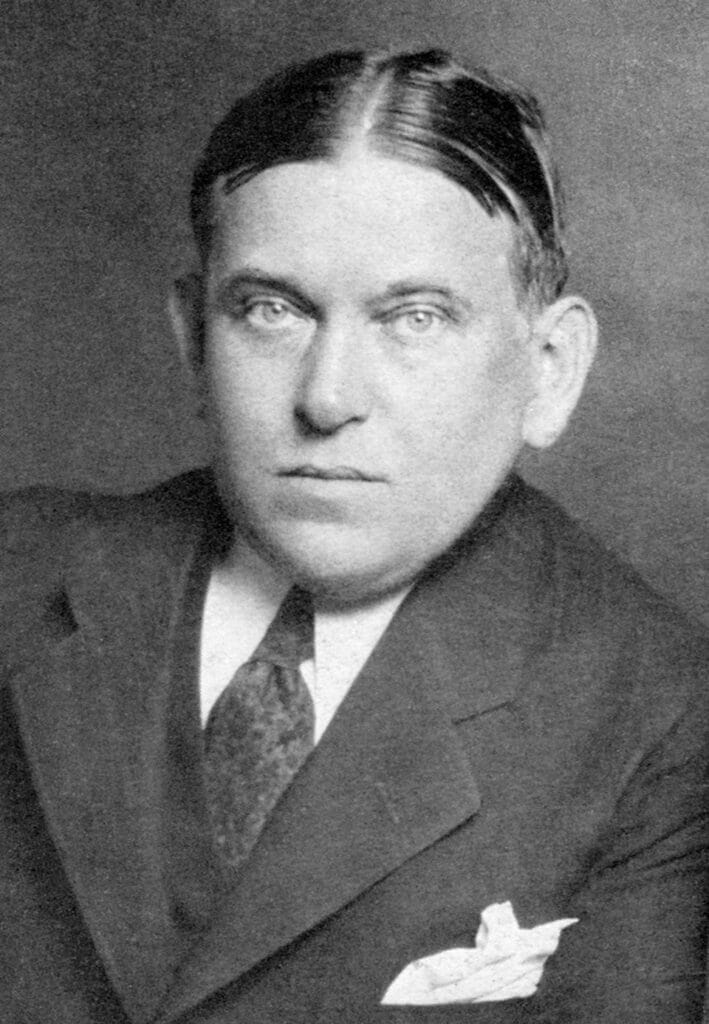
A century has gone by since Henry Louis Mencken wrote his diatribes, some of which he actually called Prejudices, now highly distasteful and taboo. He himself was born in Baltimore in 1880, spoke only German as a child, and during both wars thought the Germans should win. He studied at the Baltimore Polytechnic Institute and worked for three years in his father’s cigar factory. In 1899 he became a reporter and wrote a multitude of articles for newspapers as well as several books, notably The American Language and a First and Second Chrestomathy.
Mencken was unashamedly elitist, chauvinist, and condescendingly racist. He believed that people of Anglo-Saxon origin, from whom he himself descended, were superior to those of more Celtic origin, eastern Europeans, and everybody else. In The Sahara of the Bozart, he argued that after the Civil War many from the aristocracy of the South moved away and were successful in the North and to some extent in Europe, leaving behind the less fortunate.
Unacceptable as such views are, their holder went on to cast light on the linguistic history of the American and English, itself full of prejudices in terms of vocabulary, choice of words, and even pronunciation. In The American Language he sets out to demonstrate that American English was not simply corrupted British English, but a legitimate linguistic variation with its own logic and vitality. Amusingly, he covers in detail the period of “Forbidden Words”, when you had to say limb instead of leg, when any word with cock was proscribed so that cockroaches became roaches, when words that despite their prevalence in real life were banished from print and polite conversation. These included references to sex, bodily functions, and profanities, terms considered too coarse or scandalous for public discourse. At one time no word having even the slightest connotation to sex or reproduction was permitted; bitch, ram, boar, stallion, buck, and sow virtually disappeared from the written language; whore became lewd woman; even shirt was forbidden; to go to bed became to retire, chair became rest; and almost no word referring to an area located below the umbilicus was permitted. For obvious reasons, the biblical ass became a donkey.
Equally outdated after the passing of more than a century are many of Mencken’s ideas about medicine. He wrote at a time when neither penicillin nor sulfonamides were available, true remedies were few, and medical conversation had to be equally polite, so that syphilis, for instance, could not be talked about except in circumlocutions such as “specific disease”. Mencken wrote about medicine in two articles, “The Archfiend of Medicine” and “The Physician”, in which he praised the advances of modern medicine but criticized its pretensions, jargon of certainty, fraudulent treatments, quack cures, and medical charlatanism. In 1948, he experienced a stroke that rendered him unable to read or compose the strongly critical commentaries for which he was well known, and he died in 1956.