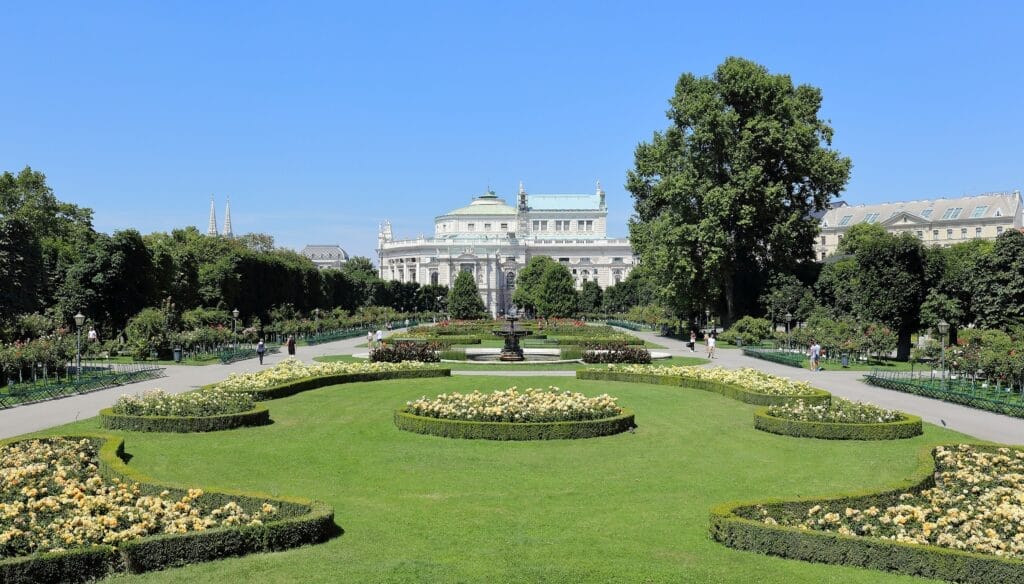

The Volksgarten, or “People’s Garden” is a public park known for its formal rose gardens, neoclassical elegance, and historical depth. Established in the early 19th century, it is one of Vienna’s most beloved green spaces, offering aesthetic pleasure and cultural enrichment. It was created on the site of fortifications destroyed by Napoleon’s troops in 1809. Following Austria’s victory and the Congress of Vienna (1814–1815), the city underwent major urban renewal. Under Emperor Francis I, the decision was made to transform this former military site into a garden for public enjoyment. It officially opened in 1823, making it one of the first public parks in the city. This shift from private aristocratic gardens to accessible urban green spaces was emblematic of Enlightenment values and an emerging civic consciousness.
The garden is most famous for its symmetrical design, manicured hedges, and more than 3,000 rose bushes representing over 200 varieties. Its architectural highlights include the neoclassical Theseus Temple—modeled after the Hephaisteion in Athens—and monuments to Austrian cultural figures such as Empress Elisabeth (Sisi) and poet Franz Grillparzer. The inclusion of such tributes in the park speaks to its dual role as a place for both reflection and recreation.
From a medical historical perspective, the Volksgarten represents a significant development in the 19th-century understanding of the therapeutic value of green spaces. As industrialization led to overcrowded and unsanitary urban environments, physicians and public health officials increasingly advocated for the creation of parks to combat the negative health effects of city living. Influential figures such as Viennese physician Johann Peter Frank, a pioneer in social medicine, emphasized the importance of fresh air, sunlight, and natural surroundings in preventing disease and promoting well-being.
Moreover, the Volksgarten’s establishment coincided with improvements in psychiatric care. In Vienna it resulted in the establishment of institutions like the Narrenturm, the world’s oldest purpose-built mental hospital. Medical reformers of the time believed that access to orderly, beautiful environments could have calming and restorative effects on patients. Women benefited in particular, in particular when diagnoses such as hysteria and neurasthenia were common. Doctors sometimes prescribed “rest cures” that included gentle walks in nature, and parks like the Volksgarten were integral to such regimens. The shaded promenades and tranquil fountains offered a reprieve from the stressors of city life, in line with contemporary medical recommendations.
In conclusion, Vienna’s Volksgarten is not only a picturesque garden but also a living monument to evolving ideas about health, space, society, and the healing power of nature.