Elizabeth Steinhart
JMS Pearce
Hull, England
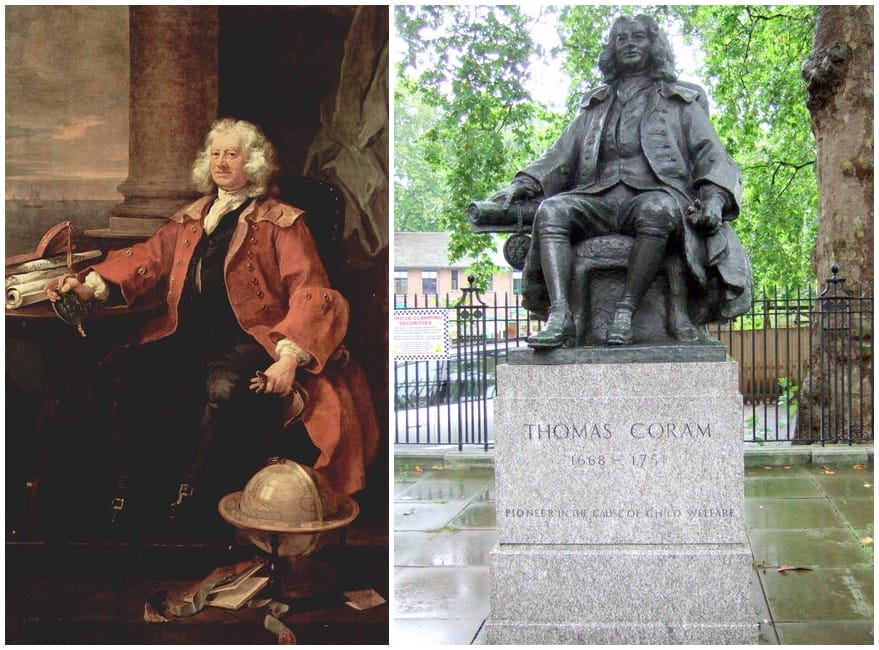
Right: Thomas Coram statue. 40 Brunswick Square, London. Photo by ceridwen on Geograph.org.uk via Wikimedia. CC BY-SA 2.0.

Nineteen years after good Captain Coram’s heart has been so touched by the exposure of children, living, dying, and dead, in his daily walks, one wing of the existing building was completed and admission given to the first score of little blanks [foundling children].
—Charles Dickens, “Received, a Blank Child” in Household Words, 19 March 1853
The work of Dr. Richard Mead and the Foundling Hospital that opened in 1741 has previously been related here.1 The aim was to provide a safe home for destitute children orphaned or abandoned. Without Thomas Coram, an uneducated sailor, the aim would not have been fulfilled.
In the eighteenth century, London, grown fat on the profits of trade, empire, and slavery, was a city of expanding industry and wealth. It also had many areas ridden with dirt, disease, and deprivation. Child mortality and infanticide rates were high. Each year some one thousand babies, many of them illegitimate, were abandoned by parents afflicted by extreme poverty or by maladies making them incapable of rearing their children. The Foundling Hospital opened in Red Lion Square in London, later moving to Lamb’s Conduit Field (now Coram Fields) in Bloomsbury.2 It was the result of many years’ work by Thomas Coram, ably supported by Hogarth, Handel, and Dickens.
Thomas Coram (c. 1668–1751)
Thomas Coram (Fig 1.) was born in Lyme Regis, Dorset, in 1668. He followed his father’s example and went to sea.3 He was an apprentice to the Shipwrights’ Guild, learning the skills of shipbuilding and carpentry, eventually becoming a merchant sailor and later a ship’s captain.4 He commanded merchant ships for several years to distant lands, including the Americas and the West Indies where he witnessed destitution, squalor, and poverty. For ten years he was in charge of a new shipyard in Boston, Massachusetts. He gradually managed to acquire modest wealth in merchant trading of tobacco, sugar, and rum.
On his return to England in 1703/4, he ventured into the London streets and was appalled by the abandoned “foundling” infants and the extreme poverty reminiscent of his experiences abroad.
He was determined to remedy the situation. But to establish a safe haven for foundlings, he needed funds. Though no aristocrat and with sparse education, he managed to obtain support from the convivial Queen Caroline (wife of King George II, described by Dr. Lucy Worsley as “the cleverest, and the funniest and also the fattest Queen consort that we have ever had in Britain!”) and from people of wealth and influence to help him build his Foundling Hospital.5
It took him seventeen years of tireless campaigning to secure money from donations from the public and wealthy benefactors whom he had persuaded to sponsor his project. He finally secured a Royal Charter from King George II in 1739. The Foundling Hospital was the first children’s charity. It opened on 25 March 1741 when the first thirty babies—eighteen boys and twelve girls—were admitted. The distinguished physician Richard Mead,1 Arthur Onslow (Speaker of the House of Commons), and George Frideric Handel were its governors.
Those mothers who could be identified were asked to leave with their child a token, such as a marked coin or scrap of fabric, should they ever want to reclaim their child.1 Between 1741 and 1760 the overall mortality rate was 61% for the hospital’s children,6 but slowly it improved with better diet, hygiene, immunization, and medical care. Dr. Richard Mead created a pharmacy and treated the children when they were ill.1 He also ordered a courtyard to be built for fresh air and exercise. Luther Holden of St. Bartholomew’s Hospital was elected Honorary Surgeon in 1864 and, like Mead, gave free advice to the hospital.
Sick children were kept in the hospital infirmary; the others were given to country nurses paid to raise them in their homes or to foster parents.1 Most children were taught to read and write and to perform domestic chores and simple practical jobs. At the age of sixteen, girls were apprenticed for domestic service; at fourteen, boys were apprenticed into various occupations. Many were trained for military service.
In 1742, just one year after the hospital opened, Coram was in dispute with other governors and was excluded from the board; he was said to have been indiscreet in his criticisms of other governors and how the hospital was run. However, he continued to visit the children and assist in their welfare. In later years, he lived in relative poverty, and the governors, perhaps relenting, eventually granted him a small pension and rooms near the hospital. He died in 1751 and was buried in accord with his wishes in the vaults beneath its chapel.
William Hogarth, George Frideric Handel, and Charles Dickens
William Hogarth (1697–1764) was renowned as a portrait painter and cartoonist famous for his series A Harlot’s Progress and A Rake’s Progress. He and his wife Jane were childless but fostered many of the Foundling children.1 Hogarth knew all about deprivation since he had spent five years as a child in the Fleet debtor’s prison. The museum’s gallery displays his famous 1740 portrait of Thomas Coram (Fig 2). Hogarth donated several paintings and prints to the hospital. He arranged art exhibitions and works with themes aligned with the Hospital’s mission; they matured into London’s first public art gallery containing works donated by Ramsey, Gainsborough, and Reynolds.
George Frideric Handel (1685–1759), to raise funds in 1749, conducted a concert he had composed for the occasion, featuring “The Foundling Hospital Anthem.”* It included Psalm 41: “Blessed is he that considereth the poor: the Lord will deliver him in time of trouble.” His charitable concerts became annual events. In 1750, he gave a successful performance of his Messiah, which was repeated annually, and he bequeathed the score and parts of the oratorio to the hospital. Handel’s last will and testament is also preserved and displayed within the current Foundling Museum, along with personal items such as his pocket watches and other trinkets, showing how important to him was his philanthropic work for the foundlings.
Charles Dickens rented a pew in the hospital chapel, an additional source of income for the school. He also named a character in Oliver Twist after the hospital’s secretary John Brownlow, and in Little Dorrit, the character Harriet Beadle is nicknamed “Tattycoram” because she grew up in the Foundling Hospital.
With the aid of Hogarth and Handel, the governors extended the functions of a hospital of refuge to the UK’s first public art gallery, and one of London’s most fashionable venues: the place to be seen in.
Coram’s legacy
Following the 1948 Children Act:


[T]he Governors of the Foundling Hospital found greater numbers of foster families to care for children and by 1954 all residential provision ceased. Changing its name to become the Thomas Coram Foundation for Children, the charity continued to accept babies, finding foster families to care for them until they could return to their mother, or be adopted (with the mother’s consent) by their foster parents, or remain as a foster child in the guardianship of the Governors. This continued until the 1968 Children Act when the responsibility for children who could not live with their birth family passed to local authorities.7
Her Royal Highness Catherine the Princess of Wales became Patron of the Foundling Museum in 2019.1
Adjacent to the Foundling Museum and Coram Fields (behind the sculpture of Thomas Coram, Fig 1.) there remains the Coram Children’s Charity. It continues to support children across the UK with many services to benefit their lives. History often repeats itself. The names of Hogarth, Handel, and Dickens have been succeeded by more recent celebrities: Lemn Sissay, Prue Leith, Jacqueline Wilson, Tracey Emin, and Cornelia Parker, who have given their time and money to continue the work of Coram.
During two centuries the Foundling Hospital looked after 25,000 children. In 1926 the old hospital was sold and demolished. The attractive museum constructed in the 1930s is in its grounds at 40 Brunswick Square in Bloomsbury.8 Coram’s greatest achievement was to provide the basis for philanthropy of a secular foundation “modelled on the joint-stock company, of which the Foundling Hospital was the first and finest expression.”4
Poverty and privation still afflict millions of children and adults worldwide. We need more Thomas Corams, more philanthropy, and more institutions to give them a decent living and fair opportunities.
End note
* Recording: https://englishconcert.co.uk/handel-for-all/foundling-hospital-anthem/
References
- Much of the information on Dr. Mead is supplied from the co-author’s previous article: Pearce JMS. The Foundling Hospital and Dr. Richard Mead. Hektoen International Spring 2023. https://hekint.org/2023/05/04/the-foundling-hospital-and-dr-richard-mead/
- Nichols RH, Wray FA. The History of the Foundling Hospital. London: Oxford University Press, 1935.
- Wagner G. Thomas Coram, Gent.: 1668-1751. Boydell Press, 2015.
- Taylor, J. Coram, Thomas (c. 1668–1751), philanthropist. Oxford Dictionary of National Biography, 28 September, 2006.
- Pugh G. London’s Forgotten Children: Thomas Coram and the Foundling Hospital. The History Press, 2007.
- Coram Story. “Health of the Foundling Pupils.” Coram. https://coramstory.org.uk/explore/content/article/health-of-the-foundling-pupils/
- Foundling Museum. “Coram.” https://foundlingmuseum.org.uk/our-story/history/coram/
- Foundling Museum. “History.”https://foundlingmuseum.org.uk/our-story/history/
ELIZABETH STEINHART, BA, Senior Philanthropy Advisor
JMS PEARCE, MD, FRCP, Emeritus Consultant Neurologist, Hull Royal Infirmary