
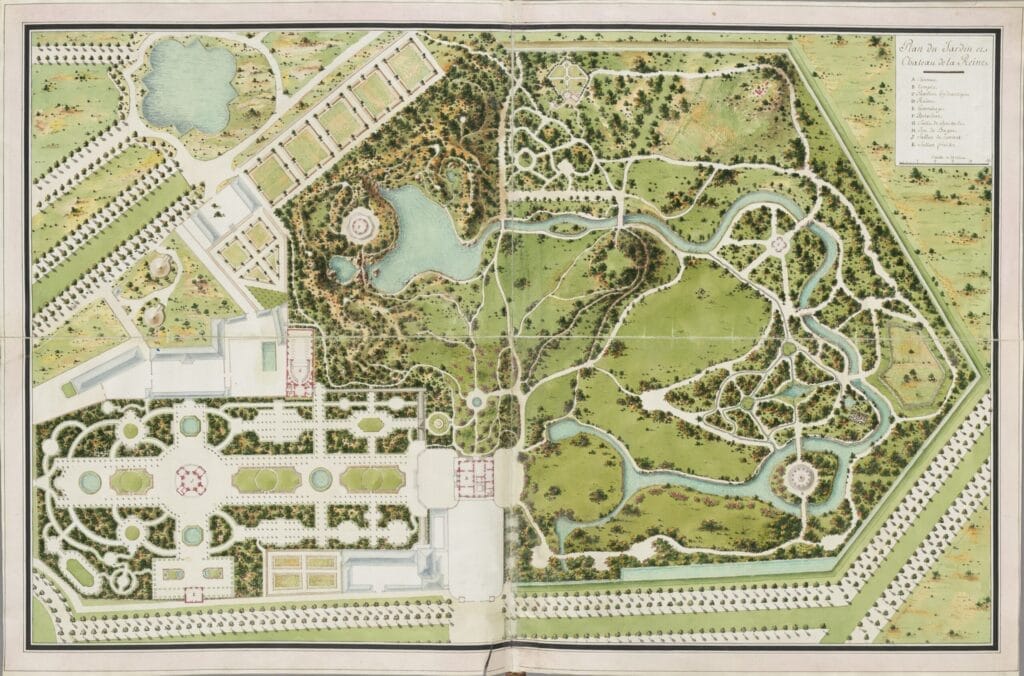
The story of Versailles begins in the early 17th century when Louis XIII acquired a small hunting lodge surrounded by marshland and woods. However, it was his son, Louis XIV, who envisioned transforming this modest estate into a grand palace that would embody the glory of France and cement his position as the Sun King. Beginning in 1661, Louis XIV embarked on an ambitious project that would consume nearly fifty years and establish Versailles as the political and cultural center of France. He understood that the landscape surrounding his palace was not merely decorative but served as an extension of royal power. To realize his vision, he appointed André Le Nôtre to oversee the design and construction of the Versailles gardens.
Le Nôtre’s design philosophy embodied the principles of French classical garden design: perfect symmetry, mathematical precision, and the complete subordination of nature to human will. This design exemplifies the French formal garden style, which prioritized order, symmetry, and grandeur above all else. The gardens were built along a central axis two miles long, serving as the organizing principle for the entire garden complex and flanked by bosquets, or groves, each designed as a distinct garden room with its own character and purpose, some for private spaces for courtiers’ conversation, entertainment, and romantic encounters. Fountains, canals, and cascades were built for both aesthetic and symbolic purposes. The gardens were designed to provide visual interest throughout the year, with carefully planned seasonal displays. The famous orangery, built into the slope south of the palace, housed over 3,000 orange trees, along with pomegranates, oleanders, and other tender plants that were moved outdoors during the warm months to create exotic displays.
The gardens of Versailles functioned as the stage for an elaborate theater of court life that reinforced royal authority. The king’s daily promenades through the gardens became public ceremonies that allowed courtiers to display their status and compete for royal attention. The gardens hosted numerous celebrations and entertainments that became legendary throughout Europe. The famous Pleasures of the Enchanted Island festival in 1664 featured elaborate theatrical performances, ballets, and fireworks displays staged throughout the gardens. These events, often lasting several days, combined the arts of theater, music, dance, and pyrotechnics with the garden setting to create total sensory experiences that dazzled visitors and reinforced France’s cultural supremacy.
Every element of the Versailles gardens carried symbolic meaning that reinforced the themes of royal power and divine authority central to Louis XIV’s reign. The numerous sculptures depicting classical gods and heroes created parallels between Louis XIV and the great figures of antiquity, while the taming of nature demonstrated the king’s ability to impose order upon chaos. Throughout the 18th century, the gardens of Versailles underwent various modifications, first under Louis XV, and then under Marie Antoinette, who commissioned the creation of the Petit Trianon gardens. The French Revolution brought dramatic changes to Versailles, as the gardens became public property and many of the most elaborate decorative features were simplified or removed.
The impact of the Versailles gardens on European landscape design cannot be overstated. The French formal garden style pioneered at Versailles was copied and adapted at royal courts throughout Europe. The arrangements pioneered at Versailles were adapted for city design in the planning of Washington, D.C., and the redesign of Paris under Baron Haussmann. Today, the gardens of Versailles face the ongoing challenge of balancing historical preservation with the demands of millions of annual visitors and yet maintain the gardens according to their original designs.